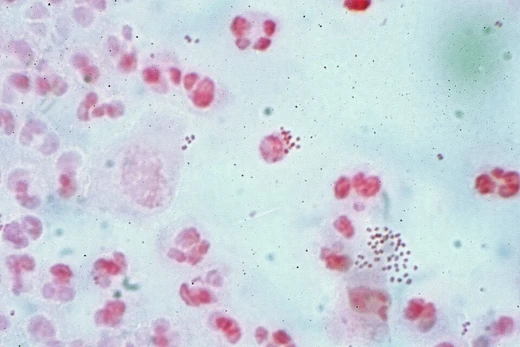
Bordetella pertussis
Causative agent of whooping cough, a reemerging human pathogen.

Bordetella pertussis is a small, rod-shaped bacterium that causes whooping cough. It is an obligate human pathogen, meaning it can only survive and cause disease in people, and it spreads through droplets in the air when an infected person coughs or sneezes. The bacterium belongs to the genus Bordetella, which includes nine species; among them, B. parapertussis causes a similar illness in humans, while B. bronchiseptica infects various mammals. Despite high vaccination rates, B. pertussis still leads to illness and death globally because immunity wanes over time and the pathogen itself evolves.
The disease has an incubation period that typically lasts 7 to 10 days, though it can range from 6 to 20 days. Once inhaled, the bacterium uses specialized surface proteins to attach to the ciliated cells lining the respiratory tract. It then releases several toxins—including pertussis toxin, adenylate cyclase toxin, filamentous haemagglutinin, pertactin, pili, and tracheal cytotoxin—that disrupt normal cell functions and produce symptoms. Humans are the only known reservoir for this bacterium.
The complete genome of B. pertussis, published in 2003, contains 4,086,186 base pairs, which is smaller than the 5.2 million base pairs found in its close relative B. bronchiseptica. Although B. pertussis can produce a flagellum-like structure, it is generally considered nonmotile.
Whooping cough was first described by French physician Guillaume de Baillou following an epidemic in 1578, though an earlier description may exist in a Korean medical text. The bacterium itself was identified and isolated by Jules Bordet and Octave Gengou in 1906. Based on 16S rRNA gene sequencing, it is thought that the genus Bordetella evolved from ancestors that could survive in soil. The expansion of agriculture increased human contact with soil, creating conditions that allowed these ancestors to thrive and eventually spread to people.
B. pertussis is considered a monomorphic pathogen, with most strains historically carrying either the ptxA1 or ptxA2 allele. However, modern genome sequencing has revealed a region called ptxP, and studies show that 25% of the genes in the reference strain Tohama I are missing compared to ancestral strains, likely due to increased intragenomic recombination and DNA loss. Mutations in the BvgAS system have made the bacterium more contagious. In particular, strains carrying the ptxP3 allele produce more toxins, leading to more severe disease. Since the 1990s, ptxP3 has become the dominant strain in developed countries like the United States, and it is increasingly common in developing nations as well. Global outbreaks occurred in 2012 in Canada, Australia, France, the UK, Japan, and the USA, while cases in Africa are underreported but rising, especially among infants and young children.
For growth, B. pertussis requires aerobic conditions and a pH between 7.0 and 7.5, with a maximum of 8.0 and a minimum for growth around 6.0 to 6.5; it cannot reproduce below pH 5.0. It thrives at temperatures of 35°C to 37°C. As a strict aerobe, it needs oxygen for cellular respiration, using it as the terminal electron acceptor. Its nutritional needs are exacting, requiring nicotinamide, and its growth is inhibited by fatty acids, peroxide, metal ions, and sulfides. The bacterium is oxidase positive but negative for urease, nitrate reductase, and citrate. Although often considered an extracellular pathogen, B. pertussis can adapt to internal environments by lowering its BvgAS two-component system, which alters virulence gene expression and leads to an avirulent state. It also adjusts its central and energy metabolism, reinforces its cell wall, maintains redox and metal balance, and repairs damaged molecules. Studies show that mutants lacking cysteine dioxygenase genes are less toxic to certain immune cells, indicating that sulfur metabolism plays a role in how the bacterium interacts with its host.
- discovered_by
- Jules Bordet and Octave Gengou
- gram_stain
- Negative
- morphology
- Coccobacillus
- oxygen_requirement
- Strict aerobe
- known_for
- Causing pertussis (whooping cough)
Lore & Background
Bordetella pertussis is a Gram-negative, aerobic, pathogenic, encapsulated coccobacillus. It is the causative agent of pertussis, or whooping cough. The bacterium is an obligate human pathogen, with humans serving as its only known reservoir. Transmission occurs via airborne droplets. After an incubation period averaging 7–10 days, the organism attaches to ciliated epithelial cells lining the respiratory tract using specialized surface proteins. It then releases several virulence factors, including pertussis toxin, adenylate cyclase toxin, filamentous haemagglutinin, pertactin, pili, and tracheal cytotoxin, which disrupt normal cellular functions. Despite widespread vaccination, the pathogen continues to cause illness and death globally due to declining immunity and adaptation. Its complete genome, published in 2003, is 4,086,186 base pairs, smaller than that of the closely related *B. bronchiseptica*. Although *B. pertussis* can express a flagellum-like structure, it is normally classified as nonmotile. The bacterium prefers aerobic conditions, a pH range of 7.0–7.5, and a temperature range of 35–37 °C. It requires nicotinamide for growth and is hindered by fatty acids, peroxide, metal ions, and sulfides. It is oxidase positive but urease, nitrate reductase, and citrate negative. *B. pertussis* is not exclusively extracellular; it can adapt to an internal environment and lower its BvgAS two-component system, leading to an avirulent phenotype.
Reader's Guide
Bordetella pertussis remains a significant public health concern due to its ability to persist among infants and young children despite high vaccination rates. The bacterium's virulence factors include pertussis toxin, adenylate cyclase toxin, filamentous haemagglutinin, pertactin, pili, and tracheal cytotoxin. Modern genome sequencing has revealed that strains with the ptxP3 allele, which developed through mutations in recent years, have increased expression of toxins and have become dominant in developed countries since the 1990s. B. pertussis is an obligate human pathogen, with humans as the only known reservoir, though outbreaks have been observed among chimpanzees and wild gorillas likely due to close contact with humans.
Did You Know?
- B. pertussis can survive intracellularly in human macrophages and epithelial cells for up to three days.
- Strains with the ptxP3 allele have become the dominant strain in developed countries since the 1990s.
Taxonomic Position and Genomic Identity
Bordetella pertussis occupies a defined niche within the genus Bordetella, a group that encompasses nine recognized species: B. parapertussis, B. bronchiseptica, B. avium, B. hinzii, B. holmesii, B. trematum, B. ansorpii, and B. petrii. Among these, B. pertussis, B. parapertussis, and B. bronchiseptica cluster tightly on the phylogenetic tree, reflecting shared evolutionary heritage. B. parapertussis produces a clinical syndrome in humans that closely mirrors whooping cough, whereas B. bronchiseptica has a considerably wider host spectrum, infecting multiple mammal species and triggering a range of respiratory disorders. Genomically, the complete B. bronchiseptica. Although conventionally categorized as nonmotile, B. pertussis retains the capacity to produce a flagellum-like appendage, a structural trait it shares with B. bronchiseptica. Morphologically, the organism is a Gram-negative, aerobic, encapsulated coccobacillus, and it remains strictly an obligate human pathogen with no identified animal reservoir.
Historical Discovery and Evolutionary Origins
Contemporary evolutionary work, anchored in 16S rRNA gene sequencing, points to soil-dwelling ancestors for the Bordetella lineage. As human societies expanded into agriculture, the resulting surge in person-to-soil contact created fertile ground for these ancestral microbes to not only survive but also to colonize human populations. In the modern era, B. pertussis continues to circulate among infants and young children even where vaccination coverage is high.
Virulence Arsenal and Pathogen Adaptation
Spread solely via airborne droplets and dependent on humans as its exclusive reservoir, B. pertussis follows an incubation window that averages seven to ten days but can span anywhere from six to twenty. Once inhaled, the bacterium secures itself to the ciliated epithelial cells lining the airways through dedicated surface proteins. From that foothold it unleashes a coordinated battery of virulence factors—pertussis toxin, adenylate cyclase toxin, filamentous haemagglutinin, pertactin, pili, and tracheal cytotoxin—each of which deranges normal host-cell physiology. The BvgAS two-component regulatory system sits at the helm of virulence-gene control. Early work painted B. pertussis as a monomorphic pathogen dominated by ptxA1 or ptxA2 alleles, yet deeper genomic interrogation uncovered the ptxP locus and its mutational plasticity. Bart and colleagues demonstrated that roughly 25% of the genes present in the Tohama I reference strain are absent when compared with ancestral lineages, a deficit linked to elevated intragenomic recombination and net DNA loss. Strains bearing the ptxP3 allele, a product of recent mutational events, show amplified toxin output and a correspondingly more acute clinical course. Since the 1990s, ptxP3 isolates have supplanted ptxA1 as the predominant form in developed settings such as the United States, and the shift is even starker in developing nations.
Growth Constraints and Metabolic Flexibility
As a strict aerobe, B. pertussis relies on oxygen as the terminal electron acceptor in its respiratory chain. It flourishes at temperatures of 35 to 37 degrees Celsius and a pH between 7.0 and 7.5, tolerates a maximum of 8.0, and cannot replicate below pH 5.0. Its nutritional demands are exacting: nicotinamide supplementation is essential, and growth is actively suppressed by fatty acids, peroxide-containing media, metal ions, and sulfides. Enzymatic profiling shows the organism is oxidase-positive yet negative for urease, nitrate reductase, and citrate utilization. Remarkably, B. pertussis is not confined to an extracellular existence; it can also adapt to life inside host cells, where it dampens the BvgAS system, adopts an avirulent phenotype, and simultaneously reconfigures central and energy metabolism, strengthens its cell wall, preserves redox and metal homeostasis, and repairs damaged macromolecules. Mutants missing cysteine dioxygenase genes exhibit markedly reduced cytotoxicity toward THP-1 cells, highlighting sulfur metabolism as a key axis in host-pathogen interplay. On the metabolic side, elevated glutamate concentrations can retard bacterial proliferation by provoking oxidative stress, an effect that may be magnified through quorum-sensing signals in small founding populations.
Frequently Asked Questions
What is Bordetella pertussis's role in the story?
It serves as the sole causative agent of pertussis, commonly called whooping cough, and is an obligate human pathogen that cannot persist outside a human host. Transmission occurs through airborne respiratory droplets expelled by an infected individual.
How does Bordetella pertussis's story end?
There is no true ending; B. pertussis remains an active, reemerging threat. Even with widespread vaccination programs in place, it continues to cause illness and death worldwide as population immunity wanes and the bacterium adapts to evade host defenses.
Why is Bordetella pertussis important to the canon?
It is one of the most clinically significant respiratory pathogens in humans, responsible for a disease that can be fatal in infants and young children. Its persistence despite decades of vaccination makes it a central figure in the ongoing narrative of infectious-disease control.
What are Bordetella pertussis's key stats?
Its genome spans roughly 4.09 million base pairs, it stains Gram-negative, and it has a coccobacillus shape. It is a strict aerobe and a pathogenic, encapsulated organism found exclusively in humans.
More in Pathogenic Bacteria 1-20
Spotted an error? Know more?
This is a living reference — every entry is fact-audited, and reader corrections feed straight into our audit queue. Suggest an edit · See this site's audit record