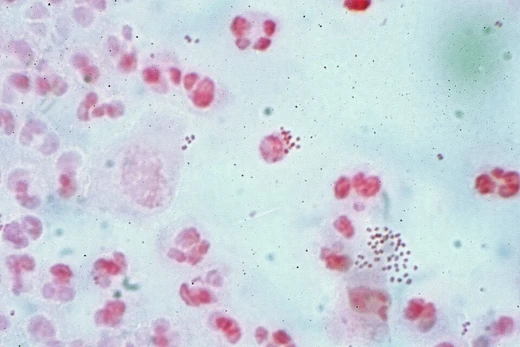
Mycobacterium leprae
First bacterium identified as a cause of human disease.

Mycobacterium leprae, commonly called the leprosy bacillus or Hansen's bacillus, is one of two bacterial species responsible for Hansen's disease (leprosy), a chronic yet curable infection that harms peripheral nerves and affects the skin, eyes, nose, and muscles. This bacterium is acid-fast, Gram-positive, and rod-shaped. It is an obligate intracellular parasite, which sets it apart from its relative *Mycobacterium tuberculosis* because it cannot survive on cell-free laboratory media. This limitation is thought to stem from gene loss and decay through reductive evolution, making the bacterium heavily reliant on its host for nutrients and metabolic intermediates. Its host range is narrow: besides humans, the only natural hosts are nine-banded armadillos and red squirrels. The bacteria mainly infect macrophages and Schwann cells, often clustering together in a palisade formation. Originally treatable with dapsone alone, *M. leprae* developed resistance to this antibiotic by the 1960s. Today, the World Health Organization recommends a multidrug therapy (MDT) combining dapsone, rifampicin, and clofazimine. The species was discovered in 1873 by Norwegian physician Gerhard Armauer Hansen, making it the first bacterium identified as a cause of human disease.
Microbiology
*Mycobacterium leprae* is an intracellular, pleomorphic, non-sporing, non-motile, acid-fast, pathogenic bacterium. It is an aerobic rod (bacillus) with parallel sides and rounded ends, encased in the waxy mycolic acid coating typical of mycobacteria. Though Gram-positive, it was traditionally stained with carbol fuchsin using the Ziehl–Neelsen method. Because it is less acid-fast than *M. tuberculosis*, the Fite-Faraco stain—which uses a weaker acid solution—is now preferred. In size and shape, it closely resembles *M. tuberculosis*. The bacteria appear in granulomatous lesions and are especially abundant in nodules, often in large numbers in lepromatous leprosy, where they typically group into a palisade. Under optical microscopy of host cells, they can be found singly or in clumps called "globi," appearing straight or slightly curved, 1–8 μm long and 0.3 μm in diameter. They grow best at 27–30 °C, which explains why the skin, nasal mucosa, and peripheral nerves are primary infection sites.
Host Range
*Mycobacterium leprae* has a narrow host range. Apart from humans, the only other natural hosts are nine-banded armadillos and red squirrels. Armadillos have been linked to zoonotic leprosy in humans. In the lab, mice can be infected and serve as a useful animal model.
Cultivation
This bacterium has an unusually long doubling time of 12 to 14 days (compared to 20 minutes for *Escherichia coli*) and cannot be cultured on classical media without host cells. As an obligate intracellular parasite, it lacks many genes needed for independent survival, making cultivation difficult. Its complex, unique cell wall—which makes mycobacteria hard to destroy—also contributes to its slow replication. *M. leprae* prefers cool temperatures, slightly acidic microaerophilic conditions, and uses lipids rather than sugars as an energy source. Although its growth requirements are known, no exact axenic medium has been found to support it. Instead, it has been grown in mouse foot pads and armadillos, whose low body temperature suits the bacterium.
Metabolism
Reductive evolution has impaired *M. leprae*’s metabolic abilities compared to other mycobacteria, especially in catabolic pathways.
Catabolism
The bacterium’s inability to grow in axenic media reflects its dependence on host nutrients and intermediates. Many catabolic pathways present in other mycobacteria are compromised due to missing enzymes crucial for breaking down nutrients. *M. leprae* has lost the ability to use common carbon sources like acetate and galactose in central energy metabolism. Lipid degradation is also impaired, with deficits in key lipase enzymes and other lipolysis proteins. However, functional carbon catabolic pathways remain, including glycolysis, the pentose phosphate pathway, and the TCA cycle. These deficiencies severely restrict growth to a limited set of carbon sources, mainly host-derived intermediates.
Anabolism
Anabolic pathways have been largely spared by reductive evolution. The species retains the ability to synthesize genetic material—purines, pyrimidines, nucleotides, and nucleosides—as well as all amino acids except methionine and lysine.
Genome
The first genome sequence of a *M. leprae* strain was completed in 2001, revealing 1,604 protein-coding genes and 1,116 pseudogenes. A strain originally isolated in Tamil Nadu, India, designated TN, was sequenced in 2013. Its genome contains 3,268,203 base pairs (bp) with an average G+C content of 57.8%, notably lower than *M. tuberculosis* (4,441,529 bp and 65.6% G+C). Comparing the two genomes shows an extreme case of reductive evolution: less than half of *M. leprae*’s genome contains functional genes.
- discovered_by
- Gerhard Armauer Hansen
- type
- Bacterium
- disease_caused
- Hansen's disease (leprosy)
- host_range
- Humans, nine-banded armadillos, red squirrels
Lore & Background
Mycobacterium leprae is an intracellular, pleomorphic, non-sporing, non-motile, acid-fast, pathogenic bacterium. It is an aerobic bacillus with parallel sides and round ends, surrounded by a waxy coating of mycolic acid. It is Gram-positive but traditionally stained with carbol fuchsin in the Ziehl–Neelsen stain; the Fite-Faraco staining method is now used due to its lower acid concentration. The bacteria are found in granulomatous lesions, especially numerous in nodules, and often occur in large numbers within lesions of lepromatous leprosy, grouped together as a palisade. By optical microscopy, they can be found singly or in clumps called 'globi,' straight or slightly curved, 1–8 μm long and 0.3 μm in diameter. They grow best at 27 to 30 °C, making skin, nasal mucosa, and peripheral nerves primary targets.
Reader's Guide
Mycobacterium leprae's significance lies in its role as the causative agent of leprosy, a disease with global distribution, highest prevalence in sub-Saharan Africa, Asia, and South America. The bacterium's obligate intracellular nature and inability to be cultured in cell-free media have hindered research, but animal models using mice and armadillos have been developed. Treatment evolved from dapsone alone, to which resistance developed by the 1960s, to a multidrug therapy recommended by the World Health Organization, including dapsone, rifampicin, and clofazimine. The bacterium's narrow host range includes humans, nine-banded armadillos, and red squirrels, with armadillos implicated as a zoonotic source.
Did You Know?
- Mycobacterium leprae has an unusually lengthy doubling time of 12 to 14 days, compared to 20 minutes for Escherichia coli.
- It can only be grown in laboratory settings using mouse foot pads or armadillos due to its inability to be cultured in cell-free media.
Frequently Asked Questions
What are Mycobacterium leprae's powers/role?
This obligate intracellular parasite specifically targets peripheral nerves, skin, eyes, nose, and muscles, slowly damaging them over time. Because it absolutely cannot grow in cell-free lab media, it has shed large chunks of its genome through reductive evolution, making it dependent on a living host for survival.
How does Mycobacterium leprae's story end?
Hansen's disease is chronic but entirely curable, so the bacterium can be fully eradicated with the right antibiotic regimen. A diagnosis is not a life sentence; with proper treatment the infection is cleared and nerve damage can be stabilized.
Who can Mycobacterium leprae infect?
Humans are the primary host, but the bacterium can also establish infection in nine-banded armadillos and red squirrels. These animal reservoirs matter because they can carry and spread the organism outside human populations.
More in Pathogenic Bacteria 1-20
Spotted an error? Know more?
This is a living reference — every entry is fact-audited, and reader corrections feed straight into our audit queue. Suggest an edit · See this site's audit record