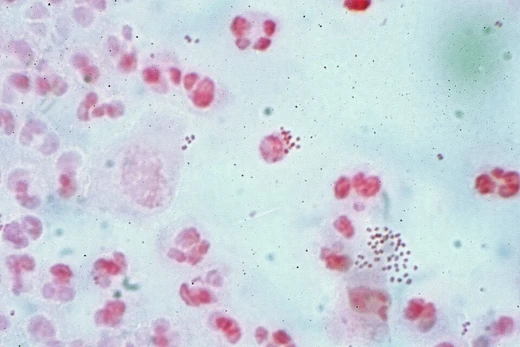
Legionella pneumophila
Primary causative agent of Legionnaires' disease, an intracellular pathogen.

Legionella pneumophila is a Gram-negative, aerobic, non-fermentative bacterium with a coccobacillus shape. It is oxidase- and catalase-positive and requires both cysteine and iron to grow, typically forming gray-white colonies with a textured, cut-glass appearance on buffered charcoal yeast extract agar. The bacterium is generally mesophilic, thriving between 20 °C and 59 °C, and can tolerate temperatures up to 66 °C, though it is killed at 70 °C or above. It also withstands high salt concentrations, enduring up to 1.5% sodium chloride in laboratory conditions and 3% in vivo. As an intracellular pathogen, L. pneumophila preferentially parasitizes protozoa such as amoebae and ciliates, which serve as natural reservoirs. This relationship shields the bacterium from environmental stressors and disinfectants, contributing to its persistence and virulence. Humans are accidental hosts, with only one reported case of human-to-human transmission; infection typically occurs when aerosolized water droplets from contaminated fixtures like faucets or showers are inhaled, allowing the bacterium to infect alveolar macrophages. The bacterium exists in two forms: a transmissive phase favored in nutrient-poor environments, characterized by flagellation and reduced sodium ion resistance, and a replicative phase for proliferation. Its cell membrane features unique lipopolysaccharides (LPS) that extend from the outer membrane, serving as the primary surface antigen and playing a key role in adhesion and pathogenicity. The chemical composition of these LPS side chains determines the organism’s somatic O-antigen specificity, which is important for serological classification. Ecologically, L. pneumophila tolerates a wide range of conditions—temperatures from 0 °C to 63 °C, pH from 5.0 to 8.5, and dissolved oxygen from 0.2 to 15.0 mg/liter—but multiplies only between 25 °C and 42 °C. It is notably resistant to chlorine derivatives and commonly contaminates water supply networks, including cooling towers, hospital systems, and cruise ships. The bacterium can form biofilms within pipes, enabling prolonged survival in low-nutrient environments and resistance to biocides, and it attaches particularly well to plumbing plastics.
- type
- Bacterium
- gram_stain
- Gram-negative
- morphology
- Coccobacillus
- oxygen_requirement
- Aerobic
- optimal_temperature_range
- 20 °C to 59 °C
- known_for
- Causing Legionnaires' disease (legionellosis)
Lore & Background
L. pneumophila is a Gram-negative, aerobic bacterium that is non-fermentative, oxidase- and catalase-positive. Its colony morphology is gray-white with a textured, cut-glass appearance, and it requires cysteine and iron to thrive, growing on buffered charcoal yeast extract agar. The bacterium is generally mesophilic, preferring environments between 20 °C and 59 °C, tolerating up to 66 °C, with death observed at or above 70 °C. It also tolerates high NaCl concentrations, enduring 1.5% sodium chloride in laboratory conditions and up to 3% sodium chloride in vivo. As an intracellular bacterium, L. pneumophila has a preferential parasitic relationship with protozoa, which serve as a reservoir and shield it from environmental stressors. Humans are accidental hosts, with only one reported case of human-to-human transmission. The bacterium exists in two forms: transmissive and replicative. The transmissive phase is favored in nutrient-low environments, exhibits spore-like character, and corresponds with infection, characterized by flagellation and decreased sodium ion resistance. The replicative form follows to carry out proliferation.
Reader's Guide
Legionella pneumophila is significant as the primary cause of Legionnaires' disease, a severe pneumonia that can affect susceptible individuals exposed to aerosolized contaminated water. Its ability to thrive in water systems, including cooling towers, hospital plumbing, and cruise ship water networks, makes it a persistent public health concern. The bacterium's resistance to chlorine derivatives and its capacity to form biofilms within pipes allow it to evade standard disinfection processes, leading to outbreaks. Its intracellular lifestyle, using protozoa as natural hosts and human alveolar macrophages as accidental hosts, contributes to its virulence and pathogenicity. Diagnosis is performed via urine antigen test, and treatment involves fluoroquinolones and azithromycin antibiotics. Understanding its ecology, biofilm formation, and metabolic reliance on amino acids is crucial for controlling its spread and preventing disease.
Did You Know?
- L. pneumophila can tolerate temperatures up to 66 °C but dies at or above 70 °C.
- It is auxotrophic for seven essential amino acids: cysteine, leucine, methionine, valine, threonine, isoleucine, and arginine.
- The bacterium uses the AnkB protein to promote host proteasomal degradation, generating free amino acids for its proliferation.
- Copper inhibits L. pneumophila attachment to surfaces, while carbon-rich environments favor its biofilm formation.
Frequently Asked Questions
Who is Legionella pneumophila?
Legionella pneumophila is a Gram-negative, aerobic coccobacillus that normally lives in aquatic environments but is best known for its capacity to invade eukaryotic cells. It is the bacterium behind Legionnaires' disease, a severe form of pneumonia.
What are Legionella pneumophila's powers/role?
Its signature ability is intracellular survival: it hijacks alveolar macrophages in the lungs and uses them as protected replication factories. In its natural niche it does the same inside soil amoebae and freshwater protozoa, which serve as its preferred multiplication hosts.
How does Legionella pneumophila's story end?
In a human, inhaled aerosolized water droplets deposit the bacterium into the alveoli, where it infects macrophages and triggers the inflammatory cascade of legionellosis. Without timely antibiotic therapy the infection can escalate to severe pneumonia and multi-organ failure.
Why is Legionella pneumophila important?
It is the primary causative agent of Legionnaires' disease, a potentially fatal pneumonia that does not spread person-to-person, making contaminated water systems the critical public-health vector. Its knack for multiplying inside plumbing biofilms and cooling towers keeps it a persistent challenge for infection-control programs.
Where does Legionella pneumophila hang out?
It thrives in freshwater at temperatures roughly between 20 °C and 59 °C, favoring warm, stagnant or slowly circulating water. In the built environment it colonizes cooling towers, hot-water tanks, showerheads, and similar fixtures where aerosolization can carry it to nearby people.
More in Pathogenic Bacteria 1-20
Spotted an error? Know more?
This is a living reference — every entry is fact-audited, and reader corrections feed straight into our audit queue. Suggest an edit · See this site's audit record