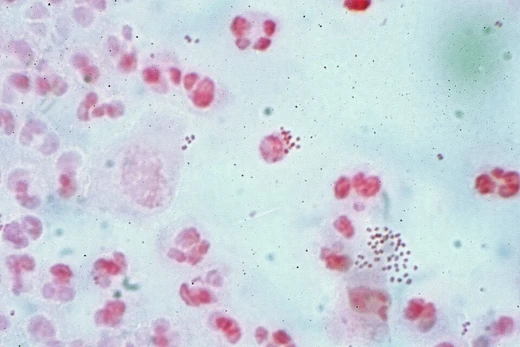
Klebsiella pneumoniae
A Gram-negative bacterium causing pneumonia and nosocomial infections.

Klebsiella pneumoniae is a rod-shaped bacterium that is Gram-negative, non-motile, and encapsulated. It ferments lactose, grows without oxygen, and appears as a mucoid colony on MacConkey agar. Though it normally lives harmlessly in the mouth, skin, and intestines, it can cause serious damage if aspirated into the lungs, destroying alveoli and producing a bloody, jelly-like sputum that may be brownish or yellow. Among the Klebsiella genus in the Enterobacteriaceae family, it is the most important in hospitals, where it has become a major cause of infections acquired during care. Other species, K. oxytoca and K. rhinoscleromatis, have also been found in human samples.
In nature, K. pneumoniae lives in soil. About 30% of strains can fix nitrogen in low-oxygen conditions, making them free-living diazotrophs. This nitrogen-fixation system has been studied extensively and is useful in agriculture, as the bacterium has been shown to boost crop yields. It is closely related to K. oxytoca but can be told apart because it does not produce indole and can grow on melezitose, not 3-hydroxybutyrate.
The genus was named after German microbiologist Edwin Klebs. The bacterium is also called Friedlander’s bacillus after Carl Friedländer, a German pathologist who identified it as the cause of pneumonia in people with weakened immune systems, such as those with chronic diseases or alcoholism. Pneumonia from this bacterium caught outside the hospital is sometimes called Friedländer’s pneumonia.
Outside hospitals, K. pneumoniae most often causes pneumonia, usually bronchopneumonia or bronchitis. These patients are more likely to develop lung abscesses, cavities, empyema, and pleural adhesions. Antibiotic resistance is highest in Asia. A 2016 study in Turkey found that bloodstream infections from Klebsiella have a death rate around 50%, even with treatment.
The infection typically follows aspiration, and alcoholism is a risk factor. It also commonly causes hospital-acquired urinary tract infections and affects people with COPD. In the body, the neutrophil myeloperoxidase system fights the bacteria, and oxidative inactivation of elastase plays a role. Lipopolysaccharide-binding protein helps transfer bacterial cell wall components to cells.
People with K. pneumoniae pneumonia often cough up “currant jelly” sputum and may have fever, nausea, fast heart rate, and vomiting. The infection tends to strike those with underlying conditions like alcoholism.
Diagnosis can involve blood culture, complete blood count, sputum culture, chest X-ray, and CT scan. Susceptibility testing is used to find drug-resistant strains.
Treatment relies on antibiotics such as aminoglycosides, piperacillin/tazobactam, and cephalosporins, chosen based on susceptibility testing, the patient’s health, medical history, and disease severity. The bacterium produces beta-lactamase, making it resistant to ampicillin. Many strains have acquired extended-spectrum beta-lactamase, adding resistance to carbenicillin, amoxicillin, and ceftazidime. They remain susceptible to aminoglycosides and some cephalosporins, and clavulanic acid can partly inhibit the beta-lactamase. In intensive care units, multidrug-resistant infections have led to the return of colistin, but colistin-resistant strains have appeared. In 2009, strains carrying the New Delhi metallo-beta-lactamase (NDM-1) gene, which resists the carbapenem antibiotics, were found in India and Pakistan. In Taiwan, some cases cause liver abscesses in people with diabetes, treated with third-generation cephalosporins.
A newer, more dangerous variant called hypervirulent K. pneumoniae (hvKp) has emerged. Unlike classical K. pneumoniae (cKp), which mostly infects immunocompromised patients in hospitals, hvKp can sicken healthy people and attack nearly any body site. Its genetic traits come from a large virulence plasmid and possibly other mobile elements. These strains overproduce capsule components and siderophores for iron uptake. While early studies found hvKp sensitive to antibiotics, it has since acquired resistance plasmids, becoming multidrug-resistant. Originating in Asia, it has a high death rate. It often spreads to the central nervous system and eye, causing endophthalmitis, nonhepatic abscesses, pneumonia, necrotizing fasciitis, and meningitis. A visible clue is a hypermucoviscous appearance, and a string test can help diagnose it. Because no international guidelines exist, treatment is decided case by case. HvKp can also live in the gastrointestinal tract of healthy people, helping it spread in communities.
- field
- Microbiology, Infectious Disease
- known_for
- Cause of Friedländer's pneumonia; nitrogen-fixing diazotroph; multidrug-resistant strains including NDM-1
- gram_stain
- Negative
- morphology
- Rod-shaped, encapsulated
- metabolism
- Facultative anaerobic
- natural_habitat
- Soil, normal flora of mouth, skin, and intestines
Lore & Background
The genus Klebsiella was named after German microbiologist Edwin Klebs. The bacterium is also known as Friedlander's bacillum in honor of Carl Friedländer, who proposed it as the etiological factor for pneumonia in immunocompromised individuals, such as those with chronic diseases or alcoholics. Community-acquired pneumonia caused by this bacterium may occasionally be called Friedländer's pneumonia. Klebsiella pneumoniae naturally occurs in soil, and about 30% of strains can fix nitrogen in anaerobic conditions. As a free-living diazotroph, its nitrogen-fixation system has been much-studied and is of agricultural interest, as it has been demonstrated to increase crop yields. It is closely related to K. oxytoca, from which it is distinguished by being indole-negative and by its ability to grow on melezitose but not 3-hydroxybutyrate. In recent years, Klebsiella species have become important pathogens in nosocomial infections. A hypervirulent variant (hvKp) has emerged, significantly more virulent than classical K. pneumoniae, causing disease in healthy individuals and infecting virtually every site of the body. hvKp originated from Asia and has a high mortality rate; it often spreads to the central nervous system and eye, causing endophthalmitis, nonhepatic abscesses, pneumonia, necrotizing fasciitis, and meningitis.
Reader's Guide
Klebsiella pneumoniae is a significant pathogen in both community and hospital settings. It is the most common cause of bacterial pneumonia outside the hospital among Klebsiella species, typically presenting as bronchopneumonia or bronchitis, with patients prone to lung abscesses, cavitation, empyema, and pleural adhesions. The bacterium possesses beta-lactamase, giving it resistance to ampicillin, and many strains have acquired extended-spectrum beta-lactamases conferring resistance to carbenicillin, amoxicillin, and ceftazidime. The emergence of New Delhi metallo-beta-lactamase (NDM-1) in strains from India and Pakistan has led to resistance against carbapenems. Hypervirulent K. pneumoniae (hvKp) is clinically concerning because it affects healthy individuals and can colonize the gastrointestinal tract, facilitating community spread. Environmental sources such as ready-to-eat vegetables, pork, public water, and fresh oysters have been found to harbor hvKp strains, underscoring the importance of surveillance. The bacterium's ability to fix nitrogen also gives it agricultural relevance, as it has been shown to increase crop yields.
Did You Know?
- Klebsiella pneumoniae is named after German microbiologist Edwin Klebs and is also known as Friedlander's bacillum.
- About 30% of strains can fix nitrogen in anaerobic conditions, and the bacterium has been demonstrated to increase crop yields.
- Hypervirulent K. pneumoniae (hvKp) can cause disease in healthy individuals and has been isolated from ready-to-eat vegetables, pork, public water, and fresh oysters.
- Strains with the New Delhi metallo-beta-lactamase (NDM-1) gene, discovered in India and Pakistan, are resistant to the intravenous antibiotic carbapenem.
Frequently Asked Questions
What is Klebsiella pneumoniae?
It is a rod-shaped, Gram-negative, encapsulated bacterium in the Enterobacteriaceae family and the most clinically significant species of the Klebsiella genus. It ferments lactose and can grow with or without oxygen, making it a versatile facultative anaerobe.
What diseases is Klebsiella pneumoniae known for causing?
It is the classic agent of Friedländer's pneumonia, a severe and destructive lung infection. It also frequently appears as a hospital-acquired (nosocomial) pathogen, particularly in immunocompromised or intubated patients.
Why are Klebsiella pneumoniae strains such a major concern in modern medicine?
Multidrug-resistant variants, especially those harbouring the NDM-1 carbapenemase gene, have become a serious threat in clinical settings. These strains resist nearly all available antibiotics and can spread rapidly among vulnerable, hospitalized patients.
Where does Klebsiella pneumoniae normally live?
It is a routine member of the normal flora in the human mouth, on the skin, and throughout the intestinal tract. It also colonises soil, so it is encountered in both environmental and human-associated niches.
What makes Klebsiella pneumoniae metabolically unusual for a gut bacterium?
It is a nitrogen-fixing diazotroph, meaning it can convert atmospheric nitrogen into biologically usable forms. This trait is rare among Enterobacteriaceae and gives it an extra metabolic edge in nutrient-poor environments.
More in Pathogenic Bacteria 1-20
Spotted an error? Know more?
This is a living reference — every entry is fact-audited, and reader corrections feed straight into our audit queue. Suggest an edit · See this site's audit record