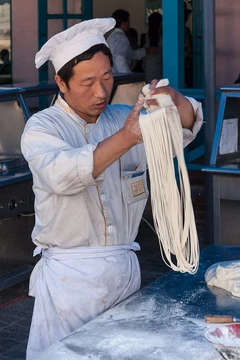
Udon
A thick wheat noodle central to Japanese cuisine.
Last updated
Udon (うどん or 饂飩) is a thick wheat-flour noodle central to Japanese cuisine. Its simplest preparation, kake udon, features the noodles in a mild broth called kakejiru, made from dashi, soy sauce, and mirin, typically topped with thinly sliced scallions. Common additions include prawn tempura, kakiage (a mixed tempura fritter), abura-age (sweet, deep-fried tofu pouches), kamaboko (sliced fish cake), and shichimi spice to taste. Broth recipes vary by region: eastern Japan uses dark (koikuchi) soy sauce, while western Japan prefers light (usukuchi) soy sauce.
Instant noodle versions often reflect this split. More unusual variants include stir-fried yaki udon and curry udon made with Japanese curry. Udon also appears as the final course in shabu shabu or Japanese hot pot.
Dishes
Udon noodles are boiled in hot water, with serving style depending on the type. They are typically served chilled in summer and hot in winter. During the Edo period, the thicker wheat noodle was called udon and served with a hot broth known as nurumugi, while the thinner, chilled variety was called hiyamugi. Cold udon, or udon salad, is often mixed with egg omelette slices, shredded chicken, and fresh vegetables like cucumber and radish.
Toppings for udon soup reflect the seasons and are usually added without much cooking, though deep-fried tempura is sometimes included. Many of these dishes can also be made with soba. Hot Udon Dishes - ("power udon"): topped with toasted mochi rice cakes. - Goboten udon: topped with deep-fried shredded burdock root. - ("modern udon"): see tanuki udon. - (Kantō) or su udon (Kansai): hot udon in broth with thinly sliced green onions and sometimes a slice of kamaboko. - Kamaage udon: served in a communal hot-pot with hot water, accompanied by a hot dipping sauce of dashi sukiyaki. - Karē nanban or karē udon ("curry udon"): udon in a spicy curry-flavoured broth, possibly with meat or vegetables. The term nanban references the Nanban trade, which influenced Japanese culture before being banned in 1639 by the Edo Shogunate.
Biei, Hokkaido, is known for a unique curry udon. - ("fox udon"): topped with abura-age (sweet, deep-fried tofu pouches); fox spirits are said to enjoy abura-age. Originated in Osaka. - Maruten udon: topped with maruten, a deep-fried large fish cake. - Nabeyaki udon: a hot-pot udon with seafood and vegetables cooked in a metal pot, often including tempura shrimp, mushrooms, and an egg cracked on top. - Oboro udon: dashi broth with kombu flakes. - Oyako udon: chicken and egg with sliced onion in a sweetened dashi soup, offering a sweet-savory flavor. - Sansai udon: udon with wild edible mountain vegetables. - Su udon: see kake udon. - ("stamina udon"): udon with hearty ingredients, usually meat, a raw egg, and vegetables. - (Kantō) or (Kansai): topped with tempura batter pieces. - Tempura udon: topped with tempura, especially prawn, or kakiage. - ("moon-viewing udon"): topped with a raw egg that poaches in the hot soup. - Wakame udon: topped with wakame, a dark green seaweed. - Yaki udon: stir-fried udon in a soy-based sauce, similar to yakisoba, with meat (usually pork) and vegetables. Simple to make, it is a popular late-night snack in Japanese izakaya.
Originated in Kitakyushu, Fukuoka Prefecture, just after World War II when food was scarce; the owner of the noodle restaurant Darumado used udon noodles in place of unavailable yakisoba noodles. Cold Udon Dishes - ("poured broth udon"): cold udon served with hot dashi broth poured over it. - ("naked udon"): cold udon served on its own. - Kijōyu udon: served in a cold soup of raw (unpasteurized) soy sauce and sudachi juice, sometimes with grated daikon radish. - Zaru udon: chilled udon topped with shredded nori, served on a bamboo tray (zaru), with a chilled dipping sauce of dashi, mirin, and soy sauce, eaten with wasabi or grated ginger. Thickness and shape vary widely across Japan. - Dango-jiru: from Ōita Prefecture, a "dumpling soup" resembling very thick, flat udon. - Gotō udon: a thin, firm variant from the Goto Islands, coated in camellia oil as a natural preservative. - ("heavy snow udon"): from Kutchan, Hokkaido, slightly translucent and chewy, made from potato starch and wheat flour. Originated as a home food for farmers at the foot of Mount Yōtei, a heavy snowfall area; the name reflects both the region and the noodle's translucent appearance. - Hakata udon: a thick, soft type from Fukuoka. - Himokawa: an extremely flat, wide type from Kiryū, Gunma. - Hōtō: a miso soup from Yamanashi Prefecture with flat, wide udon and vegetables, particularly kabocha.
Lore & Background
Udon noodles are boiled in a pot of hot water. Depending on the type, the way it is served differs.
In the Edo period, the thicker wheat noodle was generally called udon and served with a hot broth called nurumugi, while the thinner, chilled variety was called hiyamugi. Standard broth differs by region: dark (koikuchi) soy sauce is added in eastern Japan, while light (usukuchi) soy sauce is added in the west. Instant noodles are often sold in two or more versions accordingly.
There are many hot udon variants, including chikara udon topped with toasted mochi rice cakes, kitsune udon topped with aburaage (sweet, deep-fried tofu pouches), and nabeyaki udon, a hot-pot with seafood and vegetables cooked in a metal pot. Cold udon dishes include zaru udon, chilled noodles topped with shredded nori and served on a bamboo tray with a dipping sauce, and bukkake udon, cold udon served with hot dashi broth poured over it.
Regional varieties in Japan show wide variations in thickness and shape. Examples include Sanuki udon from Kagawa Prefecture, a thick and rather stiff type; Inaniwa udon from Akita Prefecture, a thin type; and Hōtō from Yamanashi Prefecture, a flat and wide type in miso soup. Outside Japan, Korean-style udon noodle soups are served in snack bars and street stalls, and a dish called udong in Palau uses spaghetti noodles with a soy sauce-based broth.
Reader's Guide
Udon is significant as a versatile and widely consumed noodle in Japanese cuisine, with a history dating back to at least the Edo period. Its importance lies in its adaptability: it can be served hot or cold, in soup or stir-fried, and with a vast array of toppings that reflect regional preferences and seasonal ingredients. The distinction between eastern and western Japan in soy sauce usage for broth highlights how udon embodies local culinary traditions.
Regional varieties such as Sanuki udon, Hōtō, and Kishimen demonstrate how the basic noodle can be transformed by local ingredients and techniques, from potato starch in Hokkaido to carrot-kneaded noodles in Saitama. Udon's influence extends beyond Japan, with Korean udong and Palauan udong showing how the dish was adapted in other cultures. Its legacy is seen in its continued popularity in both traditional and modern forms, including instant noodle versions that cater to regional tastes.
More in Pasta & Noodles
Sources
Compiled from Wikipedia and the sources listed below. Text from Wikipedia is available under CC BY-SA 4.0; this entry is adapted from it.
- Wikipedia: Udon (CC BY-SA 4.0).
Spotted an error? Know more?
Reader corrections go straight into our review queue. Suggest an edit · How this site is sourced