Ramen
Japanese-Chinese fusion noodle dish with regional varieties and global fame.
Last updated
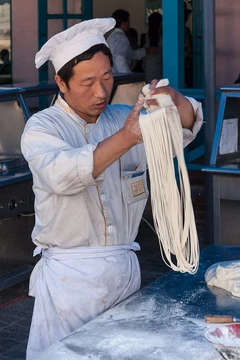
Ramen is a Japanese-Chinese fusion noodle dish consisting of Chinese-style alkaline wheat noodles served in a hot broth, with common flavors including soy sauce and miso. It originated in Yokohama Chinatown in the late 19th century, evolving from southern Chinese noodle dishes rather than from the hand-pulled lamian of northern China. Today, ramen is considered a national dish of Japan, with numerous regional varieties and global popularity.
Lore & Background
Ramen's origins trace to Yokohama Chinatown in the late 19th century, where Chinese immigrants, primarily Cantonese and Shanghainese, served noodle soups that the Japanese called Nankin soba ('Nanjing noodles'). The dish was renamed shina soba in 1910 by Kan'ichi Ozaki, reflecting imperialist attitudes. After World War II, the term shina acquired pejorative connotations and was replaced by chūka soba, while the name ramen spread following the 1958 release of Nissin Chikin Ramen by Momofuku Ando.
Ramen was initially looked down upon due to racial discrimination against the Chinese and its association with inexpensive working-class food. However, after World War II, increased wheat consumption due to rice shortages and the return of Japanese colonizers from China helped popularize it nationwide. The dish's name likely came from Japanese colonizers misapplying the term 'lamian' to southern Chinese noodle dishes they encountered in Japan.
Nearly every region in Japan has its own variation, such as tonkotsu ramen of Kyushu and miso ramen of Hokkaido. Specialist ramen shops called rāmen'ya are considered the best quality. The dish has spread internationally, becoming a cultural icon, though the term is sometimes misused in the Anglosphere as a catch-all for any noodle soup.
Reader's Guide
Ramen's significance lies in its transformation from a marginalized Chinese immigrant food to a celebrated national dish of Japan, reflecting broader social and historical shifts. Its evolution illustrates how cultural exchange, migration, and post-war conditions shaped Japanese cuisine. The invention of instant noodles in 1958 by Momofuku Ando revolutionized ramen's accessibility, leading to global export in 1971 and making it a worldwide phenomenon.
Regional varieties—from Sapporo's miso ramen to Hakata's tonkotsu—demonstrate local adaptation and pride. Ramen's legacy extends beyond food: it symbolizes Japan's ability to absorb and reinvent foreign influences, and its international popularity has made it a cultural ambassador. The dish also highlights issues of racial discrimination and imperialist naming practices, as seen in the shift from shina soba to chūka soba.
Today, ramen is studied as a case of culinary globalization, with instant ramen becoming a staple in many countries. Its misidentification in the West as a generic noodle soup underscores the challenges of cultural translation. Overall, ramen's journey from Yokohama Chinatown to global kitchens encapsulates themes of migration, adaptation, and identity.
Did You Know?
- The word 'ramen' first appeared in Japan in 1928 in a book by Seiichi Yoshida, but referred to hand-pulled noodles, not the noodle soup dish.
Also in the Codexery
More in Pasta & Noodles
Sources
Compiled from Wikipedia and the sources listed below. Text from Wikipedia is available under CC BY-SA 4.0; this entry is adapted from it.
- Wikipedia: Ramen (CC BY-SA 4.0).
Spotted an error? Know more?
Reader corrections go straight into our review queue. Suggest an edit · How this site is sourced