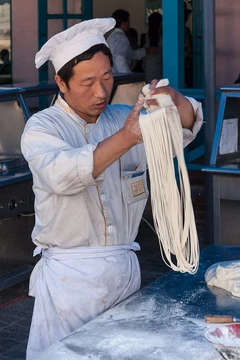
Rice noodles
Noodles made from rice flour and water, common in Asia.
Last updated

Popo le Chien · via Wikipedia: Rice noodles · CC BY-SA 3.0
Rice noodles are a type of noodle whose main ingredients are rice flour and water. To make them more transparent or give them a chewier, more gelatinous texture, cooks sometimes add tapioca or corn starch.
History
These noodles are especially common in the cuisines of China, India, and Southeast Asia. They come in many shapes, thicknesses, and textures, and can be bought fresh, frozen, or dried. Fresh rice noodles spoil quickly, often lasting only a few days.
The history of rice noodles goes back to China’s Qin dynasty, when people from the north moved south. Northern Chinese traditionally preferred wheat and millet, which grow in cold climates, while southerners favored rice, which thrives in heat. Since northerners were used to wheat noodles, they tried making noodles from rice instead, creating the first rice noodles.
Over time, these noodles and their production methods spread worldwide, becoming especially popular in Southeast Asia. In India, a dish called idi-appam—strings of cooked rice—was known in the ancient Tamil country around the 1st century AD, according to references in Sangam literature cited by food historian K. T. Achaya. Drying rice noodles can extend their shelf life by removing moisture; the International Food Research Journal has published studies on this drying process.
There are many varieties of rice noodles. Round thick types include bánh canh (thick Vietnamese noodles, where bánh means flour-based items and canh means soup), lai fun (a short, thick Chinese noodle also called bánh canh by Vietnamese), nan gyi thoke (thick round noodles mixed with chicken curry and chili oil), nan lat (medium-thick round noodles from Burma), and silver needle noodles (short, about 5 cm long and 5 mm in diameter, with tapering ends like a rat’s tail; known as silver needle noodles in Hong Kong and Taiwan, rat or mouse tail noodles in Malaysia and Singapore, locupan in Indonesia, and giam ee noodles in Thailand).
Others
Flat thick varieties include bánh phở (thick fresh noodles used in Vietnamese phở), shahe fen/chao fen/chow fun (wide Chinese rice noodles), migan (a broad, flat noodle from the Dai people of Yunnan, made from ordinary non-glutinous rice), juanfen (similar to migan), sen lek (narrow flat noodles in Thailand, used in pad thai and soups), nan byar (flat rice noodles from Burma, where byar means flat), and san see. Thin varieties include khanom chin (fresh, thin Thai noodles made from rice sometimes fermented for three days, boiled, and extruded through a sieve; similar to Burmese mont bat or mont di) and rice vermicelli (a thin form often called “rice noodles” or “rice sticks”). Other types include mixian (from Yunnan, made from ordinary non-glutinous rice, available in thinner and thicker forms) and pasta made from brown rice flour, sold in Western health food stores as a wheat-free alternative.
Rice noodles appear in many dishes across different cuisines. Burmese dishes include baik kut kyee kaik, kat kyi kaik, kyar san kyaw, kyay oh, meeshay, mohinga, mont di, nan gyi thohk, nanbyagyi thoke, Rakhine kyarzan thoke, and Shan khauk swè (similar to Yunnan mi xian, a soup version of meeshay without gel, using fish sauce instead of soy sauce, with flat or round noodles). Cambodian dishes include kuyteav, num banhchok, chha kuy teav (stir-fried), kŭytéav mii kiəv (a wonton noodle soup), mee Katang (a Cambodian version of beef chow fun, with noodles under stir-fried beef and vegetables, topped with scrambled eggs), mee Kola, cha mi sour, and lort cha. Chinese dishes include beef chow fun, cart noodle, chao fen (called chow fun in many North American Chinese restaurants), clay-pot lao shu fen, crossing-the-bridge noodles, laoyou rice noodles, luosifen, mixian, rice noodle roll, and Singapore-style noodles.
Filipino dishes include mami bihon, pancit bihon, pancit choca, pancit luglug, pancit Malabon, pancit miki-bihon (round egg noodles with bihon), pancit palabok, and pancit sinanta (flat egg noodles, bihon, clams, and chicken in annatto-colored broth, served with pinakufu). Indonesian dishes include bihun, bihun goreng, bakso, ketoprak, kwetiau ayam, kwetiau goreng, kwetiau kuah, kwetiau Medan, kwetiau sapi, lakso, and soto. Lao dishes include feu, khao piak sen, khao poon, khao soi, khua mee or pad lao (stir-fried noodles with scrambled egg, similar to pad thai), and mee ka tee.
Malaysian dishes include char kway teow, kway chap, laksa, and mee siam. South Indian and Sri Lankan dishes include idiyappam and sevai. Singaporean dishes include beef kway teow, crab bee hoon, Hokkien mee, Katong laksa, and satay bee hoon. Thai dishes include khanom chin, khao soi, kuai chap (pork broth with rolled rice noodle sheets, pork intestines, blood tofu, and boiled egg), kuai tiao khua kai, kuai tiao nam tok (noodle soup darkened with raw blood), and kuaitiao ruea.
Lore & Background
The origin of rice noodles dates back to China during the Qin dynasty when people from northern China settled the south. Due to climatic conditions, northern Chinese traditionally preferred wheat and millet which grew in cold weather, while southern Chinese preferred rice which grew in hot weather.
Noodles were traditionally made from wheat and eaten throughout northern China, so to adapt, northern cooks tried to prepare 'noodles' using rice, thus inventing rice noodles. Over time rice noodles and their processing methods have been introduced around the world, becoming especially popular in Southeast Asia. In India, idi-appam, strings of cooked rice, was known in ancient Tamil country around 1st century AD, as per references in the Sangam literature, according to food historian K. T. Achaya.
Reader's Guide
Rice noodles are a staple in many Asian cuisines, appearing in a vast array of dishes across Burma, Cambodia, China, the Philippines, Indonesia, Laos, Malaysia, South India, Sri Lanka, Singapore, Thailand, and Vietnam. Their versatility is reflected in numerous varieties, including round thick noodles like bánh canh and lai fun, flat thick noodles such as bánh phở and shahe fen, thin varieties like khanom chin and rice vermicelli, and others like mixian.
Dishes range from soups like phở and mohinga to stir-fries like pad thai and char kway teow. The shelf life of fresh noodles is highly perishable, but can be extended by drying, as studied by the International Food Research Journal. Rice noodles also serve as an alternative to wheat flour-based noodles for individuals who react poorly to gluten, with pasta made from brown rice flour available in health food stores in Western nations.
More in Pasta & Noodles
Sources
Compiled from Wikipedia and the sources listed below. Text from Wikipedia is available under CC BY-SA 4.0; this entry is adapted from it.
- Wikipedia: Rice noodles (CC BY-SA 4.0).
Spotted an error? Know more?
Reader corrections go straight into our review queue. Suggest an edit · How this site is sourced