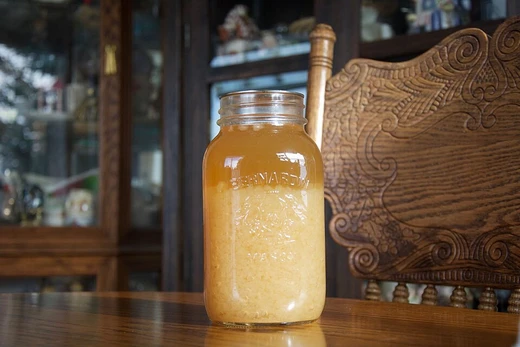
Soy sauce
A fermented Chinese condiment with saltiness and umami.
Last updated

국립국어원 · via Wikipedia: Soy sauce · CC BY-SA 2.0 kr
Shoyu exportation began in 1647 by the Dutch East India Company.[1] Soy sauce production in the United States began in the Territory of Hawaii in 1905 by Yamajo Soy Co.[2] Approximately 2,200 years ago, during China's Western Han dynasty, soy sauce was developed into its present-day form.[3] During the Song dynasty (960–1279 AD), the term jiàng yóu became the standard name for this liquid condiment.[4]
Historically, soy sauce served as a means to extend the use of salt, which was a costly item, similar to other salty condiments.[5] By the Han dynasty, that earlier recipe was superseded by one for soy paste and its by-product, soy sauce.[5] In 1737, the Dutch East India Company's records show that seventy-five large barrels of soy sauce were shipped from Dejima, Japan, to Batavia.[6]
What the cited sources add
The Clove Garden account explains that artificial soy sauce is made from hydrolyzed soy protein treated with hydrochloric acid and colored with caramel.[7] The Clove Garden account also notes that koikuchi accounts for over 80% of soy sauce production in Japan.[7] The Clove Garden account describes guk-gan-jang as the original Korean soy sauce, made for over 1000 years as a byproduct of making doenjang.[7] The same source indicates that Filipino soy sauce has a thinner consistency and a more salty flavor compared to similar sauces from other Southeast Asian countries.[8]
References
- Wikipedia, "Soy sauce" (CC BY-SA 4.0), which cites: Ohyama, "Traditional and modern Japanese soy foods : manufacturing, nutrition and cuisine of a variety of soy foods for health and joy of taste", Nova Science Publishers, 14 May 2014 (original not read by us) en.wikipedia.org
- Wikipedia, "Soy sauce" (CC BY-SA 4.0), which cites: "How Japanese and Japanese-Americans Brought Soyfoods to the United States and the Hawaiian Islands - A History (1851-2011) - SoyInfo Center", www.soyinfocenter.com; Shurtleff, "History of Soy Sauce, Shoyu, and Tamari – Page 7", Soy Info Center, 2004 (original not read by us) en.wikipedia.org
- Wikipedia, "Soy sauce" (CC BY-SA 4.0), which cites: "Soy Sauce, China's Liquid Spice", www.flavorandfortune.com; "調料文化:醬油的由來", 30 January 2012; Hsing-Tsung, "Joseph Needham: Science and Civilisation in China, Vol.6, Part 5", Cambridge University Press, 2000, p. 346; Hsing-Tsung, "Joseph Needham: Science and Civilisation in China, Vol.6, Part 5", Cambridge University Press, 2000, p. 358–359; "Shπyu:The Flavor of Japan", The Japan Foundation Newsletter Vol. XXVII, No. 2, January 2000, p. 2 (we also read that source) en.wikipedia.org
- Wikipedia, "Soy sauce" (CC BY-SA 4.0), which cites: Hsing-Tsung, "Joseph Needham: Science and Civilisation in China, Vol.6, Part 5", Cambridge University Press, 2000, p. 358–359; Hsing-Tsung, "Joseph Needham: Science and Civilisation in China, Vol.6, Part 5", Cambridge University Press, 2000, p. 358–359; Hsing-Tsung, "Joseph Needham: Science and Civilisation in China, Vol.6, Part 5", Cambridge University Press, 2000, p. 358–359; 林洪, "山家清供"; 浦江吴氏, "浦江吳氏中饋錄" (we also read that source) en.wikipedia.org
- Wikipedia, "Soy sauce" (CC BY-SA 4.0), which cites: "調料文化:醬油的由來", 30 January 2012; :zh:醬; Hsing-Tsung, "Joseph Needham: Science and Civilisation in China, Vol.6, Part 5", Cambridge University Press, 2000, p. 346; Hsing-Tsung, "Joseph Needham: Science and Civilisation in China, Vol.6, Part 5", Cambridge University Press, 2000, p. 358–359; Kurlansky, "Salt: A world history", Walker and Co., 2002, p. 20 (we also read that source) en.wikipedia.org
- Wikipedia, "Soy sauce" (CC BY-SA 4.0), which cites: Tanaka, p. 6. (original not read by us) en.wikipedia.org
- "Soy Sauce", Clove Garden. facts only, no text reused. clovegarden.com
- Liwanag, "Filipino Soy Sauce", Pinoy Bites, 7 June 2020. facts only, no text reused. pinoybites.com
Each numbered sentence above was checked against the source it cites before publication. Sentences citing Wikipedia adapt text from the English Wikipedia article Soy sauce (contributors), used under CC BY-SA 4.0; this entry is available under the same licence. Other sources were used for facts only; no text or images are copied from them.
Also in the Codexery
More in Fermented Foods
Sources
Compiled from Wikipedia and the sources listed below. Text from Wikipedia is available under CC BY-SA 4.0; this entry is adapted from it.
- Wikipedia: Soy sauce (CC BY-SA 4.0).
Spotted an error? Know more?
Reader corrections go straight into our review queue. Suggest an edit · How this site is sourced