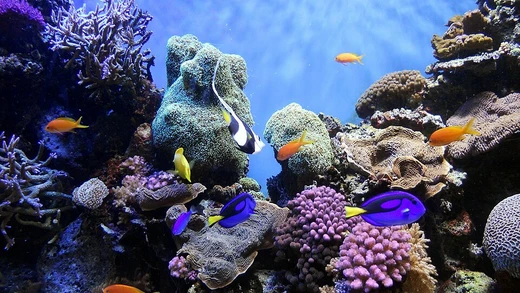
Siganus
Venomous, herbivorous reef fishes with a unique pelvic fin structure.

Rabbitfishes or spinefoots, genus Siganus, are perciform fishes in the family Siganidae, the only extant genus in that family with 29 species. They are native to shallow waters in the Indo-Pacific, though two species have become established in the eastern Mediterranean via Lessepsian migration. They are commercially important food fish and can be used in dishes such as bagoong.
Quick Facts
- Taxon
- Siganus
- Type Species
- Siganus rivulatus
- Type Species Authority
- Fabricius, 1775
Facts from the source article.
Lore & Background
The genus Siganus was described in 1775 by Danish zoologist Johan Christian Fabricius, based on notes from naturalist Peter Forsskål's Danish Arabia expedition, published by Carsten Niebuhr. The name Siganus is a latinisation of the local Arabic name for the marbled rabbitfish in Yemen, Sidjan, meaning 'rabbitfish'. Carl Linnaeus originally described the genus Teuthis, but the International Commission on Zoological Nomenclature has been asked to suppress Teuthis in favor of Siganus to reflect prevailing usage.
Rabbitfishes have laterally compressed, oval bodies, a very small mouth with incisor-like teeth forming a beak, and venomous spines in the dorsal and pelvic fins. Their pelvic fins have 2 spines with 3 soft rays between them, a characteristic unique to the Siganidae. They range in maximum total length from 20 cm to 53 cm. All are diurnal, some schooling, others solitary; they sleep in crevices at night. They are primarily herbivorous, feeding on benthic algae, though some species have been observed eating jellyfish, comb jellies, prawns, and other baits, suggesting opportunistic omnivory.
Hybridization has played a role in their evolution, as shown by DNA comparisons. Evidence exists of interbreeding between several species pairs, and one individual was found to be an offspring of a hybrid backcross. Some presumed species may actually be color morphs of a single species, while the blue-spotted spinefoot may represent more than one species.
Reader's Guide
Rabbitfishes are significant as commercially important food fish, particularly the schooling species, with catch sold fresh or processed into fish paste. Some species are used in aquaculture and the more colorful ones appear in the aquarium trade. Their venomous spines, while painful, are generally not medically significant in healthy adults. The genus is notable for its unique pelvic fin structure, which is diagnostic for the family Siganidae. Two Red Sea species have become invasive in the eastern Mediterranean via Lessepsian migration, and their gut passage of live benthic organisms has been shown to play a major role in the long-distance dispersal of foraminifera. Some species have been reported to be hallucinogenic. The taxonomy remains unsettled: a 2007 study outlined potential splits into subgenera or genera, but names are not established because the placement of the type species is unknown. Hybridization and possible species merging further complicate classification.
Did You Know?
- The name Siganus comes from the Arabic word Sidjan, meaning 'rabbitfish'.
- Rabbitfish have venomous spines in their dorsal and pelvic fins, similar to stonefish venom in at least three species.
- Two Red Sea species, S. luridus and S. rivulatus, have invaded the Mediterranean via the Suez Canal.
- Some rabbitfish species have been observed eating jellyfish and comb jellies, despite being primarily herbivorous.
Taxonomic Heritage & Nomenclature
The marbled spinefoot holds a singular position in ichthyological taxonomy: it is the type species not only of the genus Siganus but of the entire monogeneric family Siganidae, meaning the very identity of that family rests upon this single fish. The generic name traces back to the Arabic word sijan, which carries the same meaning as the English common name "rabbitfish," while the specific epithet rivulatus—literally "irregularly marked with colour"—points directly to the wavy yellow streaks that trace the fish's flanks. The species was formally described by the Swedish naturalist Peter Forsskål, though the publication did not appear in his own lifetime. His friend Carsten Niebuhr edited and released the work, Descriptiones animalium, Flora Aegyptiaco-Arabica, in 1775, preserving Forsskål's observations for the scientific record. A 2007 proposal by Kuriiwa and colleagues to split Siganus into three sub-genera has left the precise taxonomic placement of S. rivulatus in a state of uncertainty, as no formal names for the new groupings have yet been established.
Body Plan & the Danger of the Spines
The marbled spinefoot presents a distinctly laterally compressed silhouette, with standard length running between 2.7 and 3.4 times its greatest body depth. The dorsal fin carries fourteen spines above ten soft rays, while the anal fin bears seven spines and nine soft rays. The skeleton includes twenty-three vertebrae, and the caudal fin is only slightly forked. Teeth, arranged in a single row along the jaws, are incisor-like with lateral cusps, suited to scraping. Small embedded scales cover the body, with the exception of the midline along the underside. Colouration is notably variable: the upper surface shifts between grey-green and brown, the belly may be yellow or silvery white, and the flanks typically display dark spots interlaced with wavy yellow lines. Most individuals reach ten to twenty centimetres, though specimens up to twenty-seven centimetres are recorded, with an absolute maximum of forty. The slender, barbed spines of the dorsal and anal fins harbour venom glands. A sting is intensely painful, though no human fatalities have been documented. Because the venom is a heat-labile protein, treatment involves applying the highest tolerable temperature—between forty-three and forty-six degrees Celsius—to the affected area, alongside care for potential secondary infection.
Range Expansion & Ecological Consequences
The marbled spinefoot is native to the western Indian Ocean, ranging along the east African coastline from South Africa northward to the Red Sea, with populations also established around the Comoros, Madagascar, and the Seychelles. Its journey into the Mediterranean began in 1927, when the first specimen was recorded off the coast of Palestine after passing through the Suez Canal—a classic Lessepsian migration event. Since then the species has spread to become very common throughout the eastern Mediterranean basin, pushing as far west as the Sicily Channel and into portions of the Adriatic Sea. This colonisation has not been ecologically neutral. Together with the related Lessepsian invader Siganus luridus, S. rivulatus has been implicated in the creation of so-called "barrens" off the Turkish coast. The relentless grazing pressure exerted by these two species has stripped algal communities of their structural complexity, biomass, and biodiversity, leaving behind seabeds that are nearly devoid of vegetation. The transformation represents a striking example of how a single introduced herbivore can reshape an entire benthic ecosystem.
Feeding, Spawning & Early Life
In the wild, Siganus rivulatus favours shallow, sheltered waters over substrates draped in algae—rocky outcrops, sandy patches, and sea-grass beds at depths under fifteen metres. It is euryhaline and will occasionally venture into estuarine settings. The fish is strongly gregarious, typically moving in schools of fifty to several hundred individuals. While adults graze predominantly on algae such as Polysiphonia and Sphacelaria species, observations in the northern Red Sea during spring and early summer have documented them attacking ctenophores and the moon jellyfish Aurelia aurita, tearing the latter apart until it sinks. Sexual maturity is reached at a standard length of roughly thirteen and a half centimetres. Spawning occurs at dusk when water temperatures sit between twenty-four and twenty-seven degrees Celsius; the season runs from March through May in the Red Sea but is delayed to May through July in the Mediterranean. The species is oviparous with external fertilisation, producing small adhesive eggs of about half a millimetre in diameter, after which the adults provide no further care. Newly hatched larvae are planktonic, remain unfed for three days, then shift to diatoms and copepods. Around three weeks of age they undergo metamorphosis, gather into schools, and migrate toward deeper water.
Frequently Asked Questions
What is Siganus?
Siganus is the only surviving genus in the Siganidae family, a group of perciform fishes commonly called spinefoots or rabbitfishes. It was formally erected by Fabricius (citing Forsskål) in Niebuhr's 1775 publication, with Siganus rivulatus designated as the type species, and it now holds 29 recognized species.
What makes Siganus unique among reef fish?
Every species in the genus is a venomous, herbivorous reef dweller with a distinctive pelvic-fin configuration that sets it apart from other fish lineages. Their dorsal fin carries 13 spines and 10 soft rays, while the anal fin bears 7 spines and 9 soft rays.
How big do Siganus species get?
Total length varies dramatically across the 29 species: Siganus unimaculatus tops out around 20 cm, whereas Siganus javus can reach roughly 53 cm. This makes the genus span a wide size range for a group of shallow-water reef fish.
Why is Siganus important to humans?
Spinefoots are a commercially significant food fish throughout their native range, harvested for local markets and traditional cuisine. They are a key ingredient in preparations such as bagoong, giving them a long-standing role in coastal food cultures.
Where do Siganus live, and have they spread beyond their native range?
The genus is native to shallow waters across the Indo-Pacific. Two species have since taken hold in the eastern Mediterranean after migrating through the Suez Canal, a process known as Lessepsian migration.
More in Parrotfish and Rabbitfish 1-24
Spotted an error? Know more?
Reader corrections go straight into our review queue. Suggest an edit · How this site is sourced