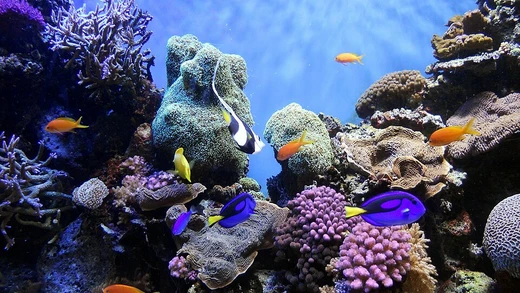
Foxface rabbitfish
A venomous, color-changing rabbitfish from Indian and Pacific Oceans.

The foxface rabbitfish (Siganus vulpinus) goes by several common names, including foxface, black-face rabbit fish, badger fish, and common foxface. It is a marine ray-finned fish belonging to the family Siganidae, found in the Indian and Pacific Oceans, and is also kept in home aquariums.
German zoologists Hermann Schlegel and Salomon Müller first described this species in 1845, naming it *Amphacanthus vulpinus* based on a specimen from Ternate Island in Indonesia’s Molucca Islands. A related fish, the blotched foxface (*S. unimaculatus*), has a large black spot below the soft part of the dorsal fin, which *S. vulpinus* lacks. These two forms live in the same area and are not genetically distinct; they may be recently evolved species or simply different color patterns, and some scientists argue they should be grouped under the name *S. vulpinus*. The species name *vulpinus* means “fox-like,” likely referring to its pointed snout, though Schlegel and Müller did not explain their reasoning.
The foxface rabbitfish has a compressed body, with its depth measuring 1.9 to 2.4 times into its standard length. Its head slopes steeply behind the eye, with a groove between the eyes and a tubular snout. The tail fin is weakly forked, and there is a forward-pointing spine on the nape in front of the dorsal fin. Like all rabbitfishes, it has 13 spines and 10 soft rays in the dorsal fin, and 7 spines and 9 soft rays in the anal fin; these spines contain venom glands. The fish reaches a maximum total length of 25 cm (9.8 inches), though 20 cm (7.9 inches) is more typical. Its main color is bright yellow, with white on the head and front body, but it can quickly change to dark brown when threatened. A black band runs from the mouth, through the eye, to the start of the dorsal fin, and a black area on the breast extends upward to just above the base of the pectoral fin, tapering as it goes.
This species lives in the far eastern Indian Ocean and western Pacific, from Indonesia to the Marshall and Gilbert Islands, north to Taiwan, and south to New Caledonia and Australia. In Australia, it appears on northern reefs and offshore reefs of Western Australia, at Ashmore Reef in the Timor Sea, and on the east coast of Queensland from the northern Great Barrier Reef to the Capricorn Islands.
Quick Facts
- Taxon
- Siganus vulpinus
Facts from the source article.
Lore & Background
The foxface rabbitfish was first formally described as Amphacanthus vulpinus in 1845 by German zoologists Hermann Schlegel and Salomon Müller, with the type locality given as Ternate Island in the Molucca Islands, Indonesia. The specific name vulpinus means 'fox-like', thought to allude to its pointed snout. The blotched foxface (S. unimaculatus) differs from S. vulpinus in possessing a large black spot below the soft-rayed part of the dorsal fin; the two are sympatric and not phylogenetically distinct, and may be just colour morphs that should arguably be united under S. vulpinus.
The foxface rabbitfish has a compressed body with a depth 1.9 to 2.4 times into its standard length. Its head has a steep dorsal profile, an indentation between the eyes, and a tubular snout. The caudal fin is weakly forked, and there is a procumbent spine in the nape. The fin spines hold venom glands. Its main color is vivid yellow with white on the head and front part of the body, but it can camouflage when threatened by quickly changing to a dark brown. A black band runs backward from the mouth through the eye to the start of the dorsal fin, and there is a black area on the breast that tapers upward above the pectoral-fin base.
Reader's Guide
The foxface rabbitfish is notable for its presence in the aquarium trade and its venomous fin spines, which produce venom similar to that of stonefishes according to a study of a congener. It is an omnivorous species that eats mostly algae and zooplankton. Adults are typically solitary or in pairs and are associated with branching Acropora corals, while juveniles and subadults may form large schools feeding on algae at the bases of those corals. The species occurs in the far eastern Indian Ocean and western Pacific, from Indonesia to the Marshall and Gilbert Islands, north to Taiwan, and south to New Caledonia and Australia, living in lagoons and seaward reefs with rich coral growth. No catch statistics are kept, but in some areas it appears in mixed reef fish catches taken by spearfishing. Its ability to rapidly change color when threatened, combined with its venomous spines, makes it a distinctive member of the rabbitfish family.
Did You Know?
- The foxface rabbitfish can quickly change color from vivid yellow to dark brown when threatened.
- Its fin spines contain venom glands, and a study found rabbitfish venom similar to that of stonefishes.
- The blotched foxface (S. unimaculatus) may be just a colour morph of S. vulpinus and not a distinct species.
- It was first described in 1845 by German zoologists Hermann Schlegel and Salomon Müller from Ternate Island.
Frequently Asked Questions
What is a Foxface rabbitfish?
The Foxface rabbitfish (Siganus vulpinus) is a small, color-changing marine fish in the rabbitfish family Siganidae. It is also widely known by nicknames such as foxface, black-face rabbit fish, and badger fish.
Where can I find Foxface rabbitfish?
They are native to the Indian and Pacific Oceans and are also a popular species in home reef aquariums. The species was first formally described in 1845 from a specimen collected near Ternate Island in Indonesia's Molucca group.
Is the Foxface rabbitfish dangerous to handle?
Yes—like every rabbitfish, it bears 13 venomous dorsal-fin spines that can deliver a very painful sting if you grab or brush against them. Aquarists should always approach the tank carefully and avoid handling the fish by its spines.
How big does a Foxface rabbitfish grow?
Adults typically measure around 20 cm (roughly 8 in), with a maximum recorded length of about 25 cm (10 in). This modest size makes them a practical choice for most home reef setups.
How do I tell a Foxface rabbitfish apart from a Blotched foxface?
The Blotched foxface (Siganus unimaculatus) has a single large black spot beneath the soft rays of its dorsal fin, a marking the regular Foxface simply lacks. That one dark blotch is the quickest visual cue to separate the two closely related species.
More in Parrotfish and Rabbitfish 1-24
Spotted an error? Know more?
Reader corrections go straight into our review queue. Suggest an edit · How this site is sourced