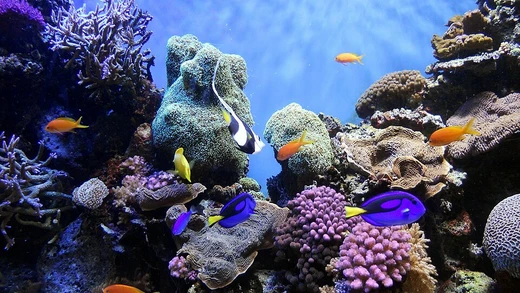
Blue-spotted spinefoot
A venomous rabbitfish with blue spots, found in Indo-Pacific coral reefs.

The blue-spotted spinefoot (Siganus corallinus) goes by several common names, including coral rabbitfish, coral spinefoot, ocellated spinefoot, and orange spinefoot. This marine ray-finned fish belongs to the rabbitfish family, Siganidae, and lives across the Indo-Pacific. People often catch it for food, and it sometimes ends up in home aquariums.
French zoologist Achille Valenciennes first described this species in 1835, calling it *Amphacanthus corallinus*, with type locations listed as the Seychelles and Java. Some experts split the current group into three species—*S. studeri* and *S. tetrazonus* being the others—based on slight differences in color and pattern. The Catalog of Fishes accepts *S. corallinus* and *S. studeri* as valid but not *S. tetrazonus*, while FishBase recognizes only *S. corallinus*. The specific name *corallinus* means "of coral," coming from the Seychellois Creole name *cordonnier de coral* ("coral cordwainer"), possibly referring to the fish's presence in coral-rich lagoon areas; *cordonnier* is a local term for rabbitfishes.
The body is deep and compressed, with a standard length about twice its depth. The head's dorsal profile slopes at roughly 45 degrees. Indentations in front of the eyes and behind the chin make the snout stick out noticeably. A forward-pointing spine sits in front of the dorsal fin. Juveniles under 5 cm (2.0 in) have an emarginate caudal fin, which becomes more forked with age, turning deeply forked in subadults with sharply pointed lobes. The dorsal fin has 13 spines and 10 soft rays; the anal fin has 7 spines and 9 soft rays. Maximum total length is 30 cm (12 in), though 20 cm (7.9 in) is more typical. The fish is orange-yellow overall, with small blue spots on the head, breast, and flanks, plus a dark smudge around the eye. Small juveniles have slender blue vertical lines on the flanks that break into spots as they grow.
This species has a wide Indo-West Pacific range. In the western Indian Ocean, it appears mostly around oceanic archipelagoes like the Seychelles and Maldives. In the western Pacific, it occurs from the Ryukyu and Ogasawara Islands east to New Caledonia and Vanuatu, and south to Australia.
Quick Facts
- Taxon
- Siganus corallinus
Facts from the source article.
Lore & Background
The blue-spotted spinefoot was first formally described in 1835 by French zoologist Achille Valenciennes as Amphacanthus corallinus, with type localities given as the Seychelles and Java. Some authorities recognize three species from the current taxon, including S. studeri and S. tetrazonus, based on minor differences in color and pattern, but Catalog of Fishes recognizes S. corallinus and S. studeri as valid while FishBase only recognizes S. corallinus. The specific name corallinus means 'of coral,' derived from the local Seychellois name 'cordonnier de coral' (coral cordwainer), possibly referring to its occurrence in coral-rich lagoon areas.
The species has a deep, compressed body with a standard length about twice its depth, a dorsal head profile inclined at about 45°, and a forward-pointing spine in front of the dorsal fin. Its caudal fin is emarginate in juveniles under 5 cm but becomes deeply forked in subadults. Overall color is orange-yellow with small blue spots on the head, breast, and flanks, and a dark smudge around the eye. Small juveniles have slender blue vertical lines on the flanks that break into spots as they grow.
Juveniles school in seagrass beds, moving into branching Acropora corals and forming pairs at around 6 cm. Adults are sedentary in branching coral areas but move into intertidal zones when flooded to feed. Juveniles browse epiphytic algae from seagrass leaves, while adults prefer macroalgae. The spines in the dorsal, anal, and pectoral fins contain venom glands; the venom is thermolabile (broken down by heat). Spawning is governed by water temperature and the lunar cycle, normally occurring at dusk.
Reader's Guide
The blue-spotted spinefoot is notable as a food fish and occasional aquarium fish across the Indo-Pacific. It is caught by spearfishing, set nets, and fish traps, and sold fresh in markets throughout its range, as well as captured live for the aquarium trade. Its widespread distribution spans from the western Indian Ocean (restricted to oceanic archipelagoes like the Seychelles and Maldives) to the western Pacific, including the Ryukyu and Ogasawara Islands, New Caledonia, Vanuatu, and Australia (Rowley Shoals, Scott Reefs, Ashmore Reef, northern Great Barrier Reef, and Christmas Island). The species inhabits coral reefs at depths of 1 to 30 meters, with juveniles found in seagrass beds. Its venomous spines can cause painful wounds, but the venom is heat-labile, offering a practical treatment. The taxonomic uncertainty—with some authorities splitting the species into three based on minor color differences—highlights ongoing debate in ichthyology. Its pairing behavior and reliance on branching corals for sedentary adult life underscore its ecological specificity.
Did You Know?
- Its specific name corallinus means 'of coral,' derived from the Seychellois name 'cordonnier de coral.'
- The spines in its dorsal, anal, and pectoral fins contain venom that is thermolabile (broken down by heat).
Frequently Asked Questions
What is the Blue-spotted spinefoot?
The Blue-spotted spinefoot (Siganus corallinus) is a venomous ray-finned fish in the rabbitfish family, Siganidae, also called coral rabbitfish, ocellated spinefoot, or orange spinefoot. It lives on coral reefs throughout the Indo-Pacific.
Where can I find the Blue-spotted spinefoot in the wild?
This species is found across Indo-Pacific reef habitats at depths ranging from about 1 to 30 meters. The original type localities recorded at its first description were the Seychelles and Java.
How large does the Blue-spotted spinefoot get?
Most individuals top out around 20 cm (roughly 8 inches) in total length, though the species can reach a maximum of 30 cm (12 inches). Its dorsal fin carries 13 spines followed by 10 soft rays.
Who first described the Blue-spotted spinefoot scientifically?
French zoologist Achille Valenciennes formally named the species in 1835, publishing it under the original binomial Amphacanthus corallinus. It has since been moved into the genus Siganus.
Is the Blue-spotted spinefoot dangerous to handle?
Yes; like other members of the rabbitfish family, it bears venomous spines that can inflict a painful sting if the fish is grabbed carelessly. Despite the risk, it is still regularly caught for food and occasionally kept in home aquariums.
More in Parrotfish and Rabbitfish 1-24
Spotted an error? Know more?
Reader corrections go straight into our review queue. Suggest an edit · How this site is sourced