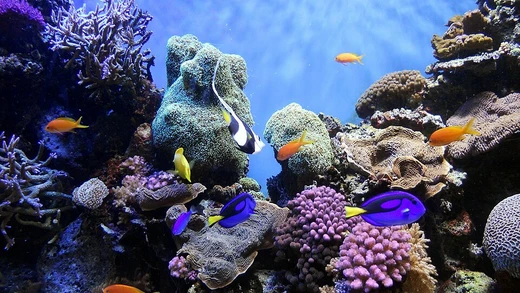
Bicolored foxface
A venomous, herbivorous rabbitfish endemic to Fiji's coral reefs.

The bicolored foxface (Siganus uspi), or Uspi rabbitfish, is a marine ray-finned fish in the family Siganidae. Its home is the coral reefs of Fiji in the Pacific Ocean, and it sometimes appears in the aquarium trade.
This species was first scientifically described in 1974 by Michael J. Gawel and David J. Woodland. They based the description on a specimen from Joske Reef, about three kilometers west of Suva on Viti Levu, Fiji. The specific name, *uspi*, adds a Latin possessive to the initials of the University of the South Pacific, acknowledging the institution's support for the authors' fish studies and thanking the people of the region who back the university.
The fish has a deep, laterally compressed body—its depth is a little more than half its standard length—and a weakly forked tail fin. The front nostril opening is a short tube that widens slightly toward the back, and a procumbent spine sits in front of the dorsal fin. Like all rabbitfishes, its dorsal fin has 13 spines and 10 soft rays, while the anal fin has 7 spines and 9 soft rays; these fin spines contain venom glands. Maximum total length reaches 24 cm (9.4 in). The body is mostly dark purplish brown, but the pectoral fins, the soft-rayed parts of the dorsal and anal fins, the tail fin, and the rear part of the body are yellow, with a clear line separating the two colors.
The bicolored foxface has only been recorded from Fiji, though unconfirmed reports mention vagrants off New Caledonia. It lives at depths of 3 to 20 meters (9.8 to 65.6 ft), in areas of hard coral on the slopes of drop-offs at reef edges or in deeper pools within reefs.
A herbivore, it feeds on seaweeds. Adults form pairs, while juveniles school. The venom in its fin spines has been studied in a related species, showing similarities to stonefish venom.
This shallow-water fish is endemic to Fiji, with a likely fragmented population that is apparently uncommon to rare. It favors coral reefs, so habitat loss in parts of its range may cause population declines. Coastal development and collection for the aquarium trade also pose threats. Due to its small range and ongoing habitat decline, the IUCN lists it as Near Threatened.
Collectors capture the bicolored foxface for the aquarium trade using drive-in nets.
Quick Facts
- Taxon
- Siganus uspi
Facts from the source article.
Lore & Background
The bicolored foxface was first formally described in 1974 by Michael J. Gawel and David J. Woodland, with the type locality given as Joske Reef, 3 kilometers west of Suva on Viti Levu, Fiji. The specific name adds a Latin possessive 'i' to the initials of the University of the South Pacific, as that institution facilitated the authors' studies and as a thank you to the people of the region who support the university.
The species has a laterally compressed deep body, with its depth fitting roughly a little over twice into its standard length, and a weakly forked caudal fin. The forward nostril opening is a very short tube that expands slightly to the rear of the nostril, and it has a procumbent spine in front of the dorsal fin. The fin spines hold venom glands. The overall colour is dark purplish brown apart from the yellow pectoral fins, soft rayed part of the dorsal and anal fins, the caudal fin, and rear part of the body, with a clear delineation between the two colours.
The bicolored foxface has only been recorded from Fiji, although there have been reports of vagrants off New Caledonia, albeit unconfirmed. It is found at depths between 3 and 20 m in areas of hard corals on the slopes of drop-offs at the reef edges or in deeper pools within the reefs. It is a herbivore that feeds on seaweeds; adults live in pairs while juveniles form schools.
Reader's Guide
The bicolored foxface is notable as a rare, endemic rabbitfish species restricted to Fiji's coral reefs, with only unconfirmed reports elsewhere. Its venomous fin spines, similar in study to stonefish venom, and its clear bicolored pattern make it distinctive. The species is assessed as Near Threatened by the IUCN due to its small range, fragmented population, and continued habitat decline from coastal development and collection for the aquarium trade using drive-in nets. Its description in 1974 by Gawel and Woodland, with a specific name honoring the University of the South Pacific, underscores its scientific and regional significance. As an uncommon to rare species favoring hard coral habitats, it may be suffering from habitat loss, and its presence in the aquarium trade adds to pressures on its population. The bicolored foxface thus represents a vulnerable component of Fiji's reef biodiversity, with conservation concerns tied to its limited distribution and human activities.
Frequently Asked Questions
What is the bicolored foxface?
The bicolored foxface (Siganus uspi) is a venomous, herbivorous rabbitfish belonging to the family Siganidae. It is endemic to the coral reefs of Fiji in the Pacific Ocean and is sometimes encountered in the aquarium trade.
Where does the bicolored foxface live and at what depth?
This species is restricted to Fiji's coral reefs, with its type locality at Joske Reef off the western coast of Viti Levu near Suva. It typically inhabits depths ranging from about 3 to 20 meters.
How big does the bicolored foxface grow?
The maximum recorded total length for Siganus uspi is roughly 24 centimeters (about 9.4 inches). Its dorsal fin carries 13 spines followed by 10 soft rays.
Who first described the bicolored foxface and why is it called 'uspi'?
Michael J. Gawel and David J. Woodland published the original scientific description in 1974, basing it on a specimen collected at Joske Reef. The specific epithet 'uspi' is a Latin possessive form of the initials of the University of the South Pacific, honoring that institution's support for the authors.
Is the bicolored foxface dangerous to handle?
Yes, like other members of Siganidae, it possesses venomous dorsal-fin spines that can deliver a painful sting to humans. Despite its venom, it is a harmless herbivore in its natural reef habitat, feeding on algae and plant material.
More in Parrotfish and Rabbitfish 1-24
Spotted an error? Know more?
Reader corrections go straight into our review queue. Suggest an edit · How this site is sourced