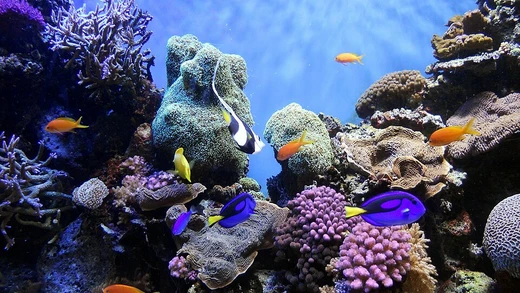
Blackeye rabbitfish
A venomous rabbitfish found in Indian Ocean coral reefs.

The blackeye rabbitfish (Siganus puelloides) is a marine ray-finned fish in the rabbitfish family, Siganidae, found in the tropical Indian Ocean.
First described in 1979 by David J. Woodland and John E. Randall, its scientific name *puelloides* refers to its resemblance to the Pacific masked spinefoot (*S. puellus*). The type specimen came from Vilingili Island in the Maldives’ Male Atoll.
This fish has 13 spines and 10 soft rays in its dorsal fin, and 7 spines and 9 soft rays in its anal fin. A forward-pointing spine is embedded in the nape, and its tail fin is deeply forked. It reaches a maximum length of 31 cm (12 in). The upper body is light blue, the lower body silvery, and the head, body, and tail base are covered in yellow spots—round on top, merging into lines below. A brown band runs across the chin.
Found in the Seychelles, Maldives, Andaman Islands, and along the Andaman Sea coasts of Myanmar and Thailand, it lives at depths of 1 to 20 m (3–66 ft) in coral reef lagoons and on outer reefs.
Usually seen in pairs, though single fish and schools occur, it differs from most rabbitfish by including animal matter in its diet—feeding on sessile colonial tunicates, sponges of the order Monaxonida, and benthic algae. Its fin spines produce venom; a study of a related species found rabbitfish venom similar to that of stonefishes.
Occasionally caught by spear fishers, any taken may be sold fresh.
Quick Facts
- Taxon
- Siganus puelloides
Facts from the source article.
Lore & Background
The blackeye rabbitfish was first formally described in 1979 by ichthyologists David J. Woodland and John E. Randall, with the type locality given as Vilingili Island, part of Male Atoll in the Maldives. Its specific name puelloides refers to its similarity to the Pacific masked spinefoot (S. puellus). The fish has 13 spines and 10 soft rays in the dorsal fin, and 7 spines and 9 soft rays in the anal fin, with a forward-pointing spine embedded in the nape and a deeply forked caudal fin. Its coloration is light blue on the upper body and silvery on the lower body, with yellow spots covering the head, body, and caudal peduncle—round on the upper body and merging into lines on the lower body—and a brown band across the chin.
Reader's Guide
The blackeye rabbitfish is found in the tropical Indian Ocean, specifically in the Seychelles, the Maldives, the Andaman Islands, and the Andaman Sea coasts of Myanmar and Thailand, at depths between 1 and 20 m in coral reef lagoons and on outer reefs. It is normally encountered in pairs, though single individuals and schools have also been recorded. Unlike most other rabbitfish, animal matter is important in its diet; it feeds on sessile colonial tunicates, sponges of the order Monaxonida, and benthic algae. The species produces venom in the spines of its fins, and a study of a congener's venom found it similar to stonefish venom. It is sometimes caught by spear fishers and sold fresh.
Did You Know?
- Its diet includes sessile colonial tunicates and sponges of the order Monaxonida.
- The venom in its fin spines is similar to that of stonefishes.
Frequently Asked Questions
Who is Blackeye rabbitfish?
The blackeye rabbitfish (Siganus puelloides) is a venomous, ray-finned marine fish in the rabbitfish family Siganidae. It was formally named in 1979 by Woodland and Randall, who based the description on a specimen collected at Vilingili Island in the Maldives' Male Atoll.
What are Blackeye rabbitfish's powers/role?
It wields venom stored in its 13 dorsal spines and 7 anal spines, making it a genuinely dangerous reef inhabitant. In its ecosystem it occupies a mid-level niche among Indian Ocean coral-reef fish, feeding and moving through the reef structure.
Why is Blackeye rabbitfish important?
As a 1979 addition to the Siganus roster, it expanded known rabbitfish diversity in the Indian Ocean and highlighted how closely related species can look across ocean basins. Its name itself—*puelloides*—acknowledges its striking resemblance to the Pacific masked spinefoot (S. puellus), making it a useful biogeographic reference.
Where does Blackeye rabbitfish live?
Its range is confined to tropical Indian Ocean waters, with the type locality at Vilingili Island in the Maldives. As a coral-reef species it is expected to inhabit shallow reef environments throughout that region.
More in Parrotfish and Rabbitfish 1-24
Spotted an error? Know more?
Reader corrections go straight into our review queue. Suggest an edit · How this site is sourced