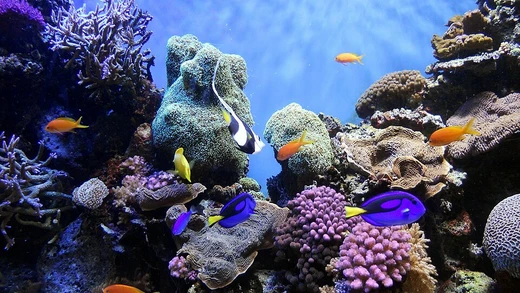
Magnificent rabbitfish
A colorful rabbitfish from the Andaman Sea, occasionally traded in aquariums.

The magnificent rabbitfish (Siganus magnificus), also called the magnificent foxface or Andaman foxface, is a marine ray-finned fish from the family Siganidae. It lives in the eastern Indian Ocean and sometimes appears in the aquarium trade. It can reach 24 cm (9.4 in) in length.
American ichthyologist Warren E. Burgess first described this species in 1977 as *Lo magnificus*, based on a specimen from Phuket, Thailand, in the Andaman Sea. He placed it in the genus *Lo* with other foxface rabbitfishes, but that genus is now considered part of *Siganus*, though some still treat it as a subgenus. The magnificent rabbitfish has an allopatric range compared to its close relative, the foxface rabbitfish (*S. vulpinus*), which is widespread in the Western Pacific. The species name *magnificus* means "splendid," referring to its vivid coloration.
The fish has an oval, compressed body and a fairly long snout. Its long dorsal fin has 13 spines and 10 soft rays, while the anal fin has 7 spines and 9 soft rays. The tail fin is slightly forked. It grows to a maximum total length of 24 cm (9.4 in), though it is rarely longer than 20 cm (7.9 in). The body is white with a large black saddle-like blotch that has fine spots along its edges. A black stripe runs across the face. The pectoral, anal, and caudal fins have bright yellow edges, and the soft-rayed part of the dorsal fin has a pale red margin.
This species is endemic to the Andaman Sea. It has been confirmed in the Mergui Archipelago (Myanmar) and the Surin and Similan Islands (Thailand), and may also occur around the Andaman and Nicobar Islands, though it has not been searched for there. Reports from Java and Sumatra need confirmation. It lives at depths of 2 to 30 m (6 ft 7 in to 98 ft 5 in) on coral reefs, most often on sheltered reefs among branching corals.
The magnificent rabbitfish eats algae and small invertebrates. Adults are often seen in pairs, while secretive juveniles are solitary and use coral for shelter. They are thought to live about 10–12 years and become sexually mature at 2 years old. Their pelagic larval stage likely means there is only a single population.
The IUCN lists the magnificent rabbitfish as Least Concern. The reefs it inhabits in Thailand are far enough offshore to be relatively safe from development, and many lie within protected areas.
Quick Facts
- Taxon
- Siganus magnificus
Facts from the source article.
Lore & Background
The magnificent rabbitfish was first formally described in 1977 as Lo magnificus by American ichthyologist Warren E. Burgess, with the type locality given as Phuket in the Andaman Sea off Thailand. Burgess placed it in the genus Lo alongside other 'foxfaced rabbitfishes,' but this genus is now subsumed within Siganus, though some workers still treat it as a subgenus. The specific name magnificus means 'splendid,' a reference to its beautiful coloration.
The fish has an oval compressed body with a relatively elongated snout. Its background color is white, broken by a large black saddle-like blotch with fine spots on its margins, and it has a black facial stripe. The pectoral, anal, and caudal fins have bright yellow margins, while the soft-rayed part of the dorsal fin has a pale red margin. It grows to a maximum total length of 24 cm, though it is rarely longer than 20 cm.
The magnificent rabbitfish is endemic to the Andaman Sea, recorded from the Mergui Archipelago in Myanmar and the Surin and Similan Islands in Thailand, and possibly around the Andaman and Nicobar Islands. Reports from Java and Sumatra require confirmation. It is found on coral reefs at depths between 2 and 30 m, most commonly on sheltered reefs among branching corals.
Reader's Guide
The magnificent rabbitfish is classified as Least Concern by the IUCN. The reefs it inhabits in Thailand are far enough offshore to be relatively safe from development, and many are in protected areas. This species is collected for the aquarium trade, though it only occasionally makes its way into that trade. Its biology includes a diet of algae and small invertebrates. Adults are frequently encountered in pairs, while secretive juveniles tend to occur solitarily and use coral for shelter. The species is thought to have a lifespan of about 10–12 years, becoming sexually mature at 2 years old. The pelagic larval stage of this species means there is likely only to be a single population. Its allopatric range relative to the closely related foxface rabbitfish (Siganus vulpinus), which has a wide Western Pacific distribution, highlights its restricted distribution in the eastern Indian Ocean.
Did You Know?
- Its specific name magnificus means 'splendid,' referring to its beautiful coloration.
- It is endemic to the Andaman Sea, with confirmed records from Myanmar and Thailand.
- Adults are frequently encountered in pairs, while juveniles are secretive and solitary.
Frequently Asked Questions
What is the magnificent rabbitfish?
The magnificent rabbitfish (Siganus magnificus) is a colorful marine ray-finned fish in the family Siganidae. It goes by the alternative common names magnificent foxface and Andaman foxface.
How large does the magnificent rabbitfish grow?
Adults can reach a total length of roughly 24 centimeters, or about 9.4 inches, placing it in the moderate size range for rabbitfishes.
Where does the magnificent rabbitfish live in the wild?
Its range is the eastern Indian Ocean, with documented occurrences in the Andaman Sea near Thailand. It is typically found at depths between 2 and 30 meters.
Who first described the magnificent rabbitfish and when?
American ichthyologist Warren E. Burgess named the species in 1977 as Lo magnificus, working from a specimen collected off Phuket, Thailand. The genus Lo is now generally treated as a subgenus nested within Siganus rather than a fully separate genus.
What are the fin-ray counts of the magnificent rabbitfish?
It bears 13 dorsal spines alongside 10 soft dorsal rays, plus 7 anal spines and 9 anal soft rays. These counts are useful for separating it from other Siganus species in the region.
More in Parrotfish and Rabbitfish 1-24
Spotted an error? Know more?
Reader corrections go straight into our review queue. Suggest an edit · How this site is sourced