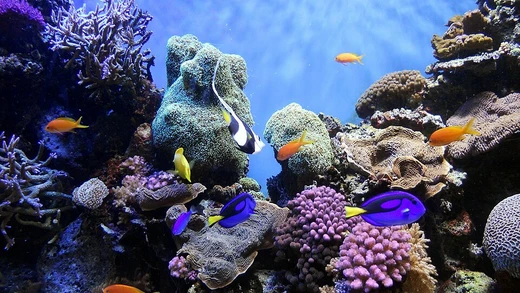
Siganus virgatus
A venomous rabbitfish with two diagonal dark bands on its head.

Siganus virgatus, also called the barhead spinefoot, doublebar rabbitfish, or doublebar spinefoot, is a marine ray-finned fish in the family Siganidae. It lives in the Indo-Pacific region.
First described in 1835 by French zoologist Achille Valenciennes as *Amphacanthus virgatus*, with Java as the type locality, its species name *virgatus* means "striped," likely referring to the two oblique brown bands on its head and front body. It is closely related to *Siganus doliatus*, and hybrids between the two occur in the Indo-Malay region.
The fish has a deep, laterally compressed body, with a depth 1.8 to 2.3 times its standard length. Its head profile bulges, and the front nostril has a tall, pointed flange. A recumbent spine sits in front of the dorsal fin. Like all rabbitfishes, it has 13 spines and 10 soft rays in the dorsal fin, and 7 spines and 9 soft rays in the anal fin; these spines contain venom glands. Juveniles have an emarginate caudal fin, while adults have a slightly forked one. Maximum total length is 30 cm, though 20 cm is more common. The body is pale with a silvery white belly, and two wide diagonal dark bands mark the head and front body. Light bluish spots and lines appear on the head and front body. The caudal and dorsal fins are yellow, and the back and caudal peduncle are normally yellow as well.
This species ranges from southern India and Sri Lanka east to West Papua and Western Australia, and north to the Ryukyu Islands. One individual was collected off the Adriatic island of Cres, likely from deliberate introduction or ship ballast. In Australia, it occurs from Ningaloo Reef and the Kimberley region in Western Australia along the northern coast to the Wessell Islands in the Northern Territory. It inhabits tropical coastal coral reefs, lagoons, and outer reefs, favoring rocky and hard coral areas with sand patches, and tolerates turbid water. Large juveniles and adults form pairs on reef slopes and in estuaries; small juveniles live in mangroves, then move to reefs in small groups, protected by corals. It is found down to 12 meters deep.
The fish is oviparous, with external fertilization and sticky eggs. Spawning happens at dusk during hot months, coinciding with the first quarter of the lunar cycle.
Quick Facts
- Taxon
- Siganus virgatus
Facts from the source article.
Lore & Background
Siganus virgatus was first formally described in 1835 as Amphacanthus virgatus by French zoologist Achille Valenciennes, with the type locality given as Java. The specific name virgatus means 'striped', presumed to refer to the two oblique brown bands on the front part of the body and head. It is closely related to Siganus doliatus, with which it has apparently hybridized in the Indo-Malay region.
The species has a deep, laterally compressed body with a bulging dorsal head profile and a recumbent spine in front of the dorsal fin. Its fin spines contain venom glands. The body is pale with a silvery white belly, two wide diagonal dark bands on the head and anterior body, and light bluish spots and lines on the head and front body. The caudal and dorsal fins are yellow, and the back and caudal peduncle are typically yellow.
Siganus virgatus is found from southern India and Sri Lanka east to West Papua and Western Australia, north to the Ryukyu Islands. An individual was collected off the Adriatic island of Cres, possibly from deliberate introduction or ballast water transport. It inhabits coastal coral reefs, lagoons, and outer reefs, frequenting rocky and hard coral areas with sand patches, and is tolerant of turbid waters. Large juveniles and adults occur in pairs on reef slopes and estuaries; small juveniles inhabit mangroves and move to reefs in small groups.
Reader's Guide
Siganus virgatus is a rabbitfish of the family Siganidae, found in the Indo-Pacific region. Its significance lies in its distinctive appearance, with two diagonal dark bands and yellow fins, and its venomous fin spines, which are characteristic of rabbitfishes. The species is primarily herbivorous, feeding on benthic macroalgae and small invertebrates, and progresses from planktonic larvae to benthic feeders. It is oviparous with external fertilization, spawning at dusk during hot months coinciding with the first quarter of the lunar cycle. The larvae are planktonic and develop a transparent post-larval stage called acronurus, remaining pelagic for an extended period before settling into adult habitats. The species is diurnal and at night sleeps in cracks, developing a brown camouflage coloration; this crypsis also occurs when stressed. Its distribution spans from southern India and Sri Lanka to West Papua and Australia, with an anomalous record in the Adriatic Sea possibly from human activity. The species is notable for its hybridization with Siganus doliatus in the Indo-Malay region, indicating close evolutionary relationships within the genus.
Did You Know?
- The specific name virgatus means 'striped', referring to the two oblique brown bands on the head and body.
- This species has venom glands in its fin spines.
More in Parrotfish and Rabbitfish 1-24
Spotted an error? Know more?
Reader corrections go straight into our review queue. Suggest an edit · How this site is sourced