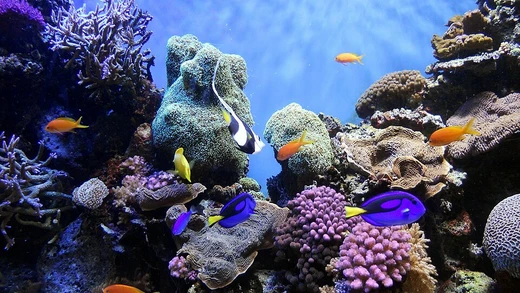
Siganus spinus
A venomous rabbitfish with labyrinthine markings, found across the Indo-Pacific.

Siganus spinus, known commonly as the little spinefoot, scribbled rabbitfish, blunt-nosed spinefoot, spiny rabbitfish, or spiny spinefoot, is a species of marine ray-finned fish belonging to the family Siganidae. It is found in the Indo-Pacific region and is notable for its venom-bearing fin spines and distinctive labyrinthine body markings.
Quick Facts
- Taxon
- Siganus spinus
Facts from the source article.
Lore & Background
Siganus spinus was first formally described in 1758 as Sparus spinus by Carl Linnaeus in the 10th edition of Systema Naturae, with the type locality given as Java. The specific name spinus means 'thorn' or 'spine', presumably referring to the forward-pointing spine in front of the dorsal fin, though it may also reference the robust, venom-bearing spines on the dorsal, anal, and pelvic fins.
The body is laterally compressed, deep, and relatively slender, with a depth 2.3 to 2.8 times its standard length. The snout is convex and blunt, and the front nostril has a long flap reaching at least two-thirds of the way to the rear nostril. The body is covered in a labyrinthine pattern of thin brown markings, with mottled fins and often 4–5 irregular light-colored bars on the caudal peduncle. The caudal fin is emarginate in juveniles and truncate in adults.
This species lives in small schools of fewer than 10 individuals, though juveniles gather in larger groups. Younger fish graze on fine-textured algae, shifting to coarser algae as they grow, and are diurnal feeders throughout life. The venom in its fin spines is similar to that of stonefishes, as indicated by a study of a congener.
Reader's Guide
Siganus spinus holds significance in both ecological and human contexts. Ecologically, it inhabits shallow coral reef flats and can occur in rivers, with juveniles aggregating in corals that have algae growing at their bases. Its feeding habits shift from fine to coarse algae as it matures, playing a role in algal control on reefs. The species is largely avoided by spear fishers in Guam, but elsewhere it appears frequently, albeit in small numbers, in fish markets where fishers use spears or fish traps. Commercially, the fry are targeted in some areas as they migrate inshore and are preserved in brine or made into fish paste; both adults and fry are also eaten fresh. Additionally, Siganus spinus appears in the aquarium trade. Its venomous spines, similar to those of stonefishes, contribute to its notoriety and caution in handling. The species' wide Indo-Pacific distribution and its presence in diverse habitats underscore its adaptability and importance in local fisheries and the ornamental trade.
Did You Know?
- Siganus spinus was first described by Carl Linnaeus in 1758 as Sparus spinus.
- This species has venom glands in its fin spines, and its venom is similar to that of stonefishes.
- Juveniles aggregate in larger numbers in corals with algae growing at their bases.
More in Parrotfish and Rabbitfish 1-24
Spotted an error? Know more?
Reader corrections go straight into our review queue. Suggest an edit · How this site is sourced