Siganus labyrinthodes
A little known rabbitfish with venomous spines and blue line markings.

Siganus labyrinthodes, the labyrinth spinefoot, is a poorly understood marine ray-finned fish from the rabbitfish family Siganidae. Its range covers the eastern Indian Ocean and western Pacific, but it has only been confirmed in Indonesia, around Java and the Moluccas, and may be overlooked elsewhere. This coastal reef dweller lives at depths of 1 to 10 meters.
The species was first formally described in 1853 by Dutch ichthyologist Pieter Bleeker, who named it *Teuthis javus* based on a specimen from Jakarta, Java. The specific name *labyrinthodes* means "labyrinth-like," possibly referring to the intricate pattern of lines on its head and flanks, though Bleeker never explained the choice.
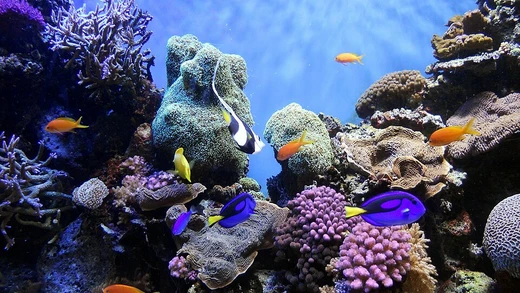
The labyrinth spinefoot has an oblong, laterally compressed body about 2.5 times as long as it is deep, with a slightly forked tail fin. Like all rabbitfish, its dorsal fin has 13 spines and 10 soft rays, and its anal fin has 7 spines and 9 soft rays. It reaches a maximum total length of 25 cm. The upper body is golden red, fading to a paler belly. The head, back, and sides are covered with many fine blue lines that can be wavy, net-like, horizontal, or transverse.
Little is known of its biology. It is thought to form schools, though pairs have been seen on shallow coastal reefs. Its teeth suggest it is herbivorous. The fin spines are thick and contain venom glands.
Quick Facts
- Taxon
- Siganus labyrinthodes
Facts from the source article.
Lore & Background
Siganus labyrinthodes was first formally described in 1853 as Teuthis javus by the Dutch physician and ichthyologist Pieter Bleeker, with the type locality given as Jakarta, Java in Indonesia. The specific name labyrinthodes means 'labyrinth like'; Bleeker did not explain this, but it may be a reference to the pattern of lines on the head and sides. The species has an oblong shaped, laterally compressed body, with a length that is around 2.5 times its depth. The caudal fin is emarginate. The upper body is golden red with a paler lower body, and the head, back and flanks are marked with many slender blue lines which vary in form, including ones which are undulating, reticulating, transverse and horizontal. It attains a maximum total length of 25 cm (9.8 in).
Reader's Guide
Siganus labyrinthodes is a little known species with a restricted distribution, recorded only from Java and the Moluccas in Indonesia, although it may be overlooked elsewhere. It is a coastal species associated with reefs at depths between 1 and 10 m. The species is thought likely to aggregate in schools, although pairs have been recorded on coastal reefs in shallow waters. Its teeth suggest that it is herbivorous. The fin spines are robust and contain venom glands, a characteristic shared with other rabbitfishes. Despite its venomous spines, the species is not well documented in the scientific literature, and its full range and ecology remain uncertain. Its notable blue line patterns and golden red coloration make it visually distinctive among rabbitfishes.
More in Parrotfish and Rabbitfish 1-24
Spotted an error? Know more?
Reader corrections go straight into our review queue. Suggest an edit · How this site is sourced