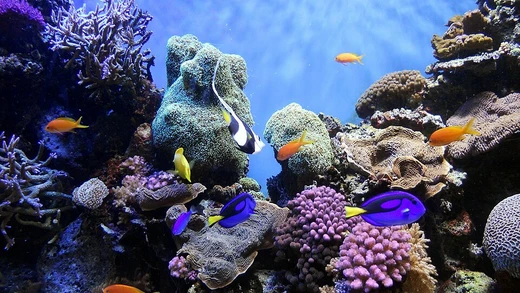
Rabbitfish
Venomous, herbivorous reef fish with a unique pelvic fin structure.

Rabbitfishes or spinefoots, genus Siganus, are perciform fishes in the family Siganidae, the only extant genus in that family with 29 species. They are native to shallow waters in the Indo-Pacific, though two species have become established in the eastern Mediterranean via Lessepsian migration. Rabbitfishes are commercially important food fish and can be used in dishes such as bagoong.
Quick Facts
- Taxon
- Siganus
- Type Species
- Siganus rivulatus
- Type Species Authority
- Fabricius, 1775
Facts from the source article.
Lore & Background
The genus Siganus was described in 1775 by Danish zoologist Johan Christian Fabricius, based on notes by naturalist Peter Forsskål from the Danish Arabia expedition, published by Carsten Niebuhr. The name Siganus is a latinisation of the Arabic name for the marbled rabbitfish in Yemen, Sidjan, meaning 'rabbitfish'. In some obsolete classifications, species with prominent face stripes—called foxfaces—were placed in the genus Lo.
Rabbitfishes have laterally compressed, oval bodies, a very small mouth with incisor-like teeth forming a beak, and a unique pelvic fin structure with 2 spines and 3 soft rays. They have venomous spines in the dorsal and pelvic fins, with venom similar to that of stonefish in at least three species. The sting is painful but generally not medically significant in healthy adults.
All rabbitfish are diurnal; some live in schools, others solitary. They sleep in reef crevices at night and are primarily herbivorous, feeding on benthic algae, though some species have been observed eating jellyfish, comb jellies, or prawns, indicating opportunistic omnivory. They lay adhesive eggs, and some species live as monogamous pairs.
Reader's Guide
Rabbitfishes hold significance as commercially important food fish, particularly the schooling species, with catch sold fresh or processed into fish paste. Some species are used in aquaculture, and colorful ones appear in the aquarium trade. Their venom, while painful, is not medically significant for healthy adults. Hybridization has played a role in their evolution, as shown by DNA comparisons; evidence exists of interbreeding between several species pairs, and one individual was found to be a backcross hybrid between a blue-spotted spinefoot and a masked spinefoot. Taxonomic uncertainty remains: some presumed species may be color morphs of a single species, while the blue-spotted spinefoot may represent more than one species. A 2007 study outlined a possible split of the genus into three groups, but names are not established because the placement of the type species is unknown. Rabbitfish also contribute to bioinvasion through ichthyochory, the live passage of benthic organisms in their guts.
Did You Know?
- Two Red Sea species, S. rivulatus and S. luridus, have invaded the Mediterranean Sea via Lessepsian migration through the Suez Canal.
- Some rabbitfish species have been reported to be hallucinogenic.
More in Parrotfish and Rabbitfish 1-24
Spotted an error? Know more?
Reader corrections go straight into our review queue. Suggest an edit · How this site is sourced