Masked spinefoot
A venomous rabbitfish with blue lines and a black eye band.

The masked spinefoot (Siganus puellus) is a marine ray-finned fish from the family Siganidae. It goes by many common names, including masked rabbitfish, bluelined rabbitfish, blue-lined spinefoot, decorated rabbitfish, and maiden spinefoot. This species lives in the shallow, coral-rich waters of clear lagoons and seaward reefs across the Indo-West Pacific region.
German zoologist Hermann Schlegel first formally described the masked spinefoot in 1852, naming it *Ampacanthus puellus*. The type locality is Ternate in the Molucca Islands, Indonesia. The specific name *puellus* means "a small boy," though Schlegel did not explain his choice.
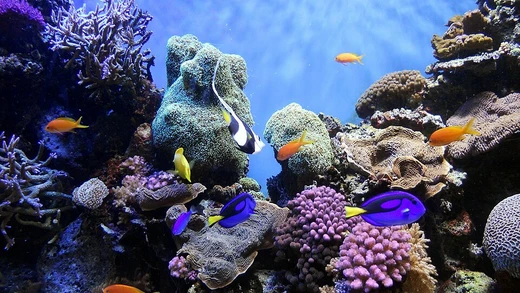
The fish has a compressed body, with its depth fitting 2.3 to 2.6 times into its standard length. Its head is symmetrical and wedge-shaped, with a slightly protruding snout. The front nostril has a flange that grows into a triangular flap pointing backward. A recumbent spine sits in front of the dorsal fin. Like all rabbitfishes, it has 13 spines and 10 soft rays in the dorsal fin, and 7 spines and 9 soft rays in the anal fin. These fin spines are robust and contain venom glands. The caudal fin is strongly forked, especially in adults, with sharply pointed lobes. Maximum total length is 38 cm (15 in), though 25 cm (9.8 in) is more typical. The upper body is yellow, shading to light blue and then white on the lower body. Sinuous blue lines run vertically near the head and horizontally toward the tail, replaced by blue spots on the abdomen. A broad diagonal black band runs through the eye, extending from the chin to the nape; above the eye, this band breaks into black spots. The fins are yellow.
The masked spinefoot has a wide Indo-West Pacific range, from the Cocos-Keeling Islands and the outer reefs of northwestern Australia, through Indonesia, to the Ryukyu Islands and Kiribati, and south to the Great Barrier Reef and New Caledonia. It lives in shallow waters down to 30 m (98 ft), in clear lagoons rich in corals and on seaward reefs.
Juveniles school, especially over areas dominated by branching *Acropora* corals. Adults live in pairs on the reef, forming pairs when they reach about 7 cm (2.8 in) in length and moving into deeper water near drop-offs. Juveniles feed on filamentous algae, while adults eat macroalgae and sponges of the order Monaxonida.
Quick Facts
- Taxon
- Siganus puellus
Facts from the source article.
Lore & Background
The masked spinefoot was first formally described in 1852 as Ampacanthus puellus by German zoologist Hermann Schlegel, with the type locality given as Ternate in the Molucca Islands, Indonesia. The specific name puellus means 'a small boy', though Schlegel did not explain why he chose that name.
This species has a compressed body, a symmetrical wedge-shaped head with a slightly protruding snout, and a recumbent spine to the front of the dorsal fin. Its upper body is yellow shading to light blue to white on the lower body, marked with sinuous blue lines that are vertical towards the head and horizontal towards the tail, replaced with blue spots towards the abdomen. A broad diagonal black band runs through the eye and extends from the chin to the nape, breaking up into black spots over the eye. The fins are yellow. The fin spines are robust and hold venom glands; a study of a congener found rabbitfish venom similar to stonefish venom.
Juveniles school, especially over areas dominated by Acropora branching corals, while adults live in pairs on the reef, pairing starting at lengths around 7 cm (2.8 in) when they move into deeper water near drop offs. Juveniles feed on filamentous algae, adults on macroalgae and sponges of the order Monaxonida.
Reader's Guide
The masked spinefoot is notable as a venomous reef fish with a wide Indo-West Pacific distribution, from the Cocos-Keeling Islands and Western Australia through Indonesia to the Ryukyu Islands, Kiribati, the southern Great Barrier Reef, and New Caledonia. It inhabits shallow, coral-rich areas of clear lagoons and seaward reefs down to 30 meters. Its distinctive coloration—yellow body with sinuous blue lines, blue spots on the abdomen, and a broad black band through the eye—makes it recognizable among rabbitfishes. The species is caught by spearfishing and in fish traps, appearing regularly in fish markets in small amounts, and occasionally in the aquarium trade. Its venomous spines, similar in composition to stonefish venom, contribute to its defensive biology. The pairing behavior starting at about 7 cm and the shift from schooling juveniles to paired adults reflect its life history on coral reefs.
Did You Know?
- The masked spinefoot was first described in 1852 by German zoologist Hermann Schlegel.
- Adults pair starting at lengths around 7 cm (2.8 in) and move into deeper water near drop offs.
Frequently Asked Questions
Who is Masked spinefoot?
The masked spinefoot (Siganus puellus) is a venomous, ray-finned fish in the rabbitfish family (Siganidae), found in shallow coral-rich lagoons and seaward reefs across the Indo-West Pacific. It is also called masked rabbitfish, bluelined rabbitfish, decorated rabbitfish, or maiden spinefoot.
What are Masked spinefoot's powers or role?
Like every member of the Siganidae family, the masked spinefoot stores venom in its fin spines, making it a genuinely dangerous fish to handle. Ecologically it acts as a reef grazer, cropping algae off coral surfaces and helping keep the lagoon and reef community in balance.
Why is Masked spinefoot important?
By continuously grazing algae on coral structures, it helps preserve the living reef framework that countless other species depend on. Its venomous spines also serve as a built-in anti-predator defense, shaping the food-web dynamics of Indo-West Pacific reef communities.
What are Masked spinefoot's physical traits?
It has a laterally compressed body with a depth-to-standard-length ratio of about 2.3 to 2.6, and its fin formula includes 13 dorsal spines, 10 dorsal soft rays, and 7 anal spines. The most eye-catching features are the network of blue lines across the flanks and a bold dark band through the eye that gives the fish its 'masked' nickname.
More in Parrotfish and Rabbitfish 1-24
Spotted an error? Know more?
Reader corrections go straight into our review queue. Suggest an edit · How this site is sourced