
Frisia
Cross-border cultural region of the Frisian people in Northwestern Europe.

Gouwenaar · CC BY-SA 4.0
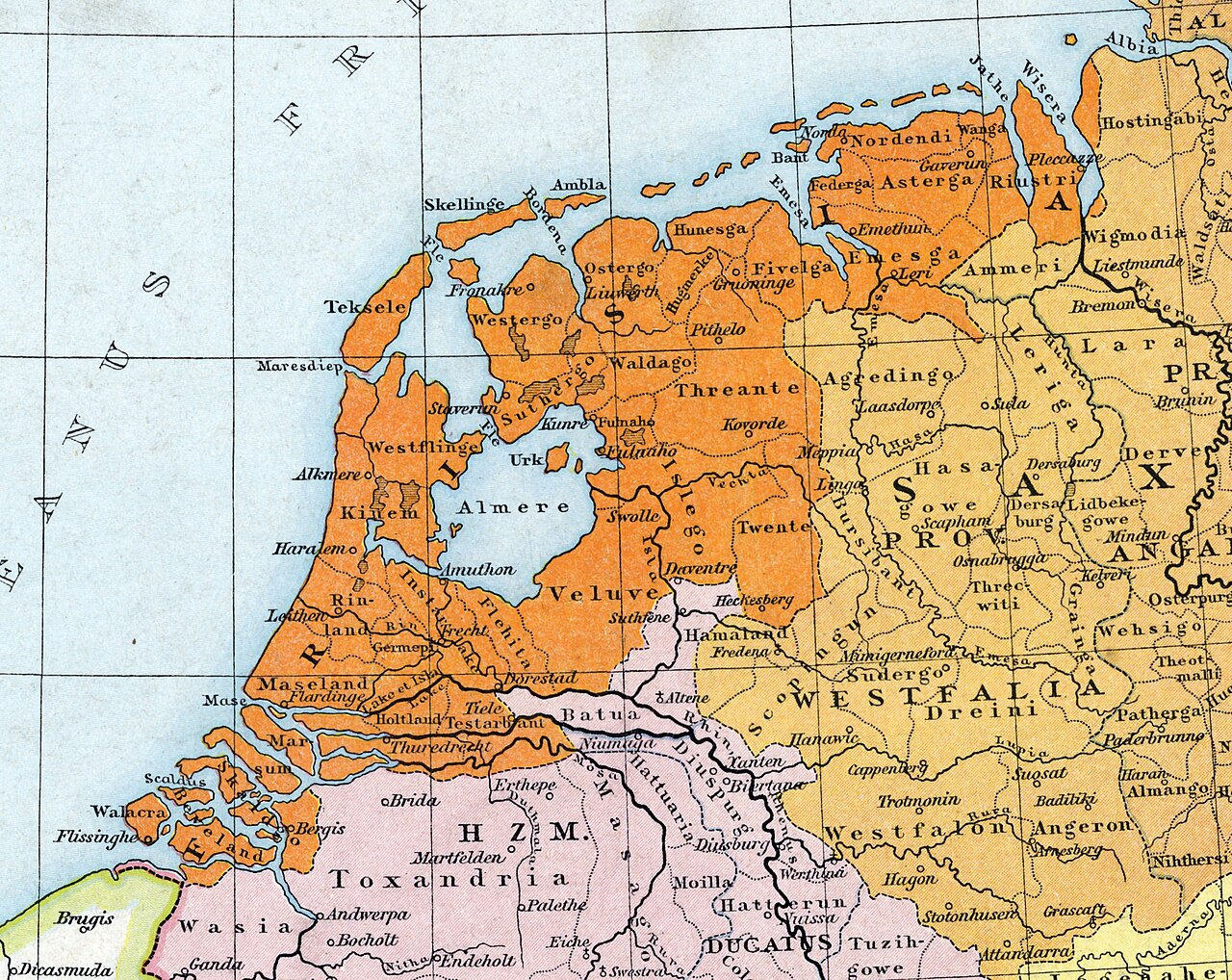
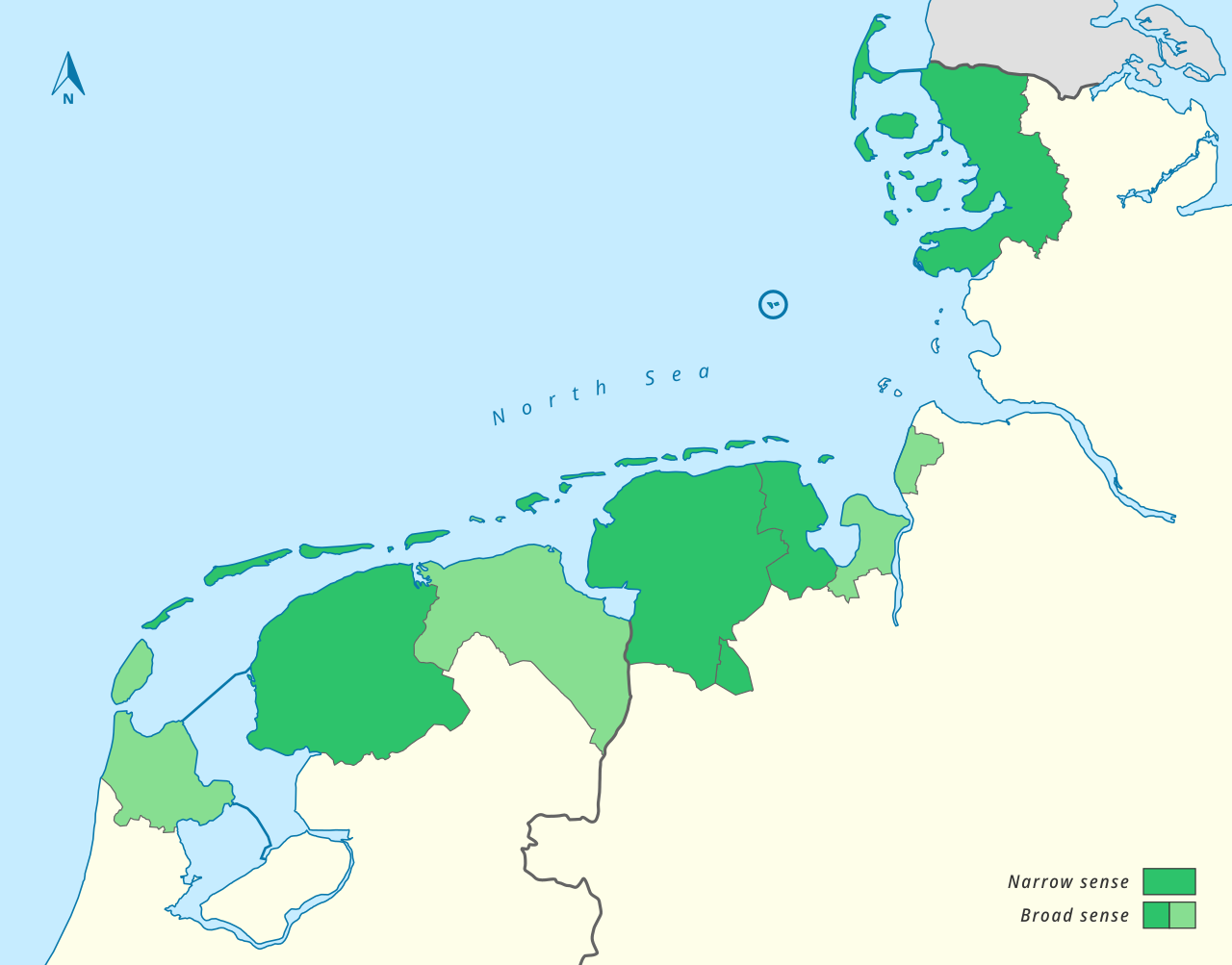
Frisia is a cross-border cultural region in Northwestern Europe, stretching along the Wadden Sea and encompassing the north of the Netherlands and parts of northwestern Germany. Wider definitions may include the Danish Wadden Sea Islands. The region is traditionally inhabited by the Frisians, a West Germanic ethnic group, and is commonly divided into three sections: West Frisia, East Frisia, and North Frisia. The name "Frisia" originates from a Latin ethnonym for ancient tribes in northwestern Germany, possibly derived from a Proto-Germanic word meaning "curly" or "crisp," likely referring to their hair. The people later known as Frisii began settling the area in the 6th century BC, living on man-made hills called terps during Roman times, according to Pliny the Elder. During the Early Middle Ages, Frisian presence extended from northwestern Flanders to the Weser River estuary, though archaeological evidence suggests these were descendants of Anglo-Saxon immigrants rather than the earlier Frisii. By the 8th century, ethnic Frisians colonized coastal areas north of the Eider River under Danish rule. The region is divided into West Frisia, roughly corresponding to the Dutch province of Friesland, with broader definitions including West Friesland and the Ommelanden; East Frisia in Lower Saxony, Germany, encompassing historical East Frisia, Oldenburger Friesland, and the Saterland; and North Frisia in Schleswig-Holstein, Germany, including the district of Nordfriesland and Heligoland, stretching from the Eider River to the Danish border. The North Frisian Islands are part of this section, where North Frisian language varieties are spoken.
- Location
- Northwestern Europe (Netherlands and Germany)
- Inhabitants
- Frisians (West Germanic ethnic group)
- Subdivisions
- West Frisia, East Frisia, North Frisia
- Historical Period
- 6th century BC to present
- Key Language
- Frisian languages (West, East, North)
Lore & Background
Frisia is a cross-border cultural region in Northwestern Europe, stretching along the Wadden Sea and encompassing the north of the Netherlands and parts of northwestern Germany, with wider definitions including the Danish Wadden Sea Islands. The region is traditionally inhabited by the Frisians, a West Germanic ethnic group. The name derives from Latin, used for ancient tribes in modern-day Northwestern Germany, possibly from a Proto-Germanic word meaning "curly" or "crisp," referring to hair. Frisia is commonly divided into three sections: West Frisia in the Netherlands, corresponding roughly to the province of Friesland and including West Friesland and the Ommelanden; East Frisia in Lower Saxony, Germany, including historical East Frisia, Oldenburger Friesland, and the Saterland; and North Frisia in Schleswig-Holstein, Germany, including the district of Nordfriesland and Heligoland. The region's history includes settlement by the Frisii from the 6th century BC, with Roman-era inhabitants living on man-made terps. During the Early Middle Ages, Frisian presence extended from Northwestern Flanders to the Weser River, though these were likely Anglo-Saxon descendants. The nascent Frisian languages were spoken along the southern North Sea coast. In the 7th and 8th centuries, Frankish chronologies mention a kingdom of the Frisians, though archaeological evidence suggests small, short-lived petty kingdoms. Early Frisian society had four social classes, including free Frisians and tenants known as laten. The basic land-holding unit for taxes and military contributions was the ploegg or teen, pledged to supply ten men for the army.
Reader's Guide
Frisia's significance lies in its enduring cultural identity and historical role as a distinct region within Northwestern Europe. The Frisians maintained a unique social structure, with early records naming four social classes: ethelings, frilings, laten, and slaves. The basic land-holding unit for taxes and military contributions was the ploegg or teen, which formed units collectively responsible for supplying armed men. The establishment of the Frisian trade network played a significant role in maintaining regional peace during the late Middle Ages, as Northern Europe and especially Frisia managed to keep low levels of violence due to its well-developed society and established rule of law. The region's legacy includes the survival of Frisian languages in three distinct areas, and the historical concept of 'Frisian freedom' that resisted feudal domination. The Upstalsboom League exemplified this resistance, though not all Frisian districts participated. Today, Frisia remains a cross-border cultural region, with its subdivisions reflecting historical and linguistic differences.
Did You Know?
- The name 'Frisia' stems from Latin Frisii, possibly from Proto-Germanic *frisaz meaning 'curly, crisp', referring to the hair of the tribesmen.
- During the French occupation of the Netherlands, the name for the Frisian department was Frise.
- The Byzantine Procopius described three peoples living in Great Britain: Angles, Frisians, and Britons.
A Coastline Divided into Three
Frisia is not a single nation or administrative unit but a cultural landscape that straddles the border between the Netherlands and Germany, hugging the Wadden Sea coastline in Northwestern Europe. Its core stretches across the northern Dutch provinces and the northwestern reaches of Germany, though broader definitions extend the concept to include Rømø and other Danish Wadden Sea islands. The people who have traditionally called this stretch of coast home are the Frisians, a West Germanic ethnic group whose identity is woven into the salt-air and tidal flats of the region. The region is conventionally split into three parts. West Frisia centers on the Dutch province of Friesland, though a wider reading pulls in West Friesland in North Holland and the Ommelanden of Groningen. East Frisia occupies Lower Saxony, covering the historical districts around Aurich, Leer, Wittmund, and Emden, as well as Oldenburger Friesland and the small municipality of Saterland. North Frisia lies in Schleswig-Holstein, spanning the Nordfriesland district and the Heligoland archipelago, running from the Eider River southward to the Danish frontier.
Curly, Crisp: The Name Behind the Name
The word Frisia traces back to the Latin ethnonym Frisii, a label the Romans applied to a cluster of ancient tribes dwelling in what is now northwestern Germany. Scholars suspect the term is a borrowing from Proto-Germanic *frisaz, a word meaning curly or crisp, most likely a reference to the distinctive hair of the tribal men. Whether that etymology is ultimately correct remains a matter of linguistic debate, but it gives the region's name a vivid, almost tactile quality. The name also shifts meaning depending on where you stand. On the North Frisian islands, locals use Frisia and Frisians not for themselves but for the inhabitants of the mainland portion of North Frisia. In the Saterland Frisian language, the word Fräislound points specifically to Ostfriesland rather than to the whole of East Frisia. During the French occupation of the Netherlands, the Frisian department was simply called Frise, a shortened French rendering that lingered in administrative records. These layered usages show that Frisia has never been a single, fixed label; it is a name that bends to local perspective and political circumstance.
Terps and Tides: Frisia in Roman Memory
The Frisii are recorded as having settled the coastal lands that would become Frisia as early as the sixth century BC, making them one of the earliest documented peoples of the North Sea littoral. The Roman naturalist Pliny the Elder noted that the Frisians, or more precisely their close neighbors the Chauci, lived on terps, artificial mounds raised above the marsh and tidal zone to keep dry feet in a landscape perpetually threatened by the sea. Other ancient sources paint a wider picture, placing the Frisians along a broad expanse of the North Sea shore, which some writers called the Frisian Sea. At the height of Roman-era Frisia, the territory is thought to have encompassed the areas that are now the provinces of Friesland and Groningen, the northern part of North Holland, and even stretches of South Holland. This suggests a people whose world was defined less by political borders than by the rhythm of the tides and the shared challenge of holding ground against the water. The terps, those humble hills of packed earth, remain a powerful symbol of that ancient negotiation between human settlement and an unforgiving coastline.
Free Frisians and the Ploegg: A Social Order of Their Own
The earliest Frisian records outline a society of four social strata. At the top stood the ethelings, termed nobiles in Latin sources, followed by the frilings. Together they formed the Free Frisians, the only class whose members could bring legal claims before a court. Below them were the laten or liten, tenant farmers working land they did not own, bound to it in a manner resembling serfdom yet retaining the possibility of buying their freedom. The lowest tier, slaves, faded during the Early Middle Ages, absorbed into the laten as formal slavery evaporated rather than being formally abolished. The basic unit of landholding, taxation, and military duty was the ploegg, cognate with plow, or the teen, related to tithing. A teen was pledged to supply ten men for the heer, the local army, and its members bore collective responsibility for one another. The ploegg, called the rott in East Frisia, originally grew from a single kinship whose men fought under a shared chief; in medieval times it became a looser union of neighbors. Several ploeggs, often three, formed a burar, whose members jointly managed common pasturage and maintained local roads.
Gallery
More in Other European Regions 1-23
Spotted an error? Know more?
This is a living reference — every entry is fact-audited, and reader corrections feed straight into our audit queue. Suggest an edit · See this site's audit record