Cahn–Ingold–Prelog priority rules
Standard process for naming stereoisomers of organic molecules.
Last updated

T.vanschaik · CC BY-SA 4.0
The Cahn–Ingold–Prelog (CIP) priority rules are a standard process to name a stereoisomer of a molecule completely and unequivocally.[1] The system assigns an R or S descriptor to each stereocenter and an E or Z descriptor to each double bond.[1]
Quick Facts
- Field
- Organic chemistry
- Known for
- CIP sequence rules for stereoisomer nomenclature
Facts from the source article.
Key facts and history
The method was originated by three chemists: R.S. Cahn, C. Ingold, and V. Prelog.[2] The key article setting out the CIP sequence rules was published in 1966.[3] That article was followed by further refinements before it was incorporated into IUPAC rules in 1974.[3] The IUPAC presentation notes that "the method has been developed to cover all compounds with ligancy up to 4... and... ligancy 6"[4]
The IUPAC documentation includes the caution that "it is essential to study the original papers, especially the 1966 paper, before using the sequence rule for other than fairly simple cases"[4] A recent paper argues for changes to sequence rules 1b and 2 to address certain molecules for which correct descriptors were unclear.[5] In rare cases, two different stereoisomers of the same molecule can have the same CIP descriptors.[5]
What the research sources say
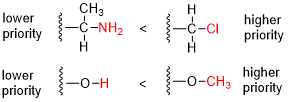
The Chemistry LibreTexts account states that substituents must be prioritized by examining the atoms directly attached to the stereocenter.[2] The same source notes that hydrogen is the lowest possible priority substituent because it has the lowest atomic number.[2] When dealing with isotopes, the atom with the higher atomic mass receives higher priority.[2] The Master Organic Chemistry account explains that "phantom atoms" are used solely for determining CIP priority and have no chemical meaning.[6]
That account also states that when atomic numbers are the same, ties are broken by assigning highest priority to higher atomic weights.[6] The Chemistry LibreTexts account describes that if none of the atoms connected at the same point has a greater atomic number, the chain bonded to the same atom multiple times has greater priority.[2]
References
- Wikipedia, "Cahn–Ingold–Prelog priority rules" (CC BY-SA 4.0), which cites: March, "March's advanced organic chemistry : reactions, mechanisms, and structure", Wiley-Interscience, 2007, p. 155–162; Cross, "Rules for the Nomenclature of Organic Chemistry: Section E: Stereochemistry (Recommendations 1974)", IUPAC Secretariat, 1974 (we also read that source) en.wikipedia.org
- "3.6 Cahn-Ingold Prelog Rules", Chemistry LibreTexts, 2014-08-05. facts only, no text reused. chem.libretexts.org
- Wikipedia, "Cahn–Ingold–Prelog priority rules" (CC BY-SA 4.0), which cites: Cahn, R.S., "Specification of Molecular Chirality", Angewandte Chemie International Edition, 1966, p. 385–415; Prelog, V., "Basic Principles of the CIP-System and Proposals for a Revision", Angewandte Chemie International Edition, 1982, p. 567–58; Cross, "Rules for the Nomenclature of Organic Chemistry: Section E: Stereochemistry (Recommendations 1974)", IUPAC Secretariat, 1974; (we also read that source) en.wikipedia.org
- Wikipedia, "Cahn–Ingold–Prelog priority rules" (CC BY-SA 4.0), which cites: Cross, "Rules for the Nomenclature of Organic Chemistry: Section E: Stereochemistry (Recommendations 1974)", IUPAC Secretariat, 1974; Cross, "Rules for the Nomenclature of Organic Chemistry: Section E: Stereochemistry (Recommendations 1974)", IUPAC Secretariat, 1974 (we also read that source) en.wikipedia.org
- Wikipedia, "Cahn–Ingold–Prelog priority rules" (CC BY-SA 4.0), which cites: Hanson, "Algorithmic Analysis of Cahn-Ingold-Prelog Rules of Stereochemistry: Proposals for Revised Rules and a Guide for Machine Implementation", Journal of Chemical Information and Modeling, 30 July 2018, p. 1755–1765; Mayfield, "Comparing CIP implementations: The need for an open CIP", October 2022 (original not read by us) en.wikipedia.org
- Ashenhurst, "Assigning Cahn-Ingold-Prelog (CIP) Priorities (2) - The Method of Dots", Master Organic Chemistry, 2017-01-17. facts only, no text reused. masterorganicchemistry.com
Each numbered sentence above was checked against the source it cites before publication. Sentences citing Wikipedia adapt text from the English Wikipedia article Cahn–Ingold–Prelog priority rules (contributors), used under CC BY-SA 4.0; this entry is available under the same licence. Other sources were used for facts only; no text or images are copied from them.
More in Organic Chemistry And Reaction Mechanisms
Sources
Compiled from Wikipedia and the sources listed below. Text from Wikipedia is available under CC BY-SA 4.0; this entry is adapted from it.
- Wikipedia: Cahn–Ingold–Prelog priority rules (CC BY-SA 4.0).
- Word definitions: the , each quoted from its Wikipedia article.
Spotted an error? Know more?
Reader corrections go straight into our review queue. Suggest an edit · How this site is sourced