Ei mechanism
Thermal syn elimination via cyclic transition state, no external reagents.
Last updated
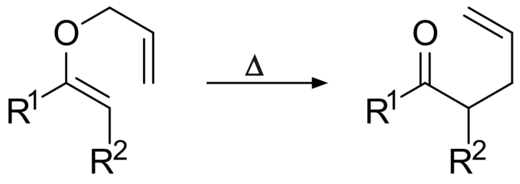
The Ei mechanism is a thermally activated elimination reaction that proceeds through a cyclic transition state without requiring additional reagents.[1] When a compound is heated alone and no other reagents are present, the elimination that proceeds through a cyclic transition state is classified as an Ei reaction.[2]
Quick Facts
- Field
- Organic chemistry
- Known for
- Thermal syn elimination via cyclic transition state, no external reagents required
- Mechanism type
- Pericyclic elimination
- Transition state sizes
- Four
- five
- or six-membered
- Product rule
- Typically follows Hofmann's rule (less substituted alkene)
Facts from the source article.
Key facts and history
Evidence supporting the Ei mechanism includes first-order kinetics and isotope studies showing partial C-H and C-N bond breaking in the transition state.[3] The Ei mechanism gives exclusively syn elimination products without intervention of other mechanisms.[3] Ei reactions typically follow Hofmann's rule, losing a β-hydrogen from the least substituted position.[1] The transition state for elimination can involve four, five, or six atoms in the ring, depending on the specific compound undergoing the reaction.[2]
The pyrolysis experiment with N,N-dimethyl-2-phenylcyclohexylamine-N-oxide illustrates how conformational effects and transition state stability influence the product composition in cyclic substrates.[4] For certain sterically hindered molecules, the Hofmann elimination can follow an Ei pathway, where an ylide intermediate is formed and then eliminates trimethylamine through a five-membered transition state.[5]
References
- Wikipedia, "Ei mechanism" (CC BY-SA 4.0), which cites: March, "Advanced Organic Chemistry", Wiley, 2007 (we also read that source) en.wikipedia.org
- Wikipedia, "Ei mechanism" (CC BY-SA 4.0), which cites: March, "Advanced Organic Chemistry", Wiley, 2007; Carey, F. A.; Sunburg, R. J. Advanced Organic Chemistry: Reaction and Synthesis, 5th Ed.; Part B; Springer: New York, 2010 (we also read that source) en.wikipedia.org
- Wikipedia, "Ei mechanism" (CC BY-SA 4.0), which cites: O’Connor, G.L.; Nace, H. R. (1953). "Further Studies on the Chugaev Reaction and Related Reactions". J. Am. Chem. Soc. 75 2118-.; Barton, D.H.R.; Head, A.J.; Williams, R.J. (1953). "Stereospecificity in Thermal Elimination Reactions. Part III. The Pyrolysis of (−)-Menthyl Benzoate". J. Che; Anslyn, E. V.; Dougherty, D. A. Modern Physical Organic Chemistry, Murdzek, J., Ed. University Science Books, 2006.; Wright, D.R.; Sims, L.B.; Fry, A. (1983). "Carbon-14 kinetic isotope effects and kinetic studies in the syn-elimination reactions of (2- en.wikipedia.org
- Wikipedia, "Ei mechanism" (CC BY-SA 4.0), which cites: Carey, F. A.; Sunburg, R. J. Advanced Organic Chemistry: Reaction and Synthesis, 5th Ed.; Part B; Springer: New York, 2010 (original not read by us) en.wikipedia.org
- Wikipedia, "Ei mechanism" (CC BY-SA 4.0), which cites: Cope, A.C.; Mehta, A.S. (1963). "Mechanism of the Hofmann Elimination Reaction: An Ylide Intermediate in the Pyrolysis of a Highly Branched Quaternary Hydroxide (original not read by us) en.wikipedia.org
Each numbered sentence above was checked against the source it cites before publication. Sentences citing Wikipedia adapt text from the English Wikipedia article Ei mechanism (contributors), used under CC BY-SA 4.0; this entry is available under the same licence. Other sources were used for facts only; no text or images are copied from them.
More in Organic Chemistry And Reaction Mechanisms
Sources
Compiled from Wikipedia and the sources listed below. Text from Wikipedia is available under CC BY-SA 4.0; this entry is adapted from it.
- Wikipedia: Ei mechanism (CC BY-SA 4.0).
- Word definitions: the , each quoted from its Wikipedia article.
Spotted an error? Know more?
Reader corrections go straight into our review queue. Suggest an edit · How this site is sourced