Diels–Alder reaction
A [4+2] cycloaddition forming six-membered rings with stereochemical control.
Last updated

Alderdiels · CC BY-SA 4.0
Otto Diels and Kurt Alder received the 1950 Nobel Prize in Chemistry for their discovery and development of the diene synthesis.[1] Their seminal work was detailed in a series of 28 articles published from 1928 to 1937.[2] The reaction is a cycloaddition governed by orbital symmetry considerations.[3] In a normal demand Diels–Alder reaction, the HOMO of the electron-rich diene interacts with the LUMO of the electron-deficient dienophile.[3]
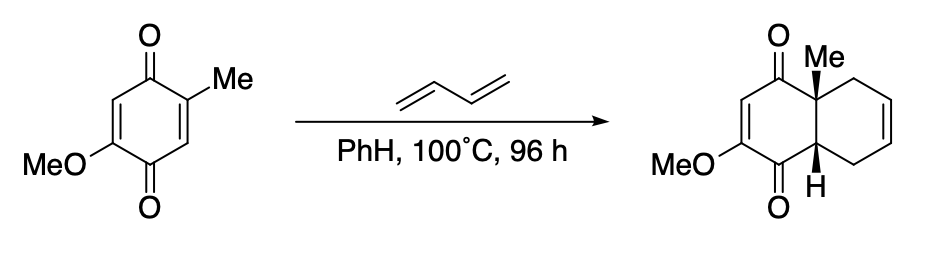
The reaction is stereospecific, with syn addition and retention of stereochemical information from both components.[4] Lewis acids such as zinc chloride and boron trifluoride can catalyze the reaction.[5] Recent studies indicate Lewis acids accelerate the reaction by reducing destabilizing steric Pauli repulsion, not by lowering the dienophile's LUMO.[6]
Quick Facts
- Field
- Organic chemistry
- Known for
- Discovery of the Diels–Alder reaction
- Nobel prize
- 1950
Facts from the source article.
What the research sources say
The Nobel Foundation's summary states the prize was awarded jointly to Otto Paul Hermann Diels and Kurt Alder "for their discovery and development of the diene synthesis"[1] A 1989 review by Kiselev and Konovalov discusses factors beyond frontier orbital interactions that affect the reaction rate.[7][8] A 1971 paper by Houk and Luskus examines the influence of steric interactions on endo stereoselectivity.[9][10] α-Chloroacrylonitrile (CH₂=CClCN) is used as a ketene equivalent in Diels–Alder reactions, as described in a 1977 paper by Ranganathan et al.[11][12]
References
- "The Nobel Prize in Chemistry 1950", The Nobel Foundation. facts only, no text reused. nobelprize.org
- Wikipedia, "Diels–Alder reaction" (CC BY-SA 4.0), which cites: Diels, "Synthesen in der hydroaromatischen Reihe, XXVIII. "Dien-Synthesen"︁ stickstoffhaltiger Heteroringe. 13. α-Picolin und Acetylen-dicarbonsäureeste", Justus Liebigs Annalen der Chemie, 1937, p. 87–98; "The Nobel Prize in Chemistry 1950", The Nobel Foundation; Berson, "Discoveries missed, discoveries made: creativity, influence, and fame in chemistry", Tetrahedron, 1992, p. 3–17 (we also read that source) en.wikipedia.org
- Wikipedia, "Diels–Alder reaction" (CC BY-SA 4.0), which cites: Carey, Part A., pp. 836–50 (original not read by us) en.wikipedia.org
- Wikipedia, "Diels–Alder reaction" (CC BY-SA 4.0), which cites: Kirmse, "Umlagerungen von 1,4,4- und 2,2,5-Trimethylbicyclo[3.2.1]oct-6-yl-Kationen", Chemische Berichte, 1991, p. 237–240; Bérubé, "Stéréosélection acyclique-1,5: Synthèse de la chaîne latérale optiquement active de la vitamine E", Bulletin de la Société Chimique de France, 1987, p. 103–115 (we also read that source) en.wikipedia.org
- Wikipedia, "Diels–Alder reaction" (CC BY-SA 4.0), which cites: Houk, "Frontier molecular orbital theory of cycloaddition reactions", Accounts of Chemical Research, 1 November 1975, p. 361–369; Fleming, "Molecular orbitals and organic chemical reactions", Wiley, 2009; Clayden, "Organic chemistry", Oxford University Press, 2012 (original not read by us) en.wikipedia.org
- Wikipedia, "Diels–Alder reaction" (CC BY-SA 4.0), which cites: Vermeeren, "How Lewis Acids Catalyze Diels–Alder Reactions", Angewandte Chemie International Edition, 6 April 2020, p. 6201–6206; Vermeeren, "Origin of rate enhancement and asynchronicity in iminium catalyzed Diels–Alder reactions", Chemical Science, 2020, p. 8105–8112; Vermeeren, "Bifunctional Hydrogen Bond Donor-Catalyzed Diels–Alder Reactions: Origin of Stereoselectivity and Rate Enhancement", Chemistry: A European Journal, 17 March 2021, p. 5180–5190; Vermeeren, "Lewis Acid-Catalyzed Diels-Alder Reactions: Reactivity Trends acr en.wikipedia.org
- Wikipedia, "Diels–Alder reaction" (CC BY-SA 4.0), which cites: Kiselev, "Factors that determine the reactivity of reactants in normal and catalysed Diels–Alder reactions", Russian Chemical Reviews, 1989 (we also read that source) en.wikipedia.org
- V. D. Kiselev, "Factors that determine the reactivity of reactants in normal and catalysed Diels–Alder reactions", Russian Chemical Reviews (1989), doi:10.1070/rc1989v058n03abeh003437. OpenAlex metadata CC0; paper not read. doi.org
- Wikipedia, "Diels–Alder reaction" (CC BY-SA 4.0), which cites: Houk, "Influence of steric interactions on endo stereoselectivity", Journal of the American Chemical Society, 1971, p. 4606–4607; Carey, Part B., pp. 474–526; Kobuke, "Role of attractive interactions in endo–exo stereoselectivities of Diels–Alder reactions", Journal of the American Chemical Society, 1972, p. 3633–3635; Williamson, "Stereochemistry of the Diels–Alder reaction. II. Lewis acid catalysis of syn-anti isomerism", Journal of the American Chemical Society, 1970, p. 7385–7389; Woodward, "The conservation of orbital symmetry en.wikipedia.org
- Kendall N. Houk, "Influence of steric interactions on endo stereoselectivity", Journal of the American Chemical Society (1971), doi:10.1021/ja00747a052. OpenAlex metadata CC0; paper not read. doi.org
- Wikipedia, "Diels–Alder reaction" (CC BY-SA 4.0), which cites: Ranganathan, "Ketene Equivalents", Synthesis, 1977, p. 289–296; Carey, Part B., pp. 474–526 (we also read that source) en.wikipedia.org
- Shoba Ranganathan, "Ketene Equivalents*", Synthesis (1977), doi:10.1055/s-1977-24362. OpenAlex metadata CC0; paper not read. doi.org
Each numbered sentence above was checked against the source it cites before publication. Sentences citing Wikipedia adapt text from the English Wikipedia article Diels–Alder reaction (contributors), used under CC BY-SA 4.0; this entry is available under the same licence. Other sources were used for facts only; no text or images are copied from them.
More in Organic Chemistry And Reaction Mechanisms
Sources
Compiled from Wikipedia and the sources listed below. Text from Wikipedia is available under CC BY-SA 4.0; this entry is adapted from it.
- Wikipedia: Diels–Alder reaction (CC BY-SA 4.0).
- Word definitions: the , each quoted from its Wikipedia article.
Spotted an error? Know more?
Reader corrections go straight into our review queue. Suggest an edit · How this site is sourced