Electrophilic addition
Addition reaction where a π bond breaks forming two σ bonds.
Last updated

V8rik ( talk ) · CC BY-SA 3.0
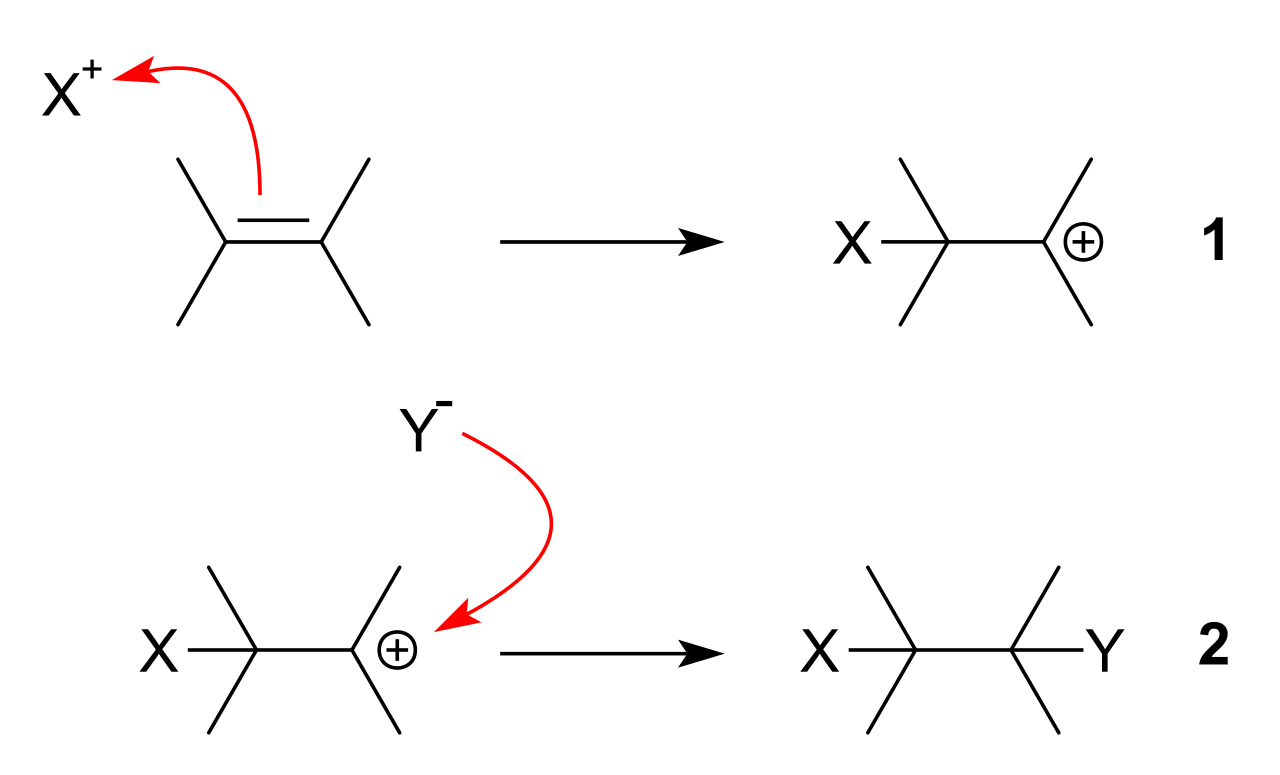
Electrophilic addition is an addition reaction in organic chemistry where a compound with a double or triple bond has a π bond broken, forming two new σ bonds.[1] The reaction involves a chemical compound containing a double or triple bond.[1]
Quick Facts
- Field
- Organic chemistry
- Key feature
- Regioselectivity often determined by Markovnikov's rule; organoborane compounds give anti-Markovnikov additions
Facts from the source article.
Key facts and history
The reaction breaks a π bond and forms two new σ bonds.[1] It is classified as an addition reaction.[1] The process occurs in organic chemistry.[1] The starting material contains a double or triple bond.[1]
The reaction is denoted as A E.[1] The third edition of that book was published by John Wiley & Sons in New York.[1]
References
- Wikipedia, "Electrophilic addition" (CC BY-SA 4.0), which cites: March, Jerry; (1985). Advanced Organic Chemistry reactions, mechanisms and structure (3rd ed.). New York: John Wiley & Sons, inc. (original not read by us) en.wikipedia.org
Each numbered sentence above was checked against the source it cites before publication. Sentences citing Wikipedia adapt text from the English Wikipedia article Electrophilic addition (contributors), used under CC BY-SA 4.0; this entry is available under the same licence. Other sources were used for facts only; no text or images are copied from them.
More in Organic Chemistry And Reaction Mechanisms
Sources
Compiled from Wikipedia and the sources listed below. Text from Wikipedia is available under CC BY-SA 4.0; this entry is adapted from it.
- Wikipedia: Electrophilic addition (CC BY-SA 4.0).
- Word definitions: the Codexery glossary, each quoted from its Wikipedia article.
Spotted an error? Know more?
Reader corrections go straight into our review queue. Suggest an edit · How this site is sourced