Matariki
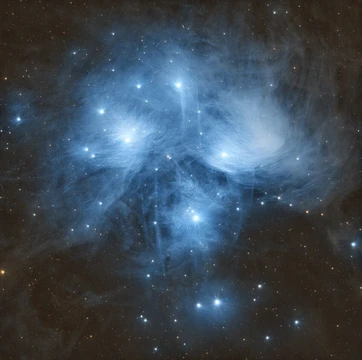
Māori name for the Pleiades, heralding the new year.
Last updated
Matariki is the Māori name for the Pleiades star cluster in the constellation Taurus. In Māori culture, its first rising in late June or early July marks the beginning of the new year in the Māori lunar calendar, and the occasion is celebrated with ceremonies that include viewing the stars for forecasts, mourning the deceased, and making food offerings.
Lore & Background
In Māori tradition, Matariki is a shortened form of 'Ngā Mata o te Ariki Tāwhirimātea', meaning 'the eyes of the god Tāwhirimātea'. According to the myth, Tāwhirimātea, the god of wind and weather, was enraged by the separation of his parents, Ranginui and Papatūānuku. Defeated in battle by his brother, he fled to the sky and in anger plucked out his eyes and flung them into the heavens, where they remain stuck to his father's chest. The unpredictability of the winds is blamed on Tāwhirimātea's blindness.
Many Māori sources, especially older ones, list seven stars in Matariki: the central star Matariki herself and six children. The emblem of the Kīngitanga movement, Te Paki o Matariki, includes Matariki flanked by three stars on each side.
The manuscript of Rāwiri Te Kōkau recognised nine stars, adding Pōhutukawa and Hiwa-i-te-Rangi. The father of Matariki's children was Rehua, identified as the star Antares. The star Pōhutukawa is associated with the departed, and Hiwa-i-te-Rangi, the youngest, is considered the 'wishing star'.
Celebration of Matariki declined during the 20th century but began a revival in the early 1990s. It was first celebrated as an official public holiday in New Zealand on 24 June 2022. Some iwi use the rise of Puanga (Rigel) or other stars to mark the new year instead of Matariki.
Reader's Guide
Matariki holds deep cultural significance as the marker of the Māori New Year, traditionally celebrated during the last quarter of the moon of the lunar month Pipiri (around June). The ceremony involved viewing the individual stars for forecasts of the year to come, mourning the deceased of the past year, and making an offering of food to replenish the stars. The star Pōhutukawa's association with the departed relates to the lone pōhutukawa tree at Te Rerenga Wairua (Cape Reinga), the departing place for spirits. Hiwa-i-te-rangi was considered the 'wishing star': Māori would rest their hopes and desires on Hiwa, and if it appeared bright and clear on the first viewing, those wishes were likely to be answered.
Traditional Māori culture was interwoven with astronomical knowledge, using constellations and the lunar cycle for navigation, planting, harvesting, and marking fish migrations. Matariki is visible for most of the year in New Zealand except for about a month in midwinter. It sets in the west in early evening in May and reappears just before sunrise in late June or early July, beginning the first month of the Māori lunar calendar, Pipiri.
Most celebration begins in the last quarter phase of the moon after the constellation's first appearance, during 3–4 nights known as 'the nights of Tangaroa', and finishes on the night before the new moon. Because Māori traditionally use a 354-day lunar calendar, the dates of Matariki vary each year. Regional variation exists: some iwi celebrate Puanga (Rigel) instead, and others use Atutahi (Canopus) or the setting of Rehua (Antares) to mark the New Year.
Did You Know?
- Matariki is sometimes incorrectly translated as 'little eyes', a mistake originating in the work of Elsdon Best.
- In Hawaii, the rising of Makali‘i on 20 November ushers in the four-month season Makahiki.
- The second Māori king, Matutaera Tāwhiao, chose Matariki as an emblem for the Kīngitanga movement.
More in Open Clusters
Sources
Compiled from Wikipedia and the sources listed below. Text from Wikipedia is available under CC BY-SA 4.0; this entry is adapted from it.
- Wikipedia: Matariki (CC BY-SA 4.0).
Spotted an error? Know more?
Reader corrections go straight into our review queue. Suggest an edit · How this site is sourced