Theta Carinae
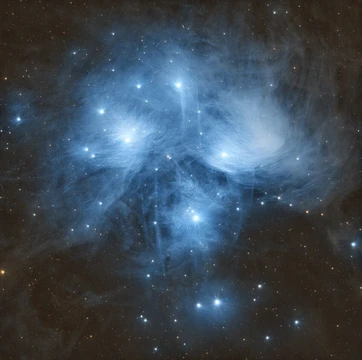
Brightest star in the Southern Pleiades cluster IC 2602.
Last updated
Theta Carinae is a binary star system located in the southern constellation Carina. Its Bayer designation, Latinized from θ Carinae, is often shortened to Theta Car or θ Car. With an apparent visual magnitude of 2.76, it shines as the brightest star in the open cluster IC 2602, commonly called the Southern Pleiades, and it also marks the northeastern tip of the Diamond Cross asterism. Based on parallax data from the Hipparcos mission, the system lies roughly 460 light-years from Earth.
In most depictions of the asterism, the nearby bright stars that trace the imaginary hull of Carina include Omega Carinae, which is about 120 light-years closer, and PP Carinae (also designated p Carinae), which lies at a similar distance to Theta.
Properties
Theta Carinae is a single-lined spectroscopic binary with an orbital period of just 2.2 days—the shortest known among massive stars. This rapid orbit suggests past mass transfer between the two components, which may explain the system’s spectral oddities.
The primary star is a blue straggler, an unusual type formed through stellar merging or interaction. The mass transfer likely originated from the less massive secondary, meaning the current primary was probably originally the smaller star. The pair is estimated to be 4 million years old, appearing much younger than the surrounding IC 2602 cluster.
The primary star has a stellar classification of B0.5 Vp, indicating it is a B-type main-sequence star fusing hydrogen in its core. The “p” suffix denotes peculiar spectral features, observed in both optical and ultraviolet light.
This star holds about 15 times the Sun’s mass and five times its radius, with an intensely hot outer atmosphere. When the primary reaches roughly 11 million years old, it will expand and begin transferring mass back to its companion. Little is known about the secondary, but it is likely an F-type star with a luminosity less than 1% of the primary’s.
Etymology
In Chinese astronomy, θ Carinae is part of an asterism called the Southern Boat, which also includes V337 Carinae, PP Carinae, β Carinae, and ω Carinae. Accordingly, θ Carinae itself is known by a specific Chinese name.
Quick Facts
- Apparent magnitude
- 2.76
- Distance
- about 460 ly
- Spectral type
- B0.5 Vp
- Mass
- about 15 times the Sun's mass
- Radius
- about 5 times the Sun's radius
- Orbital period
- 2.2 days
- Age
- 4 million years
Facts from the source article.
Lore & Background
Theta Carinae is a single-lined spectroscopic binary with a 2.2 day orbital period, the shortest known among massive stars. This short period suggests earlier mass transfer between the two components, possibly explaining the star's spectral peculiarities.
The primary star is a blue straggler, an unusual type of star created by merging or interaction between two or more stars. The source of the mass transfer is likely the less massive secondary companion, and what is now the primary star was probably originally the less massive component. The estimated age of the pair is 4 million years, and it appears much younger than the surrounding IC 2602 cluster.
The MKK stellar classification of this star is B0.5 Vp, indicating a B-type main sequence star that generates energy through nuclear fusion of hydrogen in its core. The 'p' suffix designates peculiar spectral features observed in both optical and ultraviolet wavelengths.
The primary star has about 15 times the mass of the Sun and 5 times the Sun's radius, with an intensely hot outer radiating envelope. Once the primary reaches around 11 million years old, it will expand and begin transferring its outer surface mass back to its companion. Little is known about the companion star, but it is likely an F-type star with a luminosity less than 1% of the primary.
Reader's Guide
Theta Carinae holds significance as the brightest member of IC 2602, the Southern Pleiades, and as a marker of the Diamond Cross asterism in the southern sky. Its binary nature, with the shortest known orbital period among massive stars, provides a rare laboratory for studying mass transfer and blue straggler formation. The system's peculiar spectral features and the primary's status as a blue straggler offer insights into stellar evolution through interaction and merging.
The estimated age of the pair, 4 million years, being much younger than the surrounding cluster, suggests a recent or ongoing evolutionary process. The future mass transfer back to the companion when the primary expands further highlights the dynamic life cycle of close binary systems. In Chinese astronomy, Theta Carinae is part of the Southern Boat asterism, which also includes V337 Carinae, PP Carinae, Beta Carinae, and Omega Carinae, reflecting its cultural role in traditional sky mapping.
More in Open Clusters
Sources
Compiled from Wikipedia and the sources listed below. Text from Wikipedia is available under CC BY-SA 4.0; this entry is adapted from it.
- Wikipedia: Theta Carinae (CC BY-SA 4.0).
Spotted an error? Know more?
Reader corrections go straight into our review queue. Suggest an edit · How this site is sourced