Coldwater Spring
Sacred Dakota spring and historic Army water source.
Last updated

via Wikipedia: Coldwater Spring · see source
Where it is
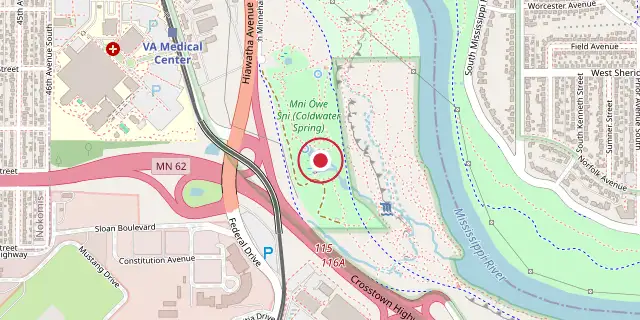
Coordinates: 44°53′56″N 93°11′46″W (44.8990, -93.1960) · Open in OpenStreetMap
Coordinates and connected clubs: the infobox of Wikipedia: Coldwater Spring (CC BY-SA 4.0). Map: drawn by Codexery from OpenStreetMap tiles.
Coldwater Spring, called Mní Ówe Sní by the Dakota people, is a sacred site in the Fort Snelling unorganized territory of Minnesota. It once served as Camp Coldwater for the U.S. Army soldiers building Fort Snelling.
The spring sits on the Mississippi River’s west bluffs, just south of Minnehaha Park and next to Fort Snelling State Park. Its waters flow year-round and never freeze in winter. The National Park Service manages the spring and its surroundings as a protected historic site and natural park within the Mississippi National River and Recreation Area.
History
For thousands of years, Dakota people have considered the spring and area around it to be a place of spiritual importance. The confluence of the Mississippi and Minnesota rivers was a neutral and sacred place where the Ojibwe, Dakota, Sauk, Meskwaki and Potowatamie tribes moved freely. In September 1805, the area was part of a 100,000-acre land purchased from the Mdewakanton Sioux Indians by Zebulon Pike. On May 5, 1820, Lieutenant Colonel Henry Leavenworth moved his troops to the spring area because their former encampment, on the Minnesota River, was causing unhealthy conditions.
Camp Coldwater
Leavenworth was succeeded by Colonel Josiah Snelling in August of that year. The soldiers lived in tents and huts on the site during three summers while they built the permanent stone fort south of the location, which was completed in 1825 and named Fort Snelling. The spring continued to supply water to the fort, first via water wagons and then via a stone water tower and underground pipes. Settlers who had left the Red River Colony settled near the spring location in 1821, but were forced to leave in 1840.
They moved down the Mississippi River and settled in what eventually became Saint Paul, Minnesota. The Coldwater area once housed blacksmith shops, stables, trading posts, a hotel, and a steamboat landing, but nearly all of those buildings were gone by the time of the American Civil War. With the re-opening of Fort Snelling during the Civil War, Coldwater Spring was once again used to supply water to the fort. In the 1880s, the Army built a formal waterworks at the site, including the extant springhouse and reservoir.
Mines research center
Following the closing of Fort Snelling after World War II, the site was turned over to the United States Bureau of Mines as their Twin Cities Research Center, where mining research was carried out for over 40 years. Several buildings were constructed in the 1960s for over 200 workers. Researchers at the site were credited with developing an air filtration system to eliminate black lung disease among coal miners, and creating a beeping device to alert people when a heavy truck is backing up.
Coldwater Spring park
The Twin Cities Research Center closed in 1996 and several buildings were left abandoned. The property was transferred to the National Park Service in 2010, and made a unit of the Mississippi National River and Recreation Area.
National Park Service crews at Coldwater Spring repaired the springhouse structure, restored the creek and wetlands, removed invasive species like buckthorn, and removed several abandoned buildings. The result was a savanna landscape said to resemble pre-settlement by European-American people. The National Park Service opened Coldwater Spring park to the public in 2012.
Recreation
The main features of Coldwater Spring park are walking paths through a tallgrass prairie, the naturally occurring spring, and the historic springhouse and reservoir. There is a .25 mi crushed limestone path from the entrance that winds through the restored savanna to the historic springhouse structure.
Beyond the springhouse, a 1 mi hiking trail crosses the creek into the nearby woodlands and connects with the multi-use Minnehaha Trail, leading northward to Minnehaha Park or southward to Fort Snelling State Park. Bird watching and wildlife viewing are popular activities for visitors. The park has limited parking and there is no visitor center or restroom facility.
Did You Know?
- Coldwater Spring flows at 144,000 gallons per day at 47 °F, remaining ice free in the winter with ducks present.
- In 2003, the Minnesota Department of Transportation welded 28,000 square yards of eight-layer synthetic liner covering approximately six acres to protect the water flow to the spring.
More in National Park Service National Recreation Areas
Sources
Compiled from Wikipedia and the sources listed below. Text from Wikipedia is available under CC BY-SA 4.0; this entry is adapted from it.
- Wikipedia: Coldwater Spring (CC BY-SA 4.0).
Spotted an error? Know more?
Reader corrections go straight into our review queue. Suggest an edit · How this site is sourced