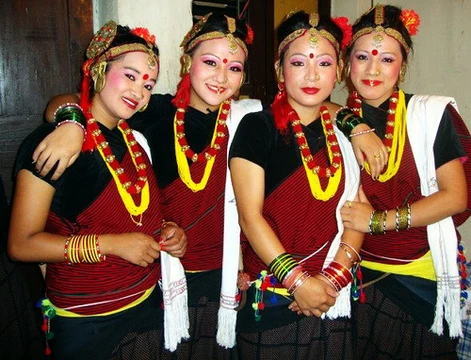
Culture of Korea
Traditional Korean culture encompasses dress, cuisine, ceramics, and lunar festivals.

Syced · CC0
The traditional culture of Korea encompasses the shared heritage that existed before the country’s division in 1945. Since the mid-20th century, the split into North and South Korea has created observable cultural differences. Before the Joseon period, Korean shamanism was a deeply embedded part of the culture.
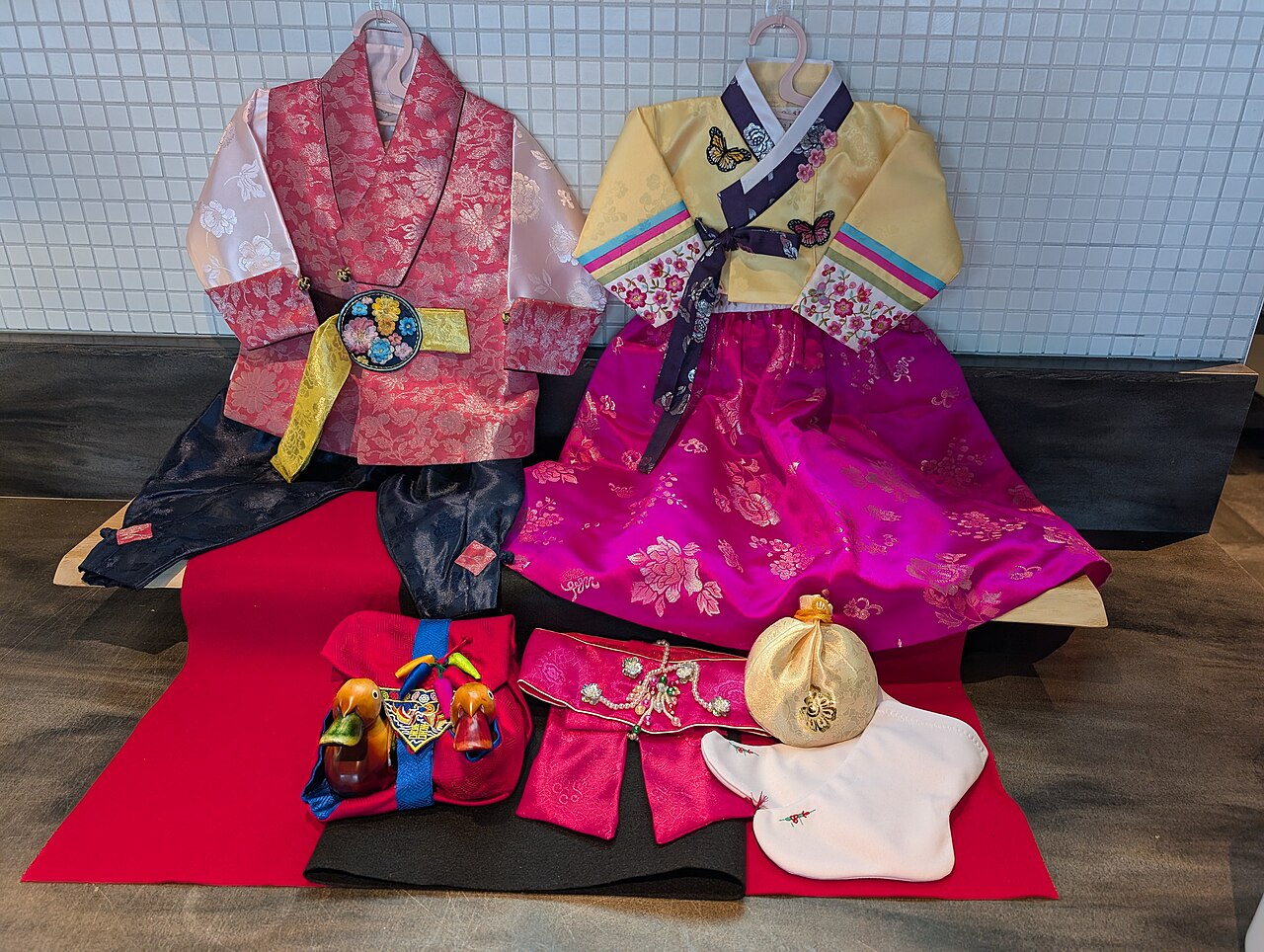
**Clothing** The hanbok (also called joseonot in North Korea) has been worn since ancient times and consists of a jeogori shirt and a chima skirt. Historically, clothing marked social rank, with distinct costumes for the ruling class and royalty, who used jewelry—such as gemstone pendants shaped like natural elements with silk tassels—to set themselves apart. For thousands of years, Koreans mostly wore plain white hanbok, adding color and ornamentation only for uniforms, status display, or special occasions, earning them the nickname “white-clothed people.” This practice likely began during the Three Kingdoms period and lasted until just after the Korean War, when poverty ended it. Everyday dress was uniform, but official and ceremonial clothes varied. In winter, cotton-wadded or fur garments were common. Hanbok are classified as everyday, ceremonial, or special dress. Ceremonial hanbok are worn for events like a child’s first birthday (doljanchi), weddings, and funerals. Special hanbok are made for shamans and officials. Today, hanbok is used for formal occasions but not daily wear, though the elderly and remnants of Joseon aristocratic families still wear it, and some young people have shown renewed interest. Traditionally, the hanbok was a wedding dress dating to the 14th century—a floor-length gown with an empire waist and fitted jacket in vibrant or pastel colors. Daily use has declined sharply in recent decades. However, with the rise of K-Pop, groups like BTS, BlackPink, and KARD have worn hanbok in music videos and public appearances, boosting interest in Korean culture.
**Cuisine** Rice is Korea’s staple food. As a largely agricultural country until recently, its essential recipes reflect this background. Main crops include rice, barley, and beans, with many supplementary crops. Fish and seafood are also important due to Korea’s peninsula geography. Fermented foods, developed early on, characterize traditional Korean cuisine—such as pickled fish and vegetables, which provide proteins and vitamins in winter. Kimchi, a famous Korean food, is pickled vegetables rich in vitamins A and C, thiamine, riboflavin, iron, calcium, and carotene. Types include cabbage kimchi, diced radish kimchi, water kimchi, and cucumber kimchi. Side dishes (banchan) are commonly eaten with meals, including kimchi, pickled radish, soybean sprouts, japchae (glass noodles), cucumber salad, and seasoned spinach.
**Ceremonial, ritual, and temple foods** Ceremonial foods are used for a child’s 100th day, first birthday, wedding, and 60th birthday. Ritual foods appear at funerals, ancestral rites, shaman’s offerings, and as temple food. Temple food avoids the five strong-flavored ingredients (garlic, spring onion, wild rocambole, leek, and ginger) and meat. Rice cakes are vital for ceremonies and rituals, with food coloring and ingredients balanced according to yin and yang.
**Royal court cuisine (surasang)** Once exclusive, surasang is now available to everyone. Vegetable dishes were essential in the past, but meat consumption has increased. Traditional dishes include ssambap, bulgogi, sinseollo, kimchi, bibimbap, and gujeolpan.
**Tea** Originally used for ceremonies or herbal medicine, tea is now enjoyed in varieties made from fruits, leaves, seeds, or roots. Five tastes are distinguished: sweet, sour, salty, bitter, and pungent.
**Festivals** The traditional Korean calendar was lunisolar, based on Korea’s meridian, with 24 turning points (jeolgi) lasting about 15 days each. This calendar once guided agrarian life but is fading in modern times. The Gregorian calendar was adopted in 1895, but traditional holidays and age reckoning still follow the old calendar, with older generations celebrating birthdays by the lunar calendar. The biggest festival today is Seollnal (the traditional Korean New Year).
- Region
- Korean Peninsula
- Known for
- Hanbok, kimchi, celadon ware, lunar calendar festivals
- Major festivals
- Seollnal, Daeboreum, Dano, Chuseok
- Staple food
- Rice
- Traditional dress
- Hanbok (also called joseonot in North Korea)
Lore & Background
The traditional dress known as hanbok has been worn since ancient times, consisting of a shirt (jeogori) and a skirt (chima). According to social status, Koreans used to dress differently, making clothing an important mark of social rank. Costumes and jewelry, such as pendants shaped like natural elements made of gemstones with silk tassels, were worn by the ruling class and royal family to distinguish themselves from ordinary people. For thousands of years, Korean people nearly exclusively wore plain white and undecorated hanbok, leading to the nickname 'white-clothed people.' This practice possibly began during the Three Kingdoms period and lasted until just after the Korean War, ending due to poverty. Color and ornamentation were only worn for uniforms, to display social status, or during special occasions. The basic everyday dress was shared by everyone, but distinctions were drawn in official and ceremonial clothes. During winter, cotton-wadded dresses or fur were common. Hanbok are classified by purpose: everyday dress, ceremonial dress (for events like a child's first birthday, weddings, or funerals), and special dress (for shamans or officials). Today the hanbok is still worn during formal occasions, though everyday use has been lost. The elderly and remnants of aristocratic families from the Joseon Dynasty continue to wear it, with a modern interest emerging among some young people. Traditionally, the hanbok was a wedding dress dating back to the 14th century—a floor-length gown with an empire waist and fitted jacket, sewn in vibrant or pastel colors. In recent years, attention from K-Pop groups like BTS and BlackPink has increased interest in Korean culture, as these groups wear hanbok in music videos and public appearances.
Reader's Guide
Korean cuisine is centered on rice as the staple food, with fish and seafood important due to the peninsula's geography. Fermented recipes such as kimchi and pickled vegetables were developed early and provide essential proteins and vitamins during winter. Kimchi is one of the famous foods, with many types including cabbage kimchi, diced radish kimchi, water kimchi, and cucumber kimchi. Side dishes (banchan) are commonly eaten with meals. Ceremonial and ritual foods are used for events such as a child's first birthday, weddings, funerals, and ancestral rites. Temple food avoids the five strong-flavored ingredients of garlic, spring onion, wild rocambole, leek, and ginger, as well as meat. Royal court cuisine (surasang) is now available to the whole population. Traditional Korean ceramics reached high refinement during the Goryeo period with jade green celadon ware and inlaid ware, considered a Korean invention. White porcelain became popular in the 15th century, and blue-and-white porcelain in the late Joseon period. Korean potters taken to Japan during the Imjin wars heavily influenced Japanese ceramics.
Did You Know?
- The traditional Korean calendar was based on the lunisolar calendar, divided into 24 turning points (jeolgi), each lasting about 15 days.
- The biggest festival in Korea today is Seollnal (the traditional Korean New Year).
- Korean people were nicknamed 'white-clothed people' because they nearly exclusively wore plain white and undecorated hanbok for thousands of years.
- Many Japanese pottery families today trace their art and ancestry to Korean potters captured during the Imjin wars.
Indigenous Peoples and Their Cultural World
The archipelago's earliest inhabitants include the Jomon people and smaller Paleolithic communities whose traces stretch deep into prehistory. From these roots emerged the Yamato, whose lineage is traced to the Yayoi period and who have exercised political authority since the Asuka era; their sheer numbers mean the word Yamato is frequently used as a synonym for Japanese. Yet the islands also sheltered distinct indigenous communities. The Ainu, native to Hokkaido, northeastern Honshu, and the Russian territories of Sakhalin, the Kuril Islands, and the Kamchatka Peninsula, developed a language wholly separate from modern Japanese, practiced traditional tattooing, and followed animistic religious beliefs. The Ryukyuan peoples of the southern islands—divided into Okinawan, Amami, Miyako, Yaeyama, and Yonaguni subgroups—speak languages forming one of the two major branches of the Japonic family. Their culture carries matriarchal undertones, a native spiritual tradition, and a cuisine shaped by the relatively late arrival of rice cultivation in the twelfth century. The Bonin Islanders of the Ogasawara chain, descended from a mix of Japanese, European, American, Polynesian, and Micronesian settlers from the eighteenth century onward, speak a dialect of English and have traditionally embraced Christianity, with only roughly two hundred remaining in Japan today.
The Construction and Erosion of a Single Identity
After the collapse of the multi-ethnic Empire of Japan in 1945, successive governments deliberately cultivated a narrative of monoculturalism, effectively denying that more than one ethnic group existed within the nation's borders. This ideology became so deeply embedded in public consciousness that even in 2020, former Prime Minister Taro Aso could stand in an election campaign and declare that no other country had endured for two thousand years with a single language, a single ethnic group, and a single dynasty. The first significant crack in that wall came in May 2008, when Prime Minister Fukuda Yasuo addressed parliament and explicitly acknowledged the Ainu as an ethnic minority, citing their preservation of a unique cultural identity, language, and religious tradition. A further legislative milestone followed in 2019, when the Japanese parliament enacted a law formally recognizing the Ainu as an indigenous people. Despite these steps, the broader framework of ethnic homogeneity continues to shape policy and public discourse, and the statistics that count foreign residents still exclude indigenous minority groups who hold Japanese citizenship, naturalized citizens, and descendants of earlier immigrants, making the true ethnic mosaic of the archipelago difficult to capture in any single figure.
A Growing Tapestry of Foreign Communities
The demographic landscape has shifted markedly in recent decades. In 2018, roughly 97.8 percent of residents held Japanese citizenship, but the foreign-born share has been climbing sharply, driven by an aging population and a shrinking domestic labor force. By 2020, about 2.3 percent of the legal resident population consisted of foreign citizens, and a 2018 report noted that approximately one in ten young people living in Tokyo were foreign nationals. The Chinese community, at 0.64 percent of the total population, remains the largest foreign minority, concentrated in Osaka, Tokyo, and Yokohama. Vietnamese residents numbered over 600,000 by mid-2024, while the Filipino community grew from roughly 202,000 in 2007 to an estimated 325,000 by early 2020; in 2006, Japanese-Filipino unions were the most common form of international marriage in the country. Koreans in Japan, the fifth-largest ethnic minority, total over 411,000 non-citizens as of 2024, most having arrived in the early twentieth century. Indian nationals, numbering about 40,750 in mid-2022, are predominantly employed in information technology and English-language office work, with South Asians generally clustered in Tokyo.
Layers of Arrival and Dispersal Across Centuries
The ethnic composition of the Japanese archipelago is the product of many waves of migration, settlement, and absorption. Prehistoric Jomon and Paleolithic communities gave way to the Yayoi-era Yamato, while groups such as the Emishi and the Hayato were gradually dispersed or absorbed into the dominant population. A formal distinction is often drawn between historical minorities—those present before or during the year 1700, including the Ainu, Ryukyuans, Chinese, Zainichi Koreans, Russians, Thais, Vietnamese, and mixed-heritage Hāfu—and modern minorities who arrived after that date, such as Brazilians, Indians, Indonesians, Nepalis, Britons, Filipinos, French, Peruvians, and Mongolians. The Bonin Islanders occupy a particularly complex position: their legal status oscillated between the United States and Japan over the years, and during and after World War II many were forcibly relocated, with some choosing to emigrate to the United States where English-speaking culture made assimilation easier than Japanese-speaking society. A small number of Nivkh people also resettled in Hokkaido when Japan evacuated southern Sakhalin at the war's end. Today, more than 60,000 American military personnel, over 35,000 of their dependents, and roughly 7,000 Department of Defense employees remain stationed on the islands, adding another layer to an already diverse population.
Gallery

More in National Cultures And Ethnic Groups 1-24
Spotted an error? Know more?
This is a living reference — every entry is fact-audited, and reader corrections feed straight into our audit queue. Suggest an edit · See this site's audit record