
Corone (crow)
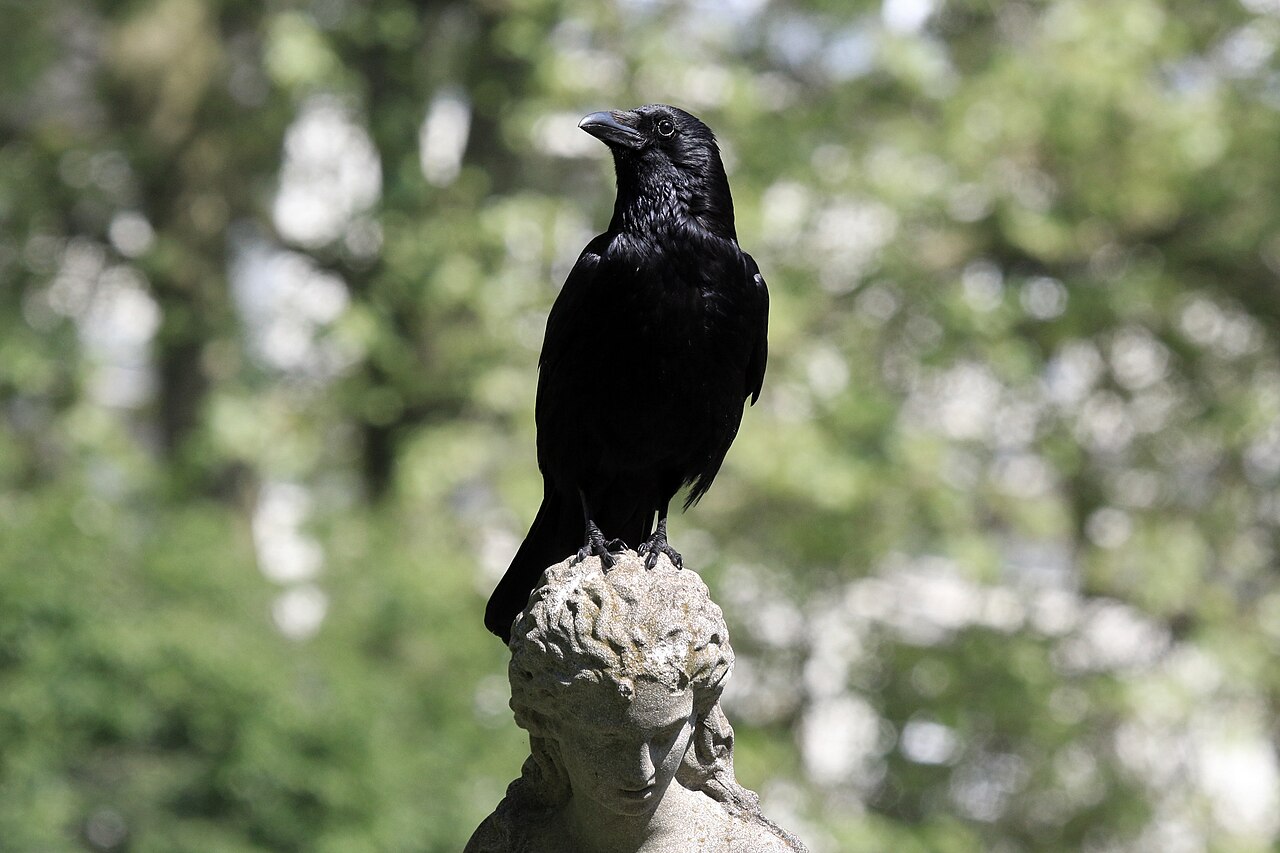
A princess turned crow to escape Poseidon's assault.

Charles J. Sharp · CC BY-SA 3.0
Corone is a figure from Greek and Roman mythology, often identified with the crow (Latin: cornix). Later sources, including an anonymous Greek paradoxographer, name her Corone and describe her as a princess transformed into a crow by Athena to escape Poseidon's assault. However, Ovid's Metamorphoses does not name her or give her a human backstory; it simply tells the story of a crow (Cornix) who complains about the owl Nyctimene.
- Name
- Corone
- Also known as
- Cornix (Latin for 'crow')
- Mythological origin
- Greek and Roman
- Father
- Coronaeus
- Deities involved
- Poseidon, Athena
- Transformation
- Crow
- Source
- Ovid, Metamorphoses
Lore & Background
According to later tradition, Corone was a princess, daughter of Coronaeus. While walking by the seashore, the sea-god Poseidon saw her and attempted seduction; when that failed, he tried to rape her. Corone fled, crying out to men and gods. No man heard her, but the virgin goddess Athena felt pity and transformed her into a crow. In Ovid's Metamorphoses, the crow (Cornix) recounts her woes to the raven Lycius and complains that the owl Nyctimene has usurped her place as Athena's bird-servant, but Ovid does not name the crow Corone or give her a human backstory as a princess. The name Corone and the princess backstory come from an anonymous Greek paradoxographer. There is no known classical source for a statue in Corone, Messenia, showing Athena holding a crow instead of an owl, nor for Athena cursing the crow so it could never fly over the Acropolis of Athens.
Reader's Guide
Corone's myth illustrates the theme of divine intervention to preserve a woman's chastity, common in Ovid's Metamorphoses. Her story is one of several linking crows to Athena, though the relationship is not always amicable. In another myth, a crow brought Athena news that the daughters of Cecrops had opened the box containing Erichthonius; Athena cursed the crow never to fly over the Acropolis. Aesop's fable and a fragment from Callimachus further explore the crow's uneasy bond with Athena. The second-century traveler Pausanias noted a statue in Corone, Messenia, where Athena held a crow instead of an owl. Later, John Gower retold the tale in Confessio Amantis, emphasizing Corone's delight in her escape. Corone's story remains a minor but illustrative example of metamorphosis as both punishment and rescue in classical mythology.
Did You Know?
- Corone's name is not given by Ovid; it comes from an anonymous Greek paradoxographer.
- In Ovid's Metamorphoses, the crow (Cornix) complains that the owl Nyctimene has replaced her as Athena's bird-servant, but the crow is not named Corone.
- A statue in Corone, Messenia, showing Athena holding a crow instead of an owl is not attested in widely-known classical canon or major sources.
The Seashore Encounter and Divine Rescue
In the brief myth preserved in Ovid's Metamorphoses, Corone—a princess and daughter of Coronaeus—finds herself at the center of a violent encounter by the seashore. The sea-god Poseidon spots her and first attempts seduction; when that fails, he escalates to a forced assault. Corone flees, crying out for help to both mortal men and the gods alike. No human voice answers her, but the goddess Athena, moved by the parallel of one virgin protecting another, intervenes. In a single transformative act, Pallas reshapes the young woman's form into that of a crow, pulling her out of Poseidon's reach. The name Corone itself derives from the Ancient Greek word for crow, and the pronunciation would have sounded something like 'kor-oh-neh.' Though the tale is short, it carries the weight of a common mythological pattern: a mortal woman's body is threatened by force, and a protective deity offers salvation through metamorphosis rather than through any physical rescue.
A Crow's Grievances: Dialogue with Lycius
Beyond the single moment of her transformation, Ovid gives Corone a voice in a later conversation with Lycius, a raven who carries his own set of grievances against the gods. In this exchange, the crow recounts the trauma of her encounter with Poseidon, but she also voices a sharper, more personal resentment: her position as Athena's chosen bird-servant had been stolen by the owl. That owl, in the mythic tradition, is Nyctimene—a woman transformed as punishment. Corone's bitterness is clear; she sees her own metamorphosis as an act of protection, yet her role was nonetheless displaced by a figure whose change was punitive. It is worth noting that Ovid himself never actually names her. In his Latin text she is simply cornix, 'the crow.' Her proper name, Korōnē, survives only through an anonymous Greek paradoxographer, a minor source that preserves what the major poet left unspoken. This gap between the named princess and the unnamed bird adds a layer of ambiguity to her identity.
The Crow and Athena: A Complicated Bond
The relationship between Athena and the crow stretches well beyond Corone's personal story and is not uniformly warm. In one narrative, after Hephaestus's assault on Athena resulted in the birth of the infant Erichthonius, the goddess placed the child in a sealed box and entrusted it to the daughters of Cecrops with strict instructions not to open it. The maidens broke that command, and the crow flew to Athena bearing the news of their disobedience. Enraged, Athena cursed the bird, forbidding it from ever flying above the Acropolis of Athens. Scholars suggest the Poseidon-Corone tale grew out of this older story, since the crow-Athena link has no independent cultic foundation. In Aesop's fables, a crow still makes a sacrifice to Athena despite knowing the goddess dislikes her, hoping to mend the relationship. A fragment of Callimachus hints at a lost story where the crow warns the owl against spreading rumors, lamenting how terrible Athena's wrath can be. Pausanias records that in the small town of Corone in Messenia, a statue of Athena held a crow in her outstretched hand rather than the more familiar owl.
Echoes in Later Literature: Gower's Delighted Crow
The Corone myth found a particularly vivid afterlife in the medieval English poet John Gower's Confessio Amantis. Where Ovid treats the transformation with relative restraint, Gower lingers on Corone's own emotional response to her metamorphosis, framing it not as a loss but as a triumph. In his verse, the young woman bursts free of Poseidon's arms with the speed of a loosed arrow, her new plumage a deep coal-black, and Gower makes explicit what the earlier sources only imply: Corone is delighted. She finds more joy in preserving her maidenhood beneath a cloak of dark feathers than she would in losing it while remaining fair-skinned. The image of pale treasure hidden under black plumage becomes a metaphor for a choice that prioritizes inner wholeness over physical beauty. Gower's rendering thus reframes the myth from a story of violation and rescue into one of active, even joyful, self-preservation. The crow, in his telling, is not a victim trapped in bird-form but a woman who chose her own shape and is glad of it.
Gallery


More in Mythological rape victims 1-24
Spotted an error? Know more?
Reader corrections go straight into our review queue. Suggest an edit · How this site is sourced