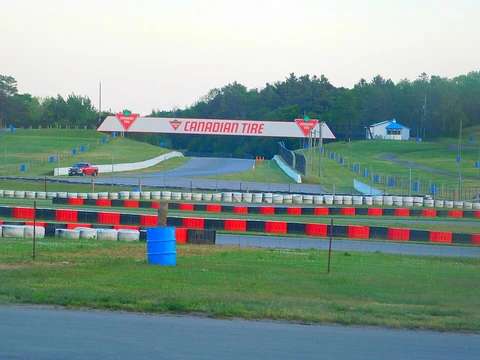
Canadian Superbike Championship
Canada's premier national motorcycle road racing championship since 1980.

The Bridgestone Canadian Superbike Championship (CSBK) is Canada’s national road racing series for superbikes. It’s run by Professional Motor Sports Productions Inc. (PMP), based in Hamilton, Ontario, and owned by Ross Millson. The championship covers seven classes, open to both professional and amateur riders. The top class, Pro Superbike, crowns its champion with the Canada Cup each season. Bridgestone became the series’ official sponsor and tire supplier in 2023, a role it will hold through at least 2026.
The championship began in 1980, following a single national event in Edmonton in 1979 won by George Morin. That first season had two rounds—in Edmonton and Shannonville—and Morin took the inaugural title and the first #1 plate. In 1981, only one race happened in Edmonton, so no official champion was named. The series returned in 1982 with Steve Dick winning after races at Shannonville and Atlantic Motorsport Park. Then, from 1983 to 1985, no national champions were crowned as regional racing took over.
Interest in a national series revived in 1986, and the RACE Series, then a regional organization, took over management. That year featured five rounds across five provinces, with Michel Mercier winning the championship after a final-round victory in Shannonville. Over the next two seasons, eight different riders won races across 13 events. Mercier defended his title in 1987, and Rueben McMurter won in 1988. That same year, Steve Crevier debuted, while Miguel Duhamel had already joined the series in 1987—both would become the sport’s biggest names over the next two decades. Crevier and Duhamel traded wins in 1989, with Crevier taking the championship before heading to the U.S. the next year. Duhamel was the favorite for 1990, but Mercier won four races to claim his third and final title. Crevier returned to Canada in 1991 and dominated for Kawasaki, winning championships in 1991, 1992, and 1993.
In the mid-1990s, Kawasaki kept winning, but with different riders. Michael Taylor took the title in 1994 and 1996, while Don Munroe won in 1995 and 1997. In 1998, fellow Kawasaki rider Jordan Szoke became the first rookie champion in CSBK history and the youngest at 19. Despite being the heavy favorite in 1999, Szoke switched to Honda and struggled early, losing the championship to Francis Martin.
Quick Facts
- Category
- Superbike racing
- Inaugural
- 1980
- Tyres
- Bridgestone
- Champion Rider
- Ben Young (2025)
- Constructor
- BMW (2025)
- Current Season
- Canadian Superbike Championship
Facts from the source article.
Lore & Background
The Canadian Superbike Championship was established in 1980, following an inaugural national event in Edmonton in 1979 won by George Morin. The 1980 season featured two events in Edmonton and Shannonville, with Morin earning the first national championship and #1 plate. After a lone event in 1981 and no official championship, Steve Dick claimed the second title in 1982. The series then went dormant for three years until 1986, when the RACE Series took over management and Michel Mercier won the first full five-round campaign. Miguel Duhamel debuted in 1987, while Steve Crevier joined the series in 1988, both becoming dominant figures for two decades.
Reader's Guide
The Canadian Superbike Championship has been the premier motorcycle road racing series in Canada since its founding in 1980. Its significance lies in developing top Canadian talent, including Miguel Duhamel, Steve Crevier, and Jordan Szoke, who holds a record 14 national championships. The series has evolved through periods of regional racing, manufacturer rivalries (Kawasaki, Suzuki, Honda, BMW), and ownership changes, most recently to Ross Millson in 2023. The Bridgestone sponsorship beginning in 2023 and continuing through at least 2026 has provided stability. Ben Young's five championships (2019, 2022, 2023, 2024, 2025) mark a modern era of dominance, while the series continues to expand its profile with increased television coverage and manufacturer involvement.
Foundations and the Birth of a National Series
The Canadian Superbike Championship traces its roots to 1979, when George Morin claimed the inaugural national event at Edmonton. The following year marked the first true multi-event season, with races at Edmonton and Shannonville, and Morin secured the first national title and the coveted #1 plate. However, the series' early trajectory was anything but steady. A single event in 1981 meant no champion was crowned, and after Steve Dick took the 1982 title, the national championship effectively vanished for three consecutive years as regional racing took precedence. The RACE Series stepped in as a management body in 1986, launching a five-round campaign across five provinces that saw Michel Mercier claim the crown. Mercier would go on to win three national titles total, but the 1988 season proved a turning point: Miguel Duhamel and Steve Crevier debuted that year and would dominate Canadian superbike racing for the next two decades. Crevier captured the 1989 championship before heading to the United States, while Mercier edged Duhamel in 1990. Crevier's return in 1991 ushered in a Kawasaki dynasty, with him sweeping three consecutive titles through 1993.
The Jordan Szoke Dynasty
No rider in the history of Canadian superbike racing has left a deeper imprint than Jordan Szoke, whose 14 national championships span nearly three decades. His first title came in 1998 with Kawasaki, when at just 19 he became the series' first rookie champion and its youngest winner at the time. Though a switch to Honda in 1999 cost him the crown, Szoke found renewed form on Suzuki in 2002, collecting five race wins and his second title before heading to the United States. His return to Kawasaki in 2006 ignited a period of extraordinary dominance: he won the first six races of that season and went on to claim four consecutive championships. A perfect season in 2010, in which he won every single race on a privateer Honda, remains one of the most remarkable feats in the series' history. Even after a mid-season injury in 2014 handed the title to Jodi Christie, Szoke rebounded with flawless campaigns in 2015 and 2016, and won all but one race in 2017 to reach 12 titles. His 13th came in 2018, and his 14th and most recent arrived in 2020, when an abbreviated pandemic schedule allowed him to deliver another perfect season.
Rivalries That Defined an Era
The CSBK has produced several rivalries that shaped its identity. In the late 1980s, Steve Crevier and Miguel Duhamel traded victories and titles, with Crevier ultimately claiming six national championships across his career, including a remarkable run of three in a row from 1991 to 1993. The 2009 season marked the arrival of teenager Brett McCormick, whose four wins for Suzuki nearly derailed Szoke's streak, but a crash at Canadian Tire Motorsport Park proved decisive, allowing Szoke to tie Crevier's all-time record of six titles. The rivalry between Szoke and McCormick reached its peak in 2011, when McCormick, now on a brand-new BMW Motorrad S1000RR program, won the first six races to finally break Szoke's five-year winning run. In the modern era, Ben Young and Alex Dumas have delivered some of the tightest battles in series history. Dumas, a 19-year-old series debutant, became the first rookie champion since Szoke in 2021 on Suzuki, only for Young to steal the title back in 2022 in what is described as one of the closest championship fights ever contested in the series.
Institutional Framework and the Modern Chapter
The Canadian Superbike Championship operates as a seven-class national series open to both professional and amateur riders, with the headline Pro Superbike category showcasing the nation's top talent and awarding the Canada Cup to its champion each season. The series is managed by Professional Motor Sports Productions Inc. (PMP), based in Hamilton, Ontario, under owner Ross Millson. The 2020 season was disrupted by the COVID-19 pandemic, which reduced the calendar to just two rounds and saw Ben Young decline to defend his 2019 title, clearing the path for Szoke's 14th championship. The post-pandemic years have brought fresh competition, with Dumas and Young trading the crown in 2021 and 2022. In 2023, Bridgestone stepped in as the series' official sponsor and tire supplier, a partnership that extends through at least the 2026 season, signaling a new chapter of commercial investment in the championship. The series' ability to attract factory-backed programs from manufacturers like BMW Motorrad, Suzuki, and Kawasaki, alongside privateer entries, has kept the competition at a high level and ensured that the national title remains a highly sought-after prize in Canadian motorcycle racing.
Frequently Asked Questions
What is the Canadian Superbike Championship?
It is Canada's national road-racing series for superbikes, running since 1980 with seven competitive classes open to both professional and amateur riders. The premier Pro Superbike division crowns its season winner with the Canada Cup.
Who holds the record for most Canadian Superbike Championship titles?
Jordan Szoke leads the all-time standings with 14 championship titles, making him the most decorated rider in the series' history.
Who is the current Canadian Superbike Championship champion?
Ben Young captured his fourth overall title in the 2024 season, solidifying his place among the series' most successful modern-era riders.
Who runs the Canadian Superbike Championship and who is its sponsor?
The series is operated by Professional Motor Sports Productions Inc. (PMP), a Hamilton, Ontario company owned by Ross Millson. Bridgestone has been the official tire supplier and title sponsor since 2023, with that deal in place through at least 2026.
When did the Canadian Superbike Championship start and who won the first title?
The championship was officially founded in 1980, following a single one-off national race held in Edmonton in 1979. George Morin claimed the inaugural Canada Cup that first season.
More in Motorsport in Canada 1-24
Spotted an error? Know more?
Reader corrections go straight into our review queue. Suggest an edit · How this site is sourced