Canadian Motorsport Hall of Fame
Honours outstanding contributions to Canadian motorsport.

5of7 · CC BY-SA 2.0
The Canadian Motorsport Hall of Fame (CMHF) is a hall of fame run by the Canadian Motorsport Heritage Foundation as a not-for-profit charitable institution that honors and recognizes the achievements of individuals and institutions that have made outstanding contributions to Canadian motorsport. It was established in 1992 by Gary Magwood and Lee Abrahamson, with assistance by Automobile Journalists Association of Canada founding president and motorsport reporter Len Coates, to celebrate the accomplishments and contributions of the various Canadian motorsports communities.
- Total inductees since 1993
- 293
- First induction ceremony
- October 20, 1993, Royal York Hotel, Toronto
Lore & Background
The Canadian Motorsport Hall of Fame was established in 1992 by Gary Magwood and Lee Abrahamson, with assistance from Len Coates. It has moved location six times due to difficulties garnering sponsorship and community support creating financial trouble, and has been housed at The Canadian Motorsport Heritage Museum in Toronto's Downsview Park since 2010. Inductees are received by a panel of motorsport experts from the CMHF Nomination Committee, and normally all inductees have to be retired from competition for at least three years or have been active in motorsports for about a quarter of a century.
Reader's Guide
The CMHF has inducted 294 individuals since 1993, with between five and fifteen auto racing figures added each year. The vast majority are men; there have been eight women elected, including Kay Petre (first woman racing driver inducted in 1995) and Nathalie Richard and Anne Roy (most recent women added in 2020). The first inducted physician was Hugh E. Scully in 2000. Hydroplane drivers Robert Theoret and Jean Theoret are the only two brothers inducted individually. The 2018 class was the first composed wholly of print and broadcast motorsport journalists. International inductees include Carroll Shelby, Bobby Rahal, Sid Watkins, Michael Andretti, Mario Andretti, Nigel Mansell, Jackie Stewart, Multimatic Motorsports, Legendary Motorcar, Honda, and McLaren. The CMHF contains nine organizations and on seven occasions there have been two or more inductees grouped for their combined work.
Did You Know?
- The CMHF has moved location six times due to financial trouble.
- There was no induction in 2009 because of the Great Recession.
- Kay Petre became the first woman racing driver inducted in 1994.
- The 2018 class included competitors and builders, not just motorsport journalists.
From Dirt to Distinction: The Birth of Mosport
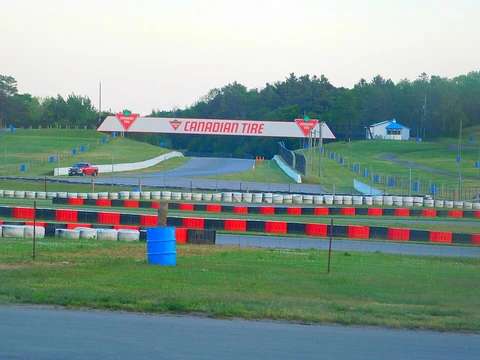
Rising out of the rural landscape north of Bowmanville in Clarington, Ontario, the circuit that would become one of Canada's most storied racing venues was designed and built in the late 1950s. It was the second purpose-built road racing course in the country, following only Westwood Motorsport Park in British Columbia, and it succeeded a string of repurposed airport circuits that had served as Ontario's earlier racing grounds. The name "Mosport" was a contraction of "Motor Sport," coined by the enterprise formed specifically to build the facility. The track's first outing came in June 1961, when the Oakville Light Car Club staged a modest local event. Days later, on June 25, the venue leapt onto the international stage with the Player's 200, a sports car race drawing competitors from around the globe to quiet Ontario countryside. Stirling Moss claimed victory in a Lotus 19, ahead of Joakim Bonnier and Olivier Gendebien. Moss proposed splitting a planned hairpin into two separate corners to increase both the challenge and the spectacle; that section was christened Moss Corner in his honour, a naming that has caused persistent confusion, with many fans mistakenly calling the venue "Mossport." Remarkably, the track's fundamental layout has remained largely untouched from that original 1961 configuration.
A Stage for the World's Finest
Mosport earned its international reputation through a succession of prestigious sports car races carried under the "Canadian Grand Prix" banner, a title typically reserved for Formula One events. These races generated enormous crowds, repeatedly shattering Canadian sports attendance records with each successive year. The venue's success was so significant that it came to be viewed as a key catalyst in the founding of the Can-Am Series. Can-Am first visited the track in its 1966 inaugural season, and Mosport hosted at least one event in every year of the series' existence except 1968. The centennial year of 1967 proved particularly spectacular, as the circuit simultaneously hosted Formula One, USAC, and a 500cc Motorcycle Grand Prix. The Formula One Grand Prix of Canada remained at Mosport until 1977, when it relocated to Montreal. Over the decades, the circuit has welcomed Formula One, USAC, the World Sportscar Championship, Can-Am, Formula 5000, and a wide array of other open-wheel, sports car, and motorcycle series. In 2001, the entire circuit was repaved to meet FIA specifications, widened to 13 metres, with drivers consulted to preserve the character and racing lines of the original surface.
The Human Cost of Speed
Beneath the glamour of international racing, Mosport has carried a sobering record of fatalities among drivers, riders, and track personnel. The most widely recognized tragedy occurred in 1985, when German Formula One driver Manfred Winkelhock was killed after his Porsche 962C struck a concrete wall. In 2008, during the 29th annual Vintage Automobile Racing Association of Canada Racing Festival, Dino Crescentini, a ten-year veteran of vintage racing from Rochester Hills, Michigan, lost control of his 1977 Wolf Dallara Can-Am car, a machine that had previously been driven by Gilles Villeneuve. The most recent fatality at the venue came in 2018, when 61-year-old former Pro Mazda driver Jeff Green speared off the racetrack at turn 8 and slammed into the barrier. Despite receiving immediate attention, he was unable to survive the crash. These incidents serve as a stark reminder that even at a venue celebrated for its heritage and community, the inherent dangers of motorsport remain ever-present.
Changing Hands, Enduring Spirit
Since the original public company that built the track, Mosport has passed through a succession of owners, each leaving their mark on the facility. Two notable former proprietors, Norm Namerow, who held the track through his publishing company CanTrack until his death, and Harvey Hudes, were both inducted into the Canadian Motorsport Hall of Fame for their contributions to the sport in Canada. In 1998, Panoz Motorsports purchased the facility, and the following year the newly formed American Le Mans Series made its first appearance at the track. In June 2011, Canadian Motorsports Ventures Ltd., a group including Orlando Corp. Chairman Carlo Fidani and Canadian road racing driver Ron Fellows, took ownership. Eight months later, in February 2012, a partnership with Canadian Tire was announced, which included the renaming of the venue to Canadian Tire Motorsport Park. The complex also expanded its educational role: the Driver Development Centre opened in spring 2000 as a 1.700-kilometre, 12-turn training circuit designed by the Bridgestone Racing Academy, and by fall 2013 it had been reconstructed into a full racing course offering both a 2.200-kilometre intermediate and a 2.900-kilometre advanced configuration, complete with a skid pad, pit lane, and a multi-storey event centre.
Gallery
Frequently Asked Questions
What is the Canadian Motorsport Hall of Fame?
It is a not-for-profit charitable hall of fame that celebrates and honors individuals and institutions for their outstanding contributions to Canadian motorsport. The organization operates under the umbrella of the Canadian Motorsport Heritage Foundation.
Who started the Canadian Motorsport Hall of Fame and when?
Gary Magwood and Lee Abrahamson founded the Hall of Fame in 1992, with assistance from Len Coates, a motorsport journalist and the founding president of the Automobile Journalists Association of Canada. Their goal was to give proper recognition to the people and groups shaping Canadian racing culture.
When and where did the first Canadian Motorsport Hall of Fame induction ceremony happen?
The inaugural ceremony took place on October 20, 1993, at the Royal York Hotel in Toronto. It marked the first time inductees were formally honored in the Hall of Fame's history.
How many people or institutions have been inducted into the Canadian Motorsport Hall of Fame?
Since the first inductions in 1993, a total of 293 inductees have been recognized. This includes both individual competitors and organizations that have made significant contributions to Canadian motorsport.
Who governs the Canadian Motorsport Hall of Fame?
The Canadian Motorsport Heritage Foundation runs the Hall of Fame as a not-for-profit charitable institution. Its mandate is to preserve the legacy of Canadian motorsport by celebrating the accomplishments of the various racing communities across the country.
More in Motorsport in Canada 1-24
Spotted an error? Know more?
Reader corrections go straight into our review queue. Suggest an edit · How this site is sourced