The Mad Moon
The only Weinbaum story set on Io.

Stanley G. Weinbaum’s science fiction short story “The Mad Moon” first appeared in the December 1935 issue of *Astounding Stories*. It is the only tale he set on Io, and, like “A Martian Odyssey” and “Parasite Planet,” it focuses on the strange ecosystems of alien worlds.
In the 22nd century, protagonist Grant Calthorpe—a former sport-hunter now collecting ferva leaves for the Neilan Drug Company—lives near the Idiots’ Hills with a parcat named Oliver. To avoid stinging palms in the Ionan jungle, he bribes loonies with chocolate to gather the leaves for him. While suffering from the local “white fever” and its hallucinations, Calthorpe follows Oliver to Lee Neilan, the drug company owner’s daughter, who is also feverish. Each mistakes the other for a vision until Calthorpe confirms her report of a newly built slinker settlement; he then rescues her from the slinkers. After restoring her health, he learns she crash-landed her aircraft against the Idiots’ Hills while trying to reach Herapolis. When slinkers undermine his shack, the pair flees into the Idiots’ Hills, hoping the thin atmosphere will stop their pursuers. In a narrow valley between two peaks, they discover a deserted city built by more-civilized earlier loonies. When modern loonies oppose them, the slinkers form a dense mob, which Calthorpe destroys with a flame pistol. This attracts Lee’s father, Gustavus, who has been searching for her. In gratitude, Gustavus offers Calthorpe charge of a ferva plantation near Junopolis, and Lee proposes marriage.
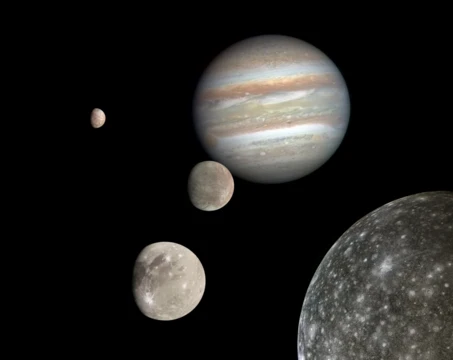
In Weinbaum’s solar system, Jupiter radiates enough heat to make the Galilean moons Earthlike. Io, the innermost, has a tropical climate, so human settlements are at the poles: Junopolis in the north and Herapolis in the south. The Idiots’ Hills extend partway around the equator, their peaks rising above Io’s dense but shallow atmosphere. Weinbaum did not know Io is tidally locked, so he shows Jupiter rising and setting in the story. Two intelligent races inhabit Io: loonies—humanoids with large balloonlike heads on long, slim necks and only moderate intelligence—and rodentine, warlike slinkers.
Quick Facts
- Author
- Stanley G. Weinbaum
- Country
- United States
- Language
- English
- Genre
- Science fiction
- Publication Type
- Periodical
- Published In
- Astounding Stories
- Publisher
- Street & Smith
- Media Type
- Print (Magazine)
- Pub Date
- December 1935
Facts from the source article.
Lore & Background
In Weinbaum's Solar System, Jupiter radiates enough heat to create Earthlike environments on the Galilean moons. Io, the innermost Galilean satellite, has a tropical climate, with two human settlements at the poles: Junopolis in the north and Herapolis in the south. Extending partway around the equator are the Idiots' Hills, whose peaks extend beyond Io's "dense but shallow" atmosphere. Weinbaum was ignorant that Io is tidally locked, and therefore showed Jupiter rise and set during the story.
Two intelligent races are native to Io: the loonies, a humanoid race of only moderate intelligence with large balloonlike heads upon long, slim necks, and the rodentine, warlike slinkers. Another native is the parcat, a feline-like animal with a "single hind leg" and the ability to mimic phrases of human conversation. Ionan flora includes ferva leaves, used by pharmaceutical companies on Earth to create alkaloids; bleeding-grass, which exudes red sap; and stinging palms, named for venomous barbs.
Reader's Guide
The story is significant as the only Weinbaum tale set on Io, showcasing his characteristic focus on alien ecologies. It introduces a detailed fictional biology for the moon, including two intelligent species (loonies and slinkers), the parcat, and various flora such as ferva leaves and stinging palms. The plot involves protagonist Grant Calthorpe collecting ferva leaves for the Neilan Drug Company, his encounter with Lee Neilan, and their escape from slinkers into the Idiots' Hills, where they discover a deserted city built by more-civilized previous generations of loonies. The story's legacy includes its inclusion in multiple Weinbaum collections, such as "The Dawn of Flame" (1936), "A Martian Odyssey and Others" (1949), and "The Best of Stanley G. Weinbaum" (1974). It also connects to the broader Weinbaum universe via a slinker appearing in the story "Valley of Dreams".
Did You Know?
- The story was first published in the December 1935 issue of Astounding Stories.
- It is the only Weinbaum story set on Io.
- The protagonist Grant Calthorpe uses chocolate to bribe loonies to collect ferva leaves.
- Weinbaum was unaware that Io is tidally locked, so the story depicts Jupiter rising and setting.
More in Moons of Jupiter, Part 2 1-24
Spotted an error? Know more?
Reader corrections go straight into our review queue. Suggest an edit · How this site is sourced