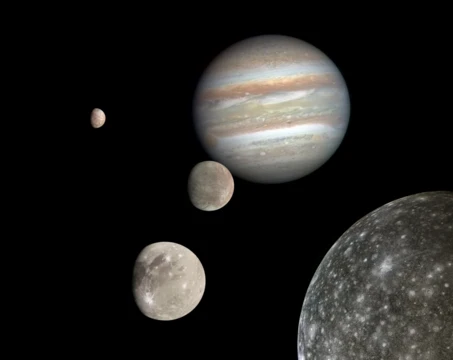
The Moons of Jupiter (short story)
A story about shifting facts and a daughter's last visit with her father.

"The Moons of Jupiter" is a short story by Canadian author Alice Munro, winner of the Nobel Prize in Literature in 2013. It was originally published in The New Yorker on 22 May 1978, and later republished as the title story of Munro's fifth collection in 1982. The story is notable for its exploration of how facts may change over time, and for its role in generating Munro's international breakthrough during the years around 1980.
Quick Facts
- Author
- Alice Munro
- Country
- Canada
- Language
- English
- Published In
- The New Yorker
- Pub Date
- 22 May 1978
Facts from the source article.
Lore & Background
The story follows Janet, a divorced, middle-aged writer who has become somewhat successful, as she visits her dying father in a Toronto hospital. She stays overnight in the apartment of her younger daughter, Judith, and thinks about her older daughter, Nichola, who prefers not to be in touch. Her father initially decided against surgery but changed his mind, unsettling Janet, who had begun to accept his prognosis. To regain composure, she visits a planetarium, where a presentation prompts realizations about how facts can be supplanted by new information. That evening at the hospital, she quizzes her father on the moons of Jupiter and the mythical origins of Ganymede, knowing these might be his last words. The story ends with her reflecting on the planetarium show and coming to some acceptance of her older daughter's and father's decisions to cut contact with their parents.
In the first version of the story, Janet is a painter, not a writer. For the second version (1982), a line about "measurement" was added in section 5, and a comparison in the sentence about Mercury was revised. The story has been included in the author's own compilations three times, making it among those republished the most.
Reader's Guide
The story's significance is underscored by Margaret Atwood's congratulatory statement on Munro's Nobel Prize, in which Atwood noted that the story illustrates how success must first be striven for, and then one seems to have to apologize for it. Atwood pointed to the character Janet as an example of Munro's characters being punished even though they are successful. Tim McIntyre, in a 2009 analysis, argued that Munro's realism—with its "capacity for characterization, compassion, and presence"—functions in opposition to the author's "sophisticated understanding of language's inability to represent perfectly either the world or the totality of being." The story's exploration of shifting facts, its multiple republications, and its role in Munro's international breakthrough around 1980 contribute to its legacy as a key work in her oeuvre.
Did You Know?
- The story is 17 pages long and made up of 7 sections, with the shortest being the final one.
- In the first version, the protagonist Janet is a painter, not a writer.
- Margaret Atwood referenced this story in her congratulatory statement on Munro's Nobel Prize in Literature.
Pioneering the Unknown: The First Flybys
The story of robotic exploration at Jupiter began in the winter of 1973, when Pioneer 10 slipped past the gas giant and transmitted the first close-up photographs ever captured of the planet and its Galilean moons. The probe studied the atmosphere, detected the magnetic field, observed the radiation belts, and determined that Jupiter's interior is predominantly fluid. A year later, Pioneer 11 pressed closer—within roughly 43,000 kilometres of the cloud tops—and delivered striking imagery of the Great Red Spot along with the first-ever views of Jupiter's polar regions. It also determined the mass of Callisto. The Voyager pair, arriving in 1979, pushed the discoveries further: they studied the moons and the ring system, and made two findings that reshaped planetary science—the volcanic activity on Io and the presence of water ice on Europa's surface. Together, these four flyby probes established the foundational picture of the Jovian system and proved that even the most distant planets could be studied in intimate detail, setting the stage for every mission that followed.
Galileo: The Long Watch from Orbit
Galileo arrived at Jupiter in 1995 and became the first spacecraft ever to enter orbit around the planet, remaining there until 2003. During those eight years it performed close approaches to all four Galilean moons, gathering evidence that three of them possess thin atmospheres and that liquid water may exist beneath their surfaces. It also discovered a magnetic field around Ganymede. One of its most dramatic moments came as it approached the planet: it witnessed the impact of Comet Shoemaker–Levy 9. In December 1995, Galileo sent an atmospheric probe into the Jovian atmosphere—the only craft to do so. Yet the mission was far from trouble-free. The intense radiation environment battered the spacecraft well beyond its design specifications. Gyroscopes exhibited increased errors, electrical arcs jumped between rotating and non-rotating components, and the ultra-stable quartz oscillator suffered phase shifts. On orbits sixteen, eighteen, and thirty-three, the radiation forced the probe into safe mode, and the data collected during those passes was lost entirely.
Engineering Against the Odds
Reaching Jupiter is one of the most energy-intensive journeys in the Solar System. The delta-v required to travel from Earth orbit to the gas giant is roughly nine kilometres per second—nearly identical to the energy needed simply to lift a spacecraft into low Earth orbit from the ground. Mission planners can shave fuel costs by threading a trajectory through gravity assists at Earth or Venus, but that trades fuel for a significantly longer cruise. The Dawn spacecraft demonstrated that ion thrusters capable of exceeding ten kilometres per second of delta-v could, in principle, handle a direct Jupiter flyby from an Earth-radius solar orbit without any assist. Once in the Jovian system, the challenges multiply. Jupiter has no solid surface; the atmosphere blends seamlessly into a fluid interior, and any descending probe is ultimately crushed by the immense pressures below. The radiation environment is equally hostile. When Pioneer 11 made its closest approach, the charged-particle flux was ten times greater than engineers had anticipated. The probe survived with minor glitches but lost most of its Io imagery because the radiation sent false commands to its imaging instrument. The Voyagers had to be redesigned entirely to endure the same belts.
The Next Wave: Orbiters and Beyond
Jupiter's exploration entered a new chapter in July 2016, when Juno—launched in 2011—completed its orbital insertion and became the second spacecraft ever to circle the planet. Its science programme, still ongoing, aims to study the magnetosphere and atmosphere in depth. The European Space Agency's JUICE mission, selected in 2012 under its Cosmic Vision programme, targets three of the Galilean moons and was launched on 14 April 2023. A Roscosmos-built Ganymede lander was once envisioned as a companion element but never materialised. NASA's Europa Clipper, launched on 14 October 2024, is dedicated to studying the moon Europa. China's National Space Administration has planned two Interstellar Express flyby missions around 2024 and a Tianwen-4 orbiter for roughly 2029, which would explore both the planet and its moon Callisto. As of 2026, nine spacecraft have visited the Jovian system, with two more en route, and all but one of these missions have been NASA-led. Because every mission to the outer Solar System has relied on a Jupiter gravity assist, the gas giant has become the most frequently visited of the outer planets—a gravitational waypoint as much as a destination.
Frequently Asked Questions
Who wrote The Moons of Jupiter?
The story was written by Canadian novelist and short-story writer Alice Munro, who went on to receive the 2013 Nobel Prize in Literature.
When and where did The Moons of Jupiter first appear?
It debuted in The New Yorker on 22 May 1978, and Munro later included it as the namesake piece in her fifth story collection, published in 1982.
What is The Moons of Jupiter actually about?
At its core it follows a daughter's final visit to her aging father, using that encounter to examine how the 'facts' people hold about a relationship can quietly shift and be rewritten over time.
How is The Moons of Jupiter structured?
The piece runs to roughly 17 pages and is divided into seven distinct sections, with the very last section being the shortest of all.
Why do fans consider The Moons of Jupiter a turning point in Munro's career?
The story helped propel Munro from a respected Canadian voice to an internationally recognized name during the late 1970s and early 1980s, cementing her reputation well before her later Nobel win.
More in Moons of Jupiter, Part 2 1-24
Spotted an error? Know more?
Reader corrections go straight into our review queue. Suggest an edit · How this site is sourced