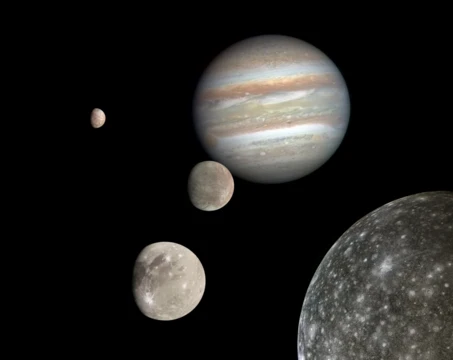
Lucky Starr and the Moons of Jupiter
Fifth Lucky Starr novel, set in the Jovian system.

Lucky Starr and the Moons of Jupiter, the fifth book in Isaac Asimov’s six-novel Lucky Starr series (published under the pen name Paul French), came out in August 1957 through Doubleday & Company. It is Asimov’s only story set in the Jovian system.
The action takes place among Jupiter’s moons. At the time of writing in the mid-1950s, twelve satellites were known. The first half of the novel occurs on Jupiter IX, then the outermost known moon, discovered by Seth Barnes Nicholson in 1914. Though Jupiter IX had been unofficially called Hades in 1955, Asimov mistakenly refers to it as Adrastea—the unofficial name of Jupiter XII. This mix-up likely happened because Jupiter IX was the twelfth farthest known satellite, while Jupiter XII was the ninth farthest. (In 1975, the International Astronomical Union officially named Jupiter IX Sinope.) Asimov gives Jupiter IX a diameter of 89 miles; current estimates put it at 23 miles. Part of the story also takes place on Io, the innermost Galilean moon, which Asimov describes with a thin methane atmosphere, fields of ammonia snow and ice, and rivers of liquid ammonia.
For six years, a secret project on Jupiter IX has been developing an antigravity (Agrav) space drive. The Council of Science learns that information is leaking to the enemy Sirians. A month after returning from Mercury, protagonists David “Lucky” Starr and John Bigman Jones are sent to Jupiter IX to investigate, bringing a V-frog to help. Upon arrival, project head Commander Donahue warns them away, saying workers are angry about the investigation. Starr and Bigman land anyway and are met by a group led by Red Summers, who forces Starr into a duel in an Agrav corridor against a larger man named Big Armand. Bigman realizes Summers is sabotaging Starr’s harness, stops him at gunpoint, and Starr wins, gaining Big Armand’s friendship.
In their quarters, blind neighbor Harry Norrich tells Starr that Summers is a convict from Earth but has earned responsibility on the project. Summers is hostile because he fears his past crimes will be exposed. Norrich mentions that when his seeing-eye dog died, Summers got him a German Shepherd named Mutt, and has done similar favors for others. Starr assures Norrich he won’t get Summers in trouble for the duel. The next morning, someone kills the V-frog while both men are distracted.
Quick Facts
- Author
- Isaac Asimov
- Illustrator
- Albert Orbaan
- Cover Artist
- Darrell K. Sweet
- Country
- United States
- Language
- English
- Series
- Lucky Starr series
- Genre
- Science fiction
- Publisher
- Doubleday & Company
- Release Date
- August 1957
- Media Type
- Print (hardcover and paperback)
- Pages
- 192
- Preceded By
- Lucky Starr and the Big Sun of Mercury
Facts from the source article.
Lore & Background
The novel takes place in the Jovian system. In the mid-1950s, when the novel was written, Jupiter had twelve known satellites. The first half of the novel takes place on what was then the outermost known satellite, Jupiter IX, discovered by Seth Barnes Nicholson in 1914. Jupiter IX had been given the unofficial name 'Hades' in 1955, but in the novel Asimov mistakenly refers to it as Adrastea, which was the unofficial name of Jupiter XII. The confusion arose from the fact that Jupiter IX was the twelfth farthest known satellite, while Jupiter XII was the ninth farthest. In 1975, the International Astronomical Union gave Jupiter IX the official name Sinope. Asimov describes Jupiter IX as being 89 miles in diameter, but its diameter is now thought to be only 23 miles. Part of the novel is also set on Io, the innermost of the Galilean moons, depicted as having a thin atmosphere of methane, fields of ammonia snow and ice, and rivers of liquid ammonia.
Reader's Guide
The novel introduces the Sirians as villains in fact, following their earlier appearances as distractions in previous series entries. The Three Laws of Robotics plays a part in the novel, revealing Asimov as the true author, though for the sake of continuity the novel was published under the pseudonym 'Paul French'. There are small inconsistencies between the various novels: the first man on Mars is named Ching in Moons of Jupiter, whereas in David Starr, Space Ranger he is named Wingrad; the name of the state that rules the Solar System changes from novel to novel, here being the Solar Federation of Worlds. The novel was reviewed favorably by Galaxy's Floyd C. Gale, who called it the best of the Lucky Starr series, and by Villiers Gerson in The New York Times, who declared it to be 'well-written adventure'.
Did You Know?
- The novel mistakenly refers to Jupiter IX as Adrastea, which was the unofficial name of Jupiter XII.
- Jupiter IX was given the official name Sinope by the International Astronomical Union in 1975.
- The novel features a robot spy disguised as a German Shepherd dog named Mutt.
- The Three Laws of Robotics appears in the novel, revealing Asimov as the true author.
Publication and Place in Asimov's Bibliography
Lucky Starr and the Rings of Saturn closes out the six-volume juvenile science fiction series that Isaac Asimov wrote under the pen name Paul French. Doubleday & Company released the book in 1958, and it marked a quiet but significant endpoint in Asimov's publishing history: it would be his last novel to reach readers until the 1966 novelization of Fantastic Voyage, and his last wholly original novel until The Gods Themselves appeared in 1973. That nearly fifteen-year gap between original novels makes the Saturn book a kind of bookend, the final word Asimov spoke in the voice of his younger-audience persona. The title also singles it out as the sole Asimov novel whose action unfolds within the Saturnian system, distinguishing it from the Jupiter-focused entries that dominate the rest of the series. For fans cataloguing the author's output, the book occupies a unique niche: a juvenile adventure that is simultaneously a career milestone and a one-off in terms of setting.
A World Built on 1950s Astronomy
The novel's stage is the Saturnian system, rendered with the best astronomical data available in the late 1950s. At the time of writing, only nine moons had been catalogued, with Mimas serving as the innermost. Asimov assigns Mimas a diameter of 340 miles, a figure that modern measurements have since revised downward to roughly 240 miles. Several chapters unfold on Titan, which in the 1950s was ranked as the third-largest moon in the Solar System, trailing only Ganymede and Triton; today we know Titan actually holds the second-largest spot behind Ganymede. The novel's Titan breathes an atmosphere described as nearly as dense as Earth's and composed primarily of methane, whereas current science tells us its atmosphere is actually denser than Earth's and consists of 98.4 percent nitrogen with just 1.6 percent methane. The story's final act shifts to the asteroid Vesta, which Asimov correctly identifies as the brightest object in the asteroid belt. He gives Vesta a diameter of 215 miles, but modern measurements place its mean diameter closer to 330 miles. These gaps between 1958 knowledge and present understanding give the book a charming, dated texture that modern readers can appreciate.
The Titan Dispute and the Vesta Conference
Six weeks after the Jovian-system adventure, David "Lucky" Starr is drawn back into interstellar politics when Jack Dorrance, the escaped chief of a Sirian spy ring, flees toward the Saturnian system. Starr and his companion Bigman Jones pursue him, but Dorrance's vessel is shattered by a fragment of Saturn's rings. The crisis escalates when the Sirians reveal they have established a colony on Titan and formally claimed it for their star, directly challenging the long-standing principle that a stellar system belongs indivisibly to its inhabitants. Starr initially orders the Terrestrial fleet home, then returns with Bigman and Councilman Ben Wessilewsky. After hiding inside Mimas and leaving Wessilewsky below its surface, Starr is captured and brought to Titan, where Sirian commander Sten Devoure coerces him into a false testimony. The conflict is ultimately resolved at an interstellar conference on the asteroid Vesta, where Starr's carefully planned revelation—that Wessilewsky was deliberately placed on Mimas to establish Earth's claim—turns the Sirians' own sovereignty argument against them. The vote results in the Sirians being ordered to vacate Titan within a month, cementing the "Indivisibility of Stellar Systems" as galactic law.
Sputnik's Shadow and the Sirians as People
Asimov drafted the novel between December 1957 and February 1958, in the immediate wake of the Soviet Union's launch of Sputnik I. That geopolitical anxiety surfaces in chapter 8, where Starr reflects on Sirian-built robots and insists that their creators are human beings whose achievement belongs to all of humanity: if Earth fears the result, the proper response is to match or surpass it, not to deny the worth of the accomplishment. The passage reads as a direct, if allegorical, commentary on the space race. The book also stands apart in the series as the only installment in which Sirians appear as actual characters rather than as robots or Earth-based agents working on their behalf. This gives the conflict a more personal, face-to-face quality. Like its predecessor Lucky Starr and the Pirates of the Asteroids, the novel places Earth on the brink of war with Sirius, and on both occasions Starr's intellect averts catastrophe on the grounds that full-scale conflict would bring ruin to both civilizations. The recurring theme underscores Asimov's conviction that diplomacy and clever thinking can outperform firepower.
Frequently Asked Questions
Who wrote Lucky Starr and the Moons of Jupiter?
Isaac Asimov penned the novel, though it was released under his pseudonym Paul French. Doubleday & Company published it in August 1957 as the fifth entry in the six-book Lucky Starr series.
Where does Lucky Starr and the Moons of Jupiter take place?
The entire plot is confined to Jupiter's satellite system, making it the only novel in the Lucky Starr cycle set there. The narrative alternates between Jupiter IX—the outermost known moon at the time—and the inner moon Io.
Why does Asimov call Jupiter IX 'Adrastea' in the novel?
Asimov appears to have confused the moon's identity, labeling Jupiter IX as Adrastea even though it had already been informally nicknamed Hades by 1955. In the book, this moon is described as roughly 89 miles in diameter.
What makes Lucky Starr and the Moons of Jupiter unique in the series?
It is the sole Lucky Starr novel whose action is entirely set among Jupiter's moons rather than on Earth or at other solar-system destinations. The world-building reflects the mid-1950s astronomical consensus of twelve known Jovian satellites.
When and by whom was Lucky Starr and the Moons of Jupiter published?
Doubleday & Company released the book in August 1957 under the pen name Paul French. It occupies the fifth slot in Asimov's six-novel Lucky Starr saga.
More in Moons of Jupiter, Part 2 1-24
Spotted an error? Know more?
Reader corrections go straight into our review queue. Suggest an edit · How this site is sourced