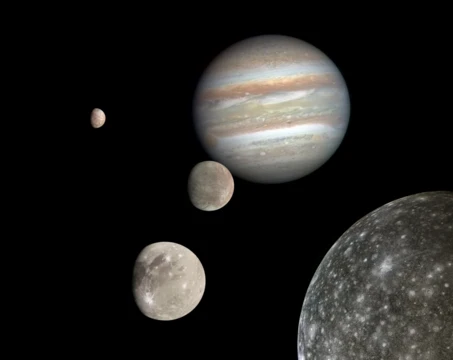
The Quiet War
A 2008 novel about Earth-Outer conflict in the Jovian system.

The Quiet War is a 2008 science fiction novel by Paul McAuley, published by Gollancz on 16 October 2008. It was nominated for the Arthur C. Clarke Award in 2009. The novel is set in the 23rd century and depicts a conflict between Earth, ruled by oligarchic nation-states, and the Outers, descendants of dissidents who settled the moons of Jupiter and Saturn.
Quick Facts
- Author
- Paul J. McAuley
- Country
- United Kingdom
- Language
- English
- Series
- Quiet War #1
- Genre
- Science fiction
- Publisher
- Gollancz
- Pub Date
- 16 October 2008
- Media Type
- Print, e-book
- Pages
- 439
- Isbn
- 978-0575079335
- Followed By
- Gardens of the Sun
Facts from the source article.
Lore & Background
The Quiet War is set in the early 21st century after the Overturn, a cataclysmic climate event on Earth. Earth is divided into three major oligarchic nation-states: Greater Brazil, the European Union, and the Pacific Community. Greater Brazil is controlled by the Peixoto family. Decades before the main plot, war between Mars and Earth wiped out Mars's population; survivors fled to the moons of Jupiter and Saturn, becoming the Outers, who practice democracy and gene manipulation. A new fusion motor shortens travel between Earth and the outer systems, increasing contact and conflict. The plot follows pro-peace factions in Greater Brazil attempting to build a biome on Callisto, supported by genetic engineer Avernus. Scientist Macy Minnot is selected for the project. Pro-war elements murder pro-peace figures and frame Macy, who flees to the Outers. Sri Hong-Owen spies on the biome project for a pro-war faction while secretly operating a lab on the Moon with clones named Dave. Captain Cash Baker trains as a pilot with experimental wiring. The story involves sabotage on Dione, an asteroid drop on Phoebe, battles in Paris on Dione, and a final confrontation on Titan.
Reader's Guide
The Quiet War is notable as an Arthur C. Clarke Award nominee in 2009. Critical reception is mixed: Eric Brown of The Guardian praised the novel's convincing future, political complexity, and science, noting it 'deftly combines bold characterisation, a thorough understanding of political complexity, and excellent science.' Abigail Nussbaum of Strange Horizons criticized the narrative as flat and characters predictable, stating the novel is 'undercut by not amounting to a single story' and that its ending lacks suspense for a sequel. The novel's significance lies in its depiction of a divided solar system and the tensions between Earth's oligarchies and the democratic Outers, with themes of genetic engineering, terraforming, and political intrigue. It is the first part of a series, though its ending leaves the political situation unresolved.
Did You Know?
- The Outers are descendants of survivors from a war that wiped out Mars's population.
- A group of clones named Dave are trained for military action on the Moon.
Frequently Asked Questions
What is The Quiet War?
The Quiet War is a 2008 science fiction novel by Paul McAuley that follows a 23rd-century conflict between oligarchic Earth nation-states and the Outers, a community of dissident descendants living on the moons of Jupiter and Saturn.
Who wrote The Quiet War and when was it published?
Paul McAuley authored the novel, and Gollancz released it on 16 October 2008.
Who are the Outers in The Quiet War?
The Outers are the descendants of political dissidents who fled Earth and established settlements on the moons of Jupiter and Saturn, forming a distinct society separate from the oligarchic nation-states back home.
What award nomination did The Quiet War receive?
The novel was put forward as a nominee for the 2009 Arthur C. Clarke Award.
Why do fans of Jovian moon fiction care about The Quiet War?
It is one of the rare novels that places the political and cultural divide between Earth and its Jovian moon colonists at the center of the plot, making the moons themselves a key setting rather than a mere backdrop.
More in Moons of Jupiter, Part 2 1-24
Spotted an error? Know more?
Reader corrections go straight into our review queue. Suggest an edit · How this site is sourced