2010: The Year We Make Contact
A sequel to 2001: A Space Odyssey, set nine years later.

In 1984, Peter Hyams wrote, produced, shot, and directed *2010: The Year We Make Contact*, an American science fiction film that serves as a sequel to Stanley Kubrick’s 1968 *2001: A Space Odyssey*. It adapts Arthur C. Clarke’s 1982 novel *2010: Odyssey Two*. The story follows a combined American and Soviet crew traveling to Jupiter to find out why the *Discovery One* mission failed. The cast includes Roy Scheider, Helen Mirren, Bob Balaban, and John Lithgow, with Keir Dullea and Douglas Rain returning from the original film. Released in the United States on December 7, 1984, the movie received mixed reviews; critics praised the special effects but thought it fell short of its predecessor. It earned $40.4 million domestically against a $28 million budget.
The plot begins nine years after the *Discovery* mission’s failure, where commander David Bowman and his crew were lost. With tensions rising between the United States and the Soviet Union, both nations plan separate trips to Jupiter. The Soviet spacecraft *Leonov* will be ready a year before the American *Discovery Two*, but only the Americans can restart the ship’s intelligent computer, HAL 9000, which is believed to have caused the disaster. Since *Discovery* will crash into Jupiter’s moon Io before the Americans can reach it, the Soviets agree to bring along former NCA Director Heywood Floyd, engineer Walter Curnow, and HAL’s creator, Dr. Chandra. Upon reaching Jupiter, the *Leonov* crew detects chlorophyll on the icy moon Europa. A probe sent to investigate is destroyed by an energy burst at the source of the chlorophyll, which Floyd interprets as a warning to stay away. After aerobraking in Jupiter’s atmosphere, the *Leonov* enters orbit around Io and finds *Discovery*. Curnow and cosmonaut Max Brailovsky spacewalk to the derelict vessel; both suffer panic attacks but bond over the experience and become friends. Curnow restores *Discovery*’s power and propulsion, and Chandra reactivates HAL. The ships move to investigate a giant monolith at the Lagrange point between Jupiter and Io. Brailovsky approaches it in an EVA pod but is killed when the pod is destroyed by an energy burst. On Earth, Bowman, now a noncorporeal being, appears through his former wife’s television to say goodbye, telling her “something wonderful” is going to happen.
Quick Facts
- Director
- Peter Hyams
- Based On
- 2010: Odyssey Two · Arthur C. Clarke
- Starring
- Roy Scheider / John Lithgow / Helen Mirren / Bob Balaban / Keir Dullea / Douglas Rain
- Editing
- James Mitchell / Mia Goldman
- Music
- David Shire
- Studio
- Metro-Goldwyn-Mayer
- Distributor
- MGM/UA Entertainment Co.
- Released
- 7 December 1984
- Runtime
- 116 minutes
- Country
- United States
- Language
- English
- Budget
- US$28 million
Facts from the source article.
Lore & Background
The film was released in the United States on December 7, 1984. It received mixed reviews from critics, who praised the special effects but considered the film inferior to its predecessor. It earned $40.4 million at the domestic box office against a budget of $28 million. The plot follows a joint American and Soviet crew traveling to Jupiter aboard the Soviet spacecraft Leonov, accompanied by former NCA Director Heywood Floyd, Discovery engineer Walter Curnow, and HAL 9000 creator Dr. Chandra. They investigate the failure of the Discovery mission and encounter a giant monolith at the Lagrange point between Jupiter and Io.
Reader's Guide
The film is notable as the direct sequel to Stanley Kubrick's 2001: A Space Odyssey, adapting Arthur C. Clarke's novel with Peter Hyams directing after receiving Kubrick's blessing. Its production involved pioneering use of e-mail communication between Hyams and Clarke, documented in The Odyssey File. The visual effects work by Video Image (VIFX) marked that company's first film project. The soundtrack, composed by David Shire, was notable for being performed mainly using digital synthesizers. The film's legacy includes its depiction of Jupiter's transformation into a star and the message from an alien power that inspires peace on Earth, as well as its exploration of HAL 9000's malfunction due to conflicting orders from the National Security Council.
Did You Know?
- Arthur C. Clarke appears as a man on a park bench feeding pigeons outside the White House.
- The film's soundtrack was composed mainly using digital synthesizers.
- Principal photography began in February 1984 for a 71-day schedule.
The Galilean Giants and the Broader Jovian Family
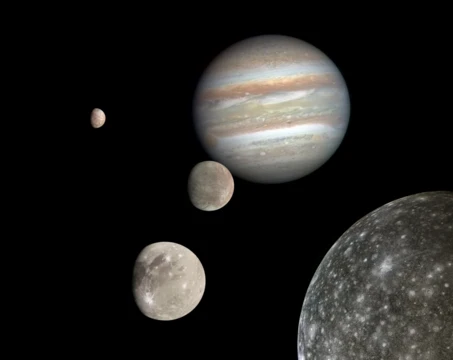
As of April 2026, astronomers have catalogued 115 moons orbiting Jupiter, though this tally excludes meter-sized moonlets shed from inner satellites and hundreds of possible kilometer-sized outer bodies glimpsed only briefly through telescopes. At the heart of this system sit the four Galilean moons—Io, Europa, Ganymede, and Callisto—first spotted in 1610 by both Galileo Galilei and Simon Marius. These were the very first celestial bodies ever observed orbiting something other than Earth or the Sun, a discovery that reshaped humanity's understanding of the cosmos. Their dominance is staggering: all four exceed 3,100 kilometres in diameter, and Ganymede alone ranks as the ninth-largest object in the entire Solar System, outsize even Mercury. Together, the remaining 111 moons and Jupiter's rings account for a mere 0.003 percent of the total mass orbiting the planet. The smaller satellites, detected beginning in 1892, carry names drawn from the mythology of Jupiter's lovers and daughters, a tradition that continues to this day.
Orbital Diversity: From Tidy Circles to Wild Eccentrics
The Jovian satellite system is divided into two broad orbital categories that could not be more different. Eight regular satellites trace prograde, nearly circular paths with only modest tilts relative to Jupiter's equatorial plane. The four Galileans are so massive that gravity has squeezed them into near-spherical shapes, and they are substantial enough that, had they formed in direct orbit around the Sun, they would qualify as planets. The other four regular moons are considerably smaller and hug Jupiter more closely; they are the source of the dust that constitutes Jupiter's ring system. Beyond this orderly inner group lie the outer irregular satellites—107 known in total, of which 58 still lack official names. Their orbits are far more distant, highly inclined, and eccentric, with many revolving in the opposite direction to Jupiter's spin. Estimates suggest roughly 100 irregular moons larger than one kilometre in diameter, plus around 500 smaller retrograde bodies down to 0.8 kilometres. All non-Galilean moons measure under 250 kilometres across, most barely topping five kilometres.
Generations of Moons: The Disk That Built the Galileans
The regular satellites of Jupiter are believed to have coalesced within a circumplanetary disk—a swirling ring of gas and solid debris analogous to the protoplanetary disks that birth planets. Computer simulations indicate that at any given moment the disk held considerable mass, and over Jupiter's early history several tenths of a percent of the material the giant planet pulled from the solar nebula passed through it. Yet only about two percent of that proto-disk mass is needed to account for the satellites we see today, implying that multiple generations of Galilean-mass bodies may have formed, each one eventually spiralling inward under the drag of the disk before a fresh generation condensed from newly captured debris. The present quartet may represent the fifth such generation, formed after the disk had thinned enough to stop disrupting their orbits. Even so, the four Galileans settled into a 1:2:4 orbital resonance—Io, Europa, and Ganymede still locked in this pattern. Because Ganymede is more massive, it migrated inward faster than its smaller siblings. Tidal forces continue to reshape the system, and Callisto is expected to be captured into the resonance in roughly 1.5 billion years, producing a 1:2:4:8 chain.
Captured Wanderers: How the Irregular Moons Came to Be
The outer irregular moons tell a very different origin story. Rather than forming in place, they are thought to have been asteroids originally on solar orbits that Jupiter snared while its proto-lunar disk was still massive enough to absorb their excess momentum and lock them into orbit. Many were shattered during or after capture—either by the mechanical stresses of the gravitational encounter or by later collisions with other small bodies—leaving behind the kilometer-sized fragments we observe today. Numerical models suggest that the Ananke and Carme collisional families arose when planetesimals roughly 0.53 and 0.59 kilometres across struck their parent bodies; the largest surviving fragments still retain 96 and 99 percent of the original mass. The Himalia group, by contrast, likely resulted from a moon-moon collision, since its largest fragment holds only 78 percent of the parent's mass and the parent's assumed 150-kilometre diameter would require an impactor around 13 kilometres wide—far too large to have been common. Among the retrograde satellites, collisions are exceedingly rare: simulations predict only about one impact across all of them in 4.5 billion years.
Frequently Asked Questions
What is 2010: The Year We Make Contact?
It is a 1984 science-fiction film written, shot, and directed by Peter Hyams that continues the story begun in Kubrick's 2001: A Space Odyssey. The movie is based on Arthur C. Clarke's 1982 novel 2010: Odyssey Two and was released in U.S. theaters on December 7, 1984.
What is the plot of 2010: The Year We Make Contact?
A joint American-Soviet crew is dispatched to Jupiter's orbit to determine why the Discovery One mission went silent and what became of its crew. During the voyage they confront a hidden alien presence and learn the true purpose behind the monolith.
Why is 2010: The Year We Make Contact important to fans of the 2001 series?
It remains the only official narrative sequel to 2001: A Space Odyssey, set roughly nine years after the original film's events. Keir Dullea and Douglas Rain both reprise their roles as Dave Bowman and HAL 9000, tying the two stories together directly.
Who stars in 2010: The Year We Make Contact?
The principal cast includes Roy Scheider, Helen Mirren, Bob Balaban, and John Lithgow as the members of the joint mission crew. Keir Dullea and Douglas Rain return from the 1968 original in their familiar capacities.
More in Moons of Jupiter, Part 2 1-24
Spotted an error? Know more?
Reader corrections go straight into our review queue. Suggest an edit · How this site is sourced