Jupiter Moon
A sci-fi soap opera set on a spaceship above Callisto.

Jupiter Moon was a science fiction soap opera that aired on British Satellite Broadcasting's Galaxy channel in 1990. Of the 150 episodes produced, only the first 108 were broadcast before BSB shut down; the remaining episodes finally aired in the UK on the Sci Fi Channel in 1996.
The story takes place in the year 2050, focusing on the spaceship Ilea, which maintains a semi-permanent orbit above a space city on Callisto, one of Jupiter's moons. The Ilea houses a university, and most plotlines revolve around its students, allowing the show to explore everyday issues despite its futuristic setting. A secondary storyline involves the Daedalus Project, an attempt to reach other stars.
The cast included Richard Derrington as Professor Charles Brelan, Anna Chancellor as post-grad Mercedes Page, Alison Dowling as bursar Rebecca Harvey, Carolyn Backhouse as bursar Rosie Greenwood, Andy Rashleigh as Captain Eliot Creasy, Phil Willmott as First Officer Finbow Lewis, Richard Hainsworth as Visiting Flight Officer Paul Fitzroy Drummond, Christopher Simon as Doctor Christophe Chazalon, Kathryn Hurlbutt as Principal Harriet Bullock, Mark Jax as Principal Paul Lockwood, Fiona Sinnott as Captain Natasha Kovitsky, Charlotte Martin as the voice of ship's computer Petra, Nicola Wright as student Victoria Frobisher, Lucy Benjamin as student Fiona McBride, Daniel Beales as student Daniel Wetherby, Suzy Cooper as student Melody Shaw, Anna Pernicci as student Anna Begani, Karen Murden as student Sara Robbins, Fay Masterson as student Gabriella Tanzi, Jamie Glover as student Philippe Gervais, Jim Shepley as student Jim Hawkins, Cheryl Martin as student Jenny Fletcher, Richard Lintern as post-grad James Bromwich, Ashley Russell as post-grad Jean-Francois Baul, Jason Durr as engineer Alex Hartmann, Nick Moran as student Zadock Wilkinson, Peter Polycarpou as Captain Jorge Amado of the Santa Maria, Caroline Evans as post-grad Chantal de Gracy, Dominic Arnold as Doctor Piers Gilpin, Andrew Read as student Tim Shaw, Nikki Brooks as student Herlinde Gothard, and Terry Molloy as Commander Pegleg Johnson.
William Smethurst, a former long-time editor of the BBC radio soap *The Archers*, created and produced the series. It was recorded at Central Television's studios in Birmingham, and many cast and writers had *Archers* backgrounds. The budget came to £6 million for all 150 episodes.
Quick Facts
- Genre
- Science fiction, soap opera
- Creator
- William Smethurst
- Country
- United Kingdom
- Language
- English
- Num Episodes
- 150
- Runtime
- 24 minutes
- Company
- Primetime-Andromeda in association with BSB
- Network
- Galaxy / Sci Fi Channel
- First Aired
- 1990-03-26
- Last Aired
- 1990-11-30 / and / 22 January – / 19 February 1996
Facts from the source article.
Lore & Background
The series was created and produced by William Smethurst, a former long-standing editor of British radio soap The Archers, and was recorded at the studios of Central Television in Birmingham. Many of the cast and writers also came from The Archers. The budget was £6m for 150 episodes. Dr Bob Parkinson of British Aerospace designed the spaceship Ilea using European Space Agency/NASA projections. It was a Primetime-Andromeda Production in association with BSB. The space station Ilea was named after the then-recently abolished Inner London Education Authority. The character Philippe Gervais was named after associate producer Jane Fallon's partner Ricky Gervais.
Reader's Guide
Jupiter Moon was commissioned to fulfil the perceived need for a soap opera in British Satellite Broadcasting's line-up and was shown three times a week (Mondays, Wednesdays, and Fridays at 6.30 pm), with an omnibus edition at weekends on BSB's Galaxy channel from 26 March until 30 November 1990. Only the first 108 episodes were broadcast by BSB because the series was curtailed owing to the merger between BSB and Sky Television plc and the subsequent cessation of the Galaxy channel. Sky was unable to continue the broadcast as its transmission area covered various European territories where Jupiter Moon was already being shown. The later episodes (109–150) were eventually shown in the UK on the Sci Fi Channel between 22 January and 19 February 1996, as part of a complete run of the series. The programme was also broadcast by television channels in countries including Germany, Austria, Switzerland, Greece, Jamaica, Zambia, Gibraltar and several of the Gulf States. The soap was screened on GBC TV (Gibraltar television) ahead of its premiere on BSB's own Galaxy channel, having taken the slot formerly occupied by EastEnders.
The Galilean Moons and Their Revolutionary Discovery
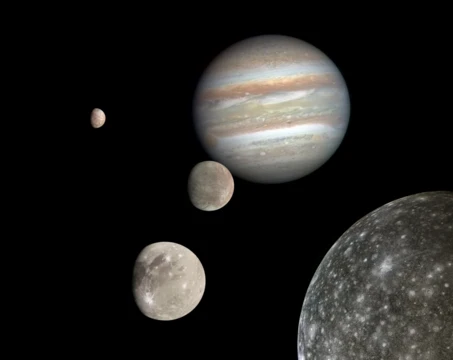
The four Galilean moons—Io, Europa, Ganymede, and Callisto—dominate Jupiter's satellite system, dwarfing everything else that circles the gas giant. In 1610, Galileo Galilei and Simon Marius independently identified these four worlds, marking the first time humans observed objects orbiting a body that was neither Earth nor the Sun. Their sheer scale is staggering: each exceeds 3,100 kilometers in diameter, and Ganymede, the largest, surpasses even Mercury in size, making it the ninth-largest object in the entire Solar System. These four moons are nearly spherical, a consequence of their planetary mass, and are massive enough that, were they placed in direct orbit around the Sun, they would qualify as planets. Together they account for virtually all of the mass orbiting Jupiter; the remaining 111 known moons and the rings combined represent a mere 0.003 percent of the total.
The Broader Jovian System and Its Naming Tradition
As of April 2026, 115 moons of Jupiter have been confirmed, though this tally excludes meter-sized moonlets shed from the inner moons and hundreds of possible kilometer-sized outer irregular moons that were only briefly glimpsed through telescopes. The full collection is colloquially called the Jovian system. Eight moons qualify as regular satellites, tracing prograde, nearly circular paths close to Jupiter's equatorial plane. The four inner regular moons are far smaller than the Galileans and serve as the dust sources feeding Jupiter's rings. Beyond them lie the outer irregular satellites, whose orbits are far more distant, highly inclined, and eccentric, with many moving retrograde. Beginning in 1892, as dozens of these smaller moons were detected, they received names drawn from the lovers, sexual partners, or daughters of the Roman god Jupiter and his Greek counterpart Zeus. Of the 107 known irregular moons, 58 still await official naming. Jupiter is expected to host roughly 100 irregular moons larger than one kilometer in diameter, plus around 500 smaller retrograde moons down to 0.8 kilometers.
The Birth of the Regular Moons and Orbital Resonance
Jupiter's regular satellites are believed to have coalesced from a circumplanetary disk—a swirling ring of gas and solid debris comparable in structure to the protoplanetary disks that birth planets. Simulations indicate that while the disk maintained a relatively high mass at any given moment, over Jupiter's long history a substantial fraction of the material it captured from the solar nebula passed through it. Yet only two percent of the original proto-disk mass is needed to account for the satellites we observe today. This gap suggests that several generations of Galilean-mass moons may have formed, each generation spiraling inward and being consumed by Jupiter through disk drag, only for new moons to form from fresh debris. By the time the present generation—possibly the fifth—emerged, the disk had thinned enough to stop disrupting their orbits. The current Galilean moons settled into a 1:2:4 orbital resonance among Io, Europa, and Ganymede. Tidal dissipation continues, and Callisto is expected to be drawn into this chain in roughly 1.5 billion years, producing a 1:2:4:8 configuration.
Captured Asteroids and the Collisional Families
The outer irregular moons of Jupiter are thought to be captured asteroids, their momentum absorbed by the still-massive proto-lunar disk in the early Solar System. Many were shattered during capture or by subsequent collisions, giving rise to the kilometer-sized fragments we observe today as collisional families sharing similar orbits. The Ananke and Carme groups likely originated from impacts with passing planetesimals rather than moon-moon collisions. The required impactor diameters—0.53 and 0.59 kilometers—were common in the early Solar System, and the largest surviving fragments retain 96 and 99 percent of their parent bodies' mass. The Himalia group, by contrast, probably formed from a moon-moon collision; its largest fragment holds only 78 percent of the parent's mass, and the parent's assumed 150-kilometer diameter demands a far more energetic impact with an impactor of roughly 13 kilometers—too large to have been a common planetesimal. Collisions among retrograde moons are exceedingly rare, with numerical integrations suggesting only about one such event across all retrograde moons in 4.5 billion years.
Frequently Asked Questions
What is Jupiter Moon?
Jupiter Moon is a British science-fiction soap opera that premiered in 1990 on the Galaxy channel, which was operated by British Satellite Broadcasting. The series was created and produced by William Smethurst and carried a production budget of roughly £6 million.
Where and when is Jupiter Moon set?
The story unfolds in the year 2050 aboard the Ilea, a spaceship that keeps a semi-permanent orbit above a space city on Callisto, one of Jupiter's moons. The Ilea houses a university, and most of the ongoing plotlines follow its student body.
Why did Jupiter Moon end after only 108 episodes?
Although 150 episodes were originally commissioned, British Satellite Broadcasting folded before the full run could be transmitted on the Galaxy channel. The remaining unaired episodes finally reached UK audiences on the Sci Fi Channel in 1996.
What kind of show is Jupiter Moon?
Despite its futuristic space-ship setting, Jupiter Moon operates primarily as a soap opera, using the university aboard the Ilea as a backdrop to explore everyday interpersonal drama among students and staff.
Who created and produced Jupiter Moon?
William Smethurst served as both the creator and the producer of the series, overseeing its development and production for BSB's Galaxy channel in 1990.
More in Moons of Jupiter, Part 2 1-24
Spotted an error? Know more?
Reader corrections go straight into our review queue. Suggest an edit · How this site is sourced