Not Final!
A story of Jovian threat and ironic technological discovery.

"Not Final!" is a science fiction short story by American writer Isaac Asimov. It first appeared in the October 1941 issue of *Astounding Science Fiction* and was later collected in *The Early Asimov* (1972). The story is one of the few Asimov works to feature non-human intelligences within the Solar System; its sequel, "Victory Unintentional," is a robot story.
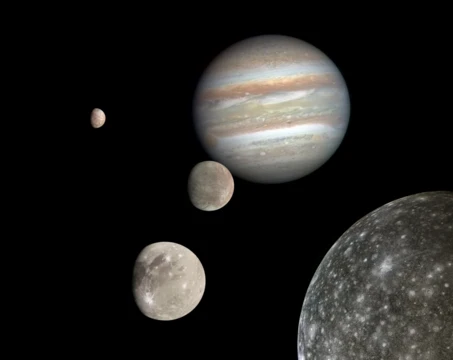
The plot follows Earth colonists on Ganymede, Jupiter’s largest moon, who discover intelligent life on Jupiter’s surface. They establish communication through a radio-click code and exchange scientific knowledge. When the Jovians realize humans are different, they break off contact and threaten to destroy what they consider inferior beings. Scientists on Ganymede conclude that any Jovian ship would need force-field technology to leave Jupiter, but experiments show such a field cannot be sustained long enough to hold Earth’s air pressure, let alone Jupiter’s. The lead scientist, a brilliant theoretician, predicts this and proves it with an explosion. Colonial Commissioner Nicholas Orloff, sent to assess the threat, reports to Earth that the danger is over.
Meanwhile, a ship en route to Ganymede to retrieve Orloff uses force-field technology in an unexpected way. A technician, through trial and error, discovered the field explodes—losing an arm and an eye in the process—but circumvented this by rapidly switching the field on and off, never leaving it on long enough to explode nor off long enough to lose air. The story ends with the line, "I imagine he'll be rather pleased," referring to Orloff’s reaction to the new technology. The irony is that this development means the Jovians can overcome their technical obstacle and eventually wage war on humanity. The story highlights a tension between theoretical and practical approaches, with the scientist declaring the technology impossible ("That's final! That's final!") and the technician’s hands-on methods reflected in the title.
Asimov wrote "Not Final!" in late May 1941, after failing his qualifying exams for a PhD in chemistry at Columbia University. He submitted it to John W. Campbell on June 2, 1941, and it was accepted on June 6, though without a bonus. The sequel, "Victory Unintentional," followed in 1942. Both stories are among Asimov’s few to posit extraterrestrial intelligence in the Solar System.
Quick Facts
- Author
- Isaac Asimov
- Country
- United States
- Language
- English
- Series
- Jovian Menace
- Genre
- Science fiction
- Publication Type
- Periodical
- Published In
- Astounding Science Fiction
- Publisher
- Street & Smith
- Media Type
- Print (Magazine, Hardback & Paperback)
- Pub Date
- October 1941
- Followed By
- Victory Unintentional
Facts from the source article.
Lore & Background
The story follows Earth colonists on Ganymede who discover intelligent life on Jupiter's surface and establish communication via a "radio-click" code. When the Jovians learn humans are not like them, they break off communication and threaten destruction. Scientists on Ganymede determine that no Jovian ship could leave Jupiter without force-field technology, and experimentally prove that such a field cannot exist for more than a fraction of a second at the needed strength—ending the threat. Meanwhile, a ship headed for Ganymede uses force-field technology in an unanticipated way: a technician discovered by trial and error that turning the field on and off at high frequency prevents the explosion that otherwise occurs, allowing the field to function. The ending line, "I imagine he'll be rather pleased," is ironic because the reader knows this technology will enable the Jovians to overcome their limitations and wage war on humanity.
Reader's Guide
The story illustrates a tension between the theoretical ("Scientific") attitude and the practical ("Technical") one, exemplified by the prominent scientist claiming his theory shows the force-field technology to be impossible ("That's final! That's final!"), mirrored by the technician's account of his methods and by the story's title. It is one of Asimov's early short stories, written at the end of his third year writing for science fiction magazines. After selling "Nightfall" in late April 1941, Asimov took a break to study for qualifying exams for a PhD in chemistry at Columbia University; he failed the exams and, disheartened, did not return to writing until 24 May, when he began "Not Final!". He submitted it to John W. Campbell on 2 June, and it was accepted on 6 June without a bonus. The story and its sequel are among the few Asimov wrote that include the idea of extra-terrestrial intelligence in the Solar System.
Did You Know?
- The story was written after Asimov failed his qualifying exams for a PhD in chemistry at Columbia University.
- It was accepted by John W. Campbell on 6 June 1941, but without a bonus.
- The story's title reflects the tension between theoretical and practical approaches to science.
Frequently Asked Questions
What is Not Final!?
'Not Final!' is a 1941 science fiction short story by Isaac Asimov in which human colonists on Ganymede make first contact with intelligent beings living on Jupiter's surface. It stands out as one of the rare Asimov works that places non-human minds inside our own Solar System rather than among distant stars.
Where is Not Final! set?
The action unfolds on Ganymede, Jupiter's largest satellite, where an Earth colony has taken root. The Jovian intelligences the colonists encounter reside on Jupiter itself, making it a notable example of fiction depicting sentient life on a gas giant's surface.
Who wrote Not Final! and where did it first appear?
Isaac Asimov authored the story, and it debuted in the October 1941 issue of Astounding Science Fiction. It was later gathered into the 1972 omnibus collection The Early Asimov.
What happens in Not Final!?
Earth colonists on Ganymede discover a thinking species on Jupiter and build a radio-click code to trade scientific knowledge with them. The Jovians then pose a serious threat, pushing the humans into a desperate technological gamble that resolves with an ironic twist.
Is there a sequel to Not Final!?
Yes; Asimov followed up with 'Victory Unintentional' in 1942, which shifts the narrative focus to a robot while continuing the broader Jovian conflict. The two stories together form a loose two-part arc exploring humanity's fraught encounter with alien intelligence.
More in Moons of Jupiter, Part 2 1-24
Spotted an error? Know more?
Reader corrections go straight into our review queue. Suggest an edit · How this site is sourced