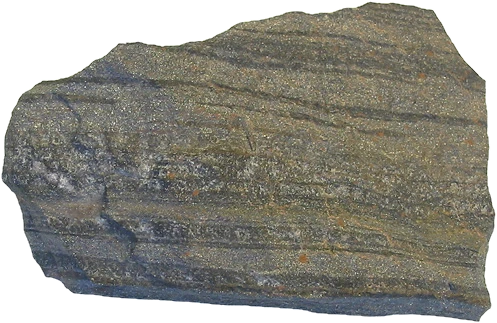
Siderite
Last updated
Containing 48% iron and being free of sulfur and phosphorus makes siderite a useful iron ore.[1]
Key facts and history
Zinc, magnesium, and manganese commonly substitute for iron in siderite.[1] Sir Thomas Lethbridge developed specific techniques for these ores in the early nineteenth century, with his 1838 'Iron Mill' using a three-chambered roasting furnace.[2] Below a Néel temperature of 37 K, siderite exhibits antiferromagnetic properties.[3] Hydrothermal veins are a common setting for siderite, where it occurs alongside minerals such as barite, fluorite, and galena.[4]
As a diagenetic mineral, siderite frequently appears in shales and sandstones, occasionally forming concretions that can preserve fossils in three dimensions.[4] Compared to oxide ores like haematite, carbonate ore requires more energy to smelt because the carbon dioxide must be driven off, which can disrupt a blast furnace if added directly.[2]
What the research sources say
A Science News report states that the Curiosity rover found siderite in the Gale crater on Mars.[5] The samples contained between 5 and 10 percent siderite by weight.[5] Planetary scientist Janice Bishop stated that this siderite explains where missing carbonate is and how the ancient Martian atmosphere could have supported liquid water.[5] Within sulfate-bearing layers, the research team identified siderite.[5]
References
- Wikipedia, "Siderite" (CC BY-SA 4.0) en.wikipedia.org
- Wikipedia, "Siderite" (CC BY-SA 4.0), which cites: Jones, "The Brendon Hills Iron Mines and the West Somerset Mineral Railway", Lightmoor Press, 2011, p. 17–22 (we also read that source) en.wikipedia.org
- Wikipedia, "Siderite" (CC BY-SA 4.0), which cites: Frederichs, "Towards the identification of siderite, rhodochrosite, and vivianite in sediments by their low-temperature magnetic properties", Physics and Chemistry of the Earth, Parts A/B/C, January 2003, p. 669–679 (original not read by us) en.wikipedia.org
- Wikipedia, "Siderite" (CC BY-SA 4.0), which cites: Garwood, "High-fidelity X-ray micro-tomography reconstruction of siderite-hosted Carboniferous arachnids", Biology Letters, 2009, p. 841–844; Mozley, "Relation between depositional environment and the elemental composition of early diagenetic siderite", Geology, 1989, p. 704–706; Ludvigson, "Meteoric sphaerosiderite lines and their use for paleohydrology and paleoclimatology", Geology, 1998, p. 1039–1042; Janice Bishop and M. Lane, Catching a glimpse of ancient Mars, Science, Vol. 388, April 18, 2025, p. 251. doi: 10.1126/science.adw4889; Benj en.wikipedia.org
- Grossman, Lisa, A NASA rover finally found Mars’ missing carbon: The finding could help explain why Mars lost its habitable climate, Science News, April 17, 202. facts only, no text reused. sciencenews.org
Each numbered sentence above was checked against the source it cites before publication. Sentences citing Wikipedia adapt text from the English Wikipedia article Siderite (contributors), used under CC BY-SA 4.0; this entry is available under the same licence. Other sources were used for facts only; no text or images are copied from them.
More in Minerals & Ore Deposits
Sources
Compiled from Wikipedia and the sources listed below. Text from Wikipedia is available under CC BY-SA 4.0; this entry is adapted from it.
- Wikipedia: Siderite (CC BY-SA 4.0).
- Word definitions: the Codexery glossary, each quoted from its Wikipedia article.
Spotted an error? Know more?
Reader corrections go straight into our review queue. Suggest an edit · How this site is sourced