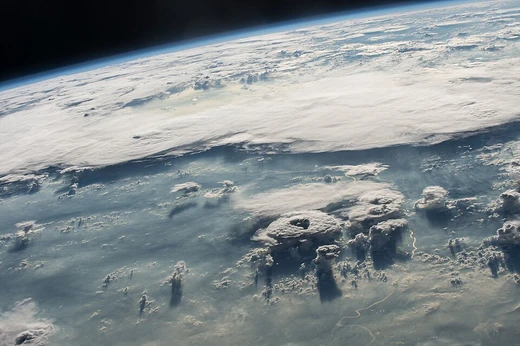
Weather
Weather is the state of the atmosphere at a given time and place.
Weather is the state of the Earth's atmosphere at a specific place and time, typically described in terms of temperature, humidity, cloud cover, and stability. On Earth, most weather phenomena occur in the troposphere, the lowest atmospheric layer just below the stratosphere, though weather can also occur in the stratosphere and influence conditions lower down, though the exact mechanisms are not well understood. Weather is driven by differences in air pressure, temperature, and moisture from one location to another. These differences arise primarily from variations in the Sun’s angle, which changes with latitude: areas farther from the tropics receive less direct sunlight, making them cooler. The strong temperature contrast between polar and tropical air generates large-scale atmospheric circulations, including the Hadley cell, Ferrel cell, polar cell, and the jet stream. In the middle latitudes, weather systems like extratropical cyclones are caused by instabilities in the jet stream flow, while tropical systems such as monsoons and organized thunderstorms result from different processes. Earth’s axial tilt relative to its orbital plane causes sunlight to strike at varying angles throughout the year, creating seasons. Over thousands to hundreds of thousands of years, changes in Earth’s orbital parameters alter the distribution of solar energy, influencing long-term climate. Surface temperature differences lead to pressure differences; warmer surfaces heat the air above, causing it to expand and lower pressure, which drives wind as air moves from high to low pressure, with Earth’s rotation deflecting this flow. Higher altitudes are generally cooler due to surface heating and radiational loss, though temperature inversions can occur, where temperature increases with height, sometimes capping thunderstorm development or forming fog. Different surfaces—such as oceans, forests, or ice—have varying reflectivity, roughness, and moisture content, creating local temperature differences. Weather forecasting applies science and technology to predict future atmospheric states, but Earth’s weather system is chaotic, meaning small changes can grow into large effects. Human activities like agriculture and industry have modified weather patterns, and attempts to control weather have occurred throughout history. Studying weather on other planets, such as Jupiter’s long-liv
- field
- Atmospheric science
- known_for
- Day-to-day atmospheric conditions and weather phenomena
- key_processes
- Air pressure, temperature, moisture differences, solar heating
- primary_layer
- Troposphere
- chaotic_nature
- Chaotic system; small changes can cause large effects
Lore & Background
Weather is driven by differences in air pressure, temperature, and moisture, which result from the Sun's angle varying with latitude. The strong temperature contrast between polar and tropical air gives rise to large-scale circulations like the Hadley cell, Ferrel cell, polar cell, and jet stream. Weather systems in the middle latitudes, such as extratropical cyclones, are caused by instabilities of the jet stream flow. Because Earth's axis is tilted relative to its orbital plane, sunlight is incident at different angles at different times of the year, causing seasons. Over thousands of years, changes in Earth's orbit affect the amount and distribution of solar energy, influencing long-term climate.
Reader's Guide
Weather is a fundamental process that shapes the Earth through weathering, breaking down rocks and soils. Rainwater absorbs carbon dioxide, becoming slightly acidic, which aids erosion. The released sediment and chemicals participate in chemical reactions that affect the surface, such as acid rain, and deposit salts in oceans. Weather also has direct effects on humans, with tornadoes causing significant fatalities and property damage. The atmosphere is a chaotic system, making weather forecasting difficult beyond a few days, and it is theoretically impossible to make useful day-to-day predictions more than about two weeks ahead. Studying weather on other planets, such as Jupiter's Great Red Spot, has helped understand Earth's weather. Human activities like agriculture and industry have modified weather patterns.
Did You Know?
- Most weather phenomena occur in the troposphere, just below the stratosphere.
- The strong temperature contrast between polar and tropical air gives rise to the Hadley cell, Ferrel cell, polar cell, and jet stream.
- It is theoretically impossible to make useful day-to-day weather predictions more than about two weeks ahead.
More in Meteorology 1-24
Spotted an error? Know more?
This is a living reference — every entry is fact-audited, and reader corrections feed straight into our audit queue. Suggest an edit · See this site's audit record