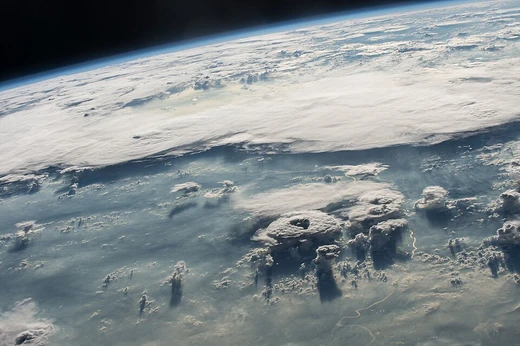
Hail
Solid ice precipitation from thunderstorms, often damaging.

Hail is a solid form of precipitation composed of balls or irregular lumps of ice, each known as a hailstone. It is often confused with ice pellets, called sleet in American English, but the two are distinct. Ice pellets typically fall during cold weather, whereas hail growth is significantly inhibited when surface temperatures are low. Unlike other ice-based precipitation such as graupel (which is rime ice), smaller and translucent ice pellets, or delicate snow crystals, hailstones generally measure between a certain range in diameter. The METAR reporting code for hail of a specific size or greater is GR, while smaller hailstones and graupel are coded GS. Hail is possible during most thunderstorms, as it is produced by cumulonimbus clouds, and can occur within a certain distance of the parent storm. Its formation requires strong upward air motion within the thunderstorm, similar to conditions that produce tornadoes, and a lowered freezing level. In mid-latitudes, hail forms near continental interiors, while in the tropics it is mostly confined to high elevations. Weather satellites and radar can detect hail-producing storms. Hailstones generally fall faster as they grow, though melting, air friction, wind, and interaction with rain and other hailstones can slow their descent. Severe weather warnings are issued for hail that reaches a damaging size, as it can seriously harm structures and, most commonly, farmers' crops. A hailstorm is defined as any thunderstorm that produces hail reaching the ground. An ice crystal with a diameter greater than a certain threshold is considered a hailstone, and hailstones can grow to very large sizes and weigh more than a certain amount. Unlike ice pellets, hailstones are often layered, irregular, and can clump together. They are composed of transparent ice or alternating layers of transparent and translucent ice at least a certain thickness, deposited as the hailstone travels through the cloud, suspended by strong updrafts until its weight overcomes them and it falls. The average observation of damaging hail in the United States falls between a certain size and golf-ball size. Stones larger than a specific diameter are usually considered large enough to cause damage, with different countries setting thresholds based on local sensitivities, such as in grape-growing areas. Weaker hailstorms produce smaller hailstones than str
- type
- Atmospheric precipitation
- composition
- Transparent ice or alternating layers of transparent and translucent ice
- typical_size
- 5 mm (0.2 in) to 15 cm (6 in) in diameter
- maximum_weight
- More than 0.5 kg (1.1 lb)
- formation_environment
- Strong updrafts in thunderstorms, especially supercells
- common_regions
- Continental interiors of mid-latitudes; high elevations in tropics
Lore & Background
Hail is a form of solid precipitation distinct from ice pellets, graupel, and snow. It consists of balls or irregular lumps of ice called hailstones, which typically measure between 5 mm and 15 cm in diameter, though stones larger than 5 mm are considered true hail. Hailstones are often layered, composed of alternating transparent and translucent ice at least 1 mm thick, giving them an onion-like cross-section. This layering results from the hailstone’s journey through a thunderstorm’s updraft, where it encounters varying concentrations of supercooled water droplets and water vapor. In areas with many droplets, it acquires a translucent layer; in areas of mostly vapor, it gains an opaque white layer. Hail forms in strong cumulonimbus clouds with intense updrafts, high liquid-water content, and a freezing level low enough to support ice growth. It occurs most frequently in the mid-latitudes near continental interiors, while in the tropics it is confined to high elevations. Hailstones grow as they are suspended aloft by upward-moving air until their weight overcomes the updraft and they fall. Larger stones fall faster, though melting, air friction, wind, and interactions with rain can slow their descent. Hail can cause serious damage to structures and crops, with stones larger than 2 cm (0.79 in) typically considered damaging. The METAR code for hail 5 mm or greater is GR; smaller hailstones and graupel are coded GS.
Reader's Guide
Hail is a significant meteorological phenomenon due to its potential for severe damage to structures and agriculture. The layered structure of hailstones, once thought to require multiple ascents and descents, is now understood to result from a single trajectory through varying humidity and supercooled water droplet concentrations. Hail is most common in mid-latitude continental interiors, where dry air intrusion can lower the freezing level and promote growth. In the tropics, hail is rare except at high elevations. Detection methods using weather satellites and radar exist, and severe weather warnings are issued based on size thresholds that vary by country. Hailstones can reach 15 cm in diameter and weigh over 0.5 kg, falling at speeds influenced by melting, friction, wind, and interaction with rain.
Did You Know?
- Hailstones can grow to 15 cm (6 in) in diameter and weigh more than 0.5 kg (1.1 lb).
- The METAR code for hail 5 mm or greater is GR; smaller hailstones and graupel are coded GS.
- Hail growth becomes vanishingly small when air temperatures fall below −30 °C (−22 °F).
More in Meteorology 1-24
Spotted an error? Know more?
This is a living reference — every entry is fact-audited, and reader corrections feed straight into our audit queue. Suggest an edit · See this site's audit record