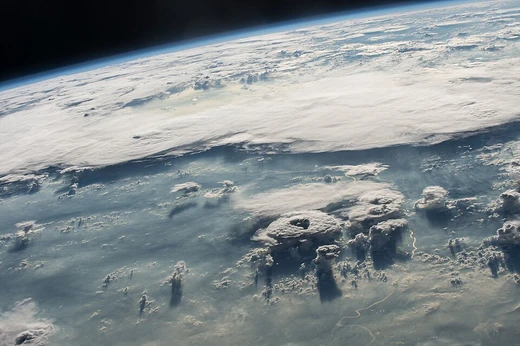
High-pressure area
High-pressure areas bring clear skies and light winds.

A high-pressure area, also known as an anticyclone, is a region near a planet's surface where atmospheric pressure is greater than in surrounding areas. These middle-scale meteorological features result from interactions within the larger-scale dynamics of a planet's atmospheric circulation. The strongest high-pressure systems form from masses of cold air that spread outward from polar regions, though they weaken when moving over warmer bodies of water. More common but weaker highs arise from atmospheric subsidence, where air cools enough to precipitate its water vapor, and large masses of cooler, drier air descend from above. Within these systems, winds flow from the center, where pressure is highest, toward the periphery, but the Coriolis effect from Earth's rotation bends their direction opposite to the planet's rotation. In the Northern Hemisphere, high-pressure winds rotate clockwise; in the Southern Hemisphere, they rotate counterclockwise. On English-language weather maps, these centers are marked with the letter H. The term "anticyclone" was coined in 1877 by Francis Galton. High-pressure areas typically bring light surface winds and subsidence through the lower troposphere, which dries air through compressional heating, resulting in clear skies. During the day, this leads to warmer temperatures; at night, the lack of clouds allows heat to escape, causing cooler lows. In temperate latitudes, highs bring warm weather in summer and cold weather in winter. In the Southern Hemisphere, the subtropical ridge produces hot, dry summers and cooler, wetter winters. Highs form beneath the western side of upper-level troughs, where converging winds occur near the 500 hPa pressure level. When surface winds are light, subsidence can trap particulates, creating haze, and if humidity nears 100 percent overnight, fog may develop. Arctic air masses associated with strong, shallow highs modify rapidly over unfrozen oceans, reducing the system's strength. The horse latitudes, near the 30th parallel, are the source of warm high-pressure systems, part of the Hadley cell circulation known as the subtropical ridge, which expands north and south following the sun.
- field
- Meteorology
- known_for
- Bringing clear skies, light winds, and fair weather; rotating clockwise in the Northern Hemisphere and counterclockwise in the Southern Hemisphere
- type
- Meteorological phenomenon
Lore & Background
High-pressure areas form due to downward motion through the troposphere, often beneath the western side of troughs in the synoptic flow pattern. The strongest highs result from masses of cold air spreading from polar regions, weakening over warmer water. Weaker but more frequent highs arise from atmospheric subsidence, where air cools, precipitates water vapor, and descends as cooler, drier air. Winds within a high-pressure system flow from the center outward but are curved by the Coriolis effect: clockwise in the Northern Hemisphere and counterclockwise in the Southern Hemisphere. On English-language weather maps, high-pressure centers are marked with the letter H. In temperate latitudes, highs generally bring warm weather in summer and cold weather in winter. The subtropical ridge, a warm core high-pressure system, follows the sun's track and is responsible for many of the world's deserts. The Siberian High is a notable cold core high that can remain quasi-stationary for over a month.
Reader's Guide
High-pressure areas are fundamental to understanding global weather patterns. They are associated with subsidence, which dries the air and typically produces clear skies, though they can also lead to fog or haze under certain conditions. Their rotation direction, opposite in each hemisphere due to the Coriolis effect, governs the movement of air masses and influences the tracks of storms. Climatologically, persistent high-pressure systems like the subtropical ridge shape the world's desert belts and drive seasonal weather patterns, such as the summer heat waves in western Europe from the Azores High. Understanding highs is crucial for forecasting daily weather, predicting heat waves, and analyzing long-term climate dynamics.
Did You Know?
- High-pressure systems rotate clockwise in the Northern Hemisphere and counterclockwise in the Southern Hemisphere.
- The subtropical ridge, a warm core high-pressure system, is responsible for many of the world's deserts.
More in Meteorology 1-24
Spotted an error? Know more?
This is a living reference — every entry is fact-audited, and reader corrections feed straight into our audit queue. Suggest an edit · See this site's audit record