Fog
Low-lying cloud that reduces visibility and hosts active microbiomes.

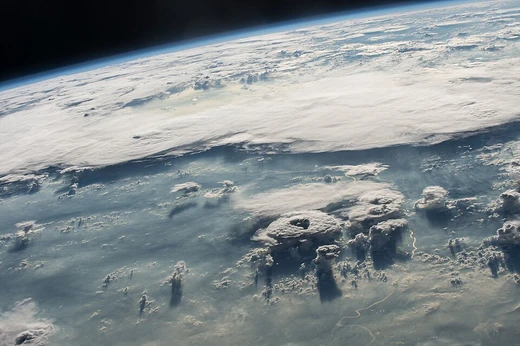
Fog is a visible haze of tiny water droplets or ice crystals that hangs in the air just above the ground. Think of it as a low-lying cloud, much like stratus, and its formation is heavily shaped by nearby water, the lay of the land, and the wind. This phenomenon has a big impact on things like shipping, travel, and warfare. More surprisingly, recent atmospheric studies show that fog acts as a living aquatic ecosystem: its droplets host bacteria that grow, divide, and interact with the chemistry of the air.
Fog forms when water vapor—water in its gaseous state—condenses. During this process, vapor molecules clump together into tiny droplets that stay suspended. Sea fog, for instance, appears near salty water when vapor condenses on salt particles. Fog is similar to mist but less transparent.
By definition, fog is different from a generic cloud because it sits low and its moisture often comes from local sources—like a lake, ocean, wet ground, or marshes. Fog cuts visibility to less than 1 kilometer (0.62 miles), while mist reduces it less severely.
For fog to form, the air temperature and dew point must be within 2.5 °C (4.5 °F) of each other. Condensation happens when water vapor turns into droplets, triggered by things like wind convergence, falling precipitation or virga, daytime heating evaporating water from oceans or wet land, transpiration from plants, cool or dry air moving over warmer water, or air lifting over mountains. Water vapor usually needs condensation nuclei—dust, ice, or salt—to form droplets. Fog, like its elevated cousin stratus, is a stable cloud deck that tends to form when a cool, stable air mass gets trapped under a warm one.
Fog typically occurs when relative humidity is near 100%, either from added moisture or a drop in air temperature. But it can form at lower humidities, and sometimes it fails to form even at 100% humidity. At that point, the air can’t hold more moisture, so it becomes supersaturated if extra moisture is added.
Fog often produces drizzle or very light snow. Drizzle happens when humidity hits 100% and tiny cloud droplets merge into bigger ones. This can occur when the fog layer lifts and cools, or when descending air compresses it from above. If the surface temperature is below freezing, that drizzle becomes freezing drizzle.
The thickness of a fog layer depends largely on the altitude of the inversion boundary—the point where the air above is warmer and drier. In coastal or oceanic areas, this boundary is also the top of the marine layer. The inversion’s height changes mainly with atmospheric pressure: high pressure squashes the marine layer and any fog bank, while lower pressure lets it expand upward.
Research on overland radiation fogs shows that fog droplets are an active microhabitat. Fog water contains bacterial concentrations similar to those in lakes or oceans. The fog microbiome differs from the dry aerosol microbiome, being enriched with specific bacteria—especially pink-pigmented, photoheterotrophic *Methylobacterium* species. Bacteria in fog water grow larger in cell volume and divide more actively than those in dry air, indicating real biological growth. After fog dissipates, the concentration of these bacteria in the local air can rise by an average of 45%.
Fogs are classified by how they form. Radiation fog happens when the Earth’s surface and lower atmosphere cool after sunset under clear, calm skies. The ground radiates heat absorbed during the day, cooling itself and then the air above it by conduction. This creates an inversion where the air near the ground is cooler than the air above. If that lower air is humid enough to reach the dew point, fog forms. Moderate to strong winds prevent fog by mixing the air, but a slight breeze can spread the cooled surface air, producing a fog layer several hundred feet deep. Low soil conductivity helps by limiting heat flow upward, letting radiative cooling dominate. High soil moisture boosts humidity just above the ground, aiding fog formation. Radiation fog is most common over swamps and in valleys where cold air collects. It covers wide areas but can’t form over water. It usually starts in the late afternoon and is thickest just after sunrise, when the sun’s energy increases turbulence before it’s strong enough to evaporate the droplets. In summer, longer days mean the ground is heated more.
- definition
- Reduces visibility to less than 1 km (0.62 mi)
- formation_condition
- Difference between air temperature and dew point less than 2.5 °C (4.5 °F)
- relative_humidity
- Normally near 100%
- types
- Radiation, ground, advection, frontal, sea fog
- microbiome
- Contains bacterial concentrations similar to bodies of water
Lore & Background
Fog is a visible aerosol of tiny water droplets or ice crystals suspended in the air near the Earth's surface, resembling a low-lying stratus cloud. Its appearance is heavily shaped by nearby bodies of water, topography, and wind conditions. Fog forms when the difference between air temperature and the dew point is less than a certain threshold, and water vapor condenses on nuclei such as dust, ice, or salt. Sea fog, for instance, arises when vapor condenses on salt particles from saline water. Fog is less transparent than mist, and by definition reduces visibility to less than a specified distance, whereas mist causes lesser impairment. Fog commonly produces drizzle or very light snow when humidity reaches 100% and droplets coalesce; this drizzle can become freezing drizzle if surface temperatures drop below freezing. The thickness of a fog layer is largely determined by the altitude of an inversion boundary, which in coastal areas is also the top of the marine layer. This boundary is compressed under high atmospheric pressure and expands under lower pressure. Fog also functions as an active aquatic ecosystem: its droplets harbor microbiomes where bacteria grow, divide, and interact with atmospheric chemistry. Fog water contains bacterial concentrations similar to those in bodies of water, and its microbiome is enriched with specific taxa, such as pink-pigmented Methylobacterium species. Bacteria in fog droplets increase in cell volume and show higher rates of division than those in dry air, and after fog dissipates, local airborne bacterial concentrations rise by an average of 45%.
Reader's Guide
Fog is significant for its impact on human activities, including shipping, travel, and warfare, by severely reducing visibility. It also plays a role in atmospheric chemistry and ecology, as fog droplets harbor microbiomes where bacteria actively grow and divide. Research shows that fog water contains bacterial concentrations similar to continental or marine bodies of water, and after fog dissipates, local bacterial concentrations can increase by an average of 45%. Fog types, such as radiation fog and advection fog, are shaped by local topography, wind conditions, and nearby bodies of water, influencing weather patterns and environmental conditions.
Did You Know?
- Fog reduces visibility to less than 1 km (0.62 mi), while mist causes lesser impairment.
- Fog droplets harbor microbiomes where bacteria actively grow, divide, and interact with atmospheric chemistry.
- Sea fog forms as water vapor condenses on bits of salt near saline water.
- After fog dissipates, the concentration of certain bacteria in the local air can increase by an average of 45%.
More in Meteorology 1-24
Spotted an error? Know more?
This is a living reference — every entry is fact-audited, and reader corrections feed straight into our audit queue. Suggest an edit · See this site's audit record