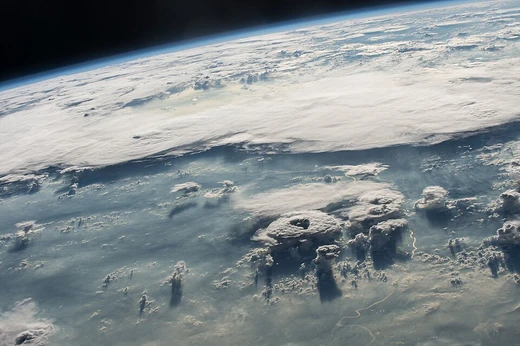
Extratropical cyclone
Large-scale low-pressure systems that drive mid-latitude weather.

Extratropical cyclones, also called mid-latitude cyclones or wave cyclones, are large-scale low-pressure weather systems that occur in the middle latitudes of Earth, typically between 30° and 60° latitude. Along with anticyclones, they drive much of the weather over the mid-latitudes, producing conditions ranging from mild showers and cloudiness to severe hail, thunderstorms, blizzards, and tornadoes. Unlike tropical cyclones, they are associated with rapid changes in temperature and dew point along weather fronts. These systems are primarily baroclinic, forming along zones of temperature and dew point gradient known as frontal zones, though they can become barotropic late in their life cycle when the heat distribution around the cyclone becomes more uniform. Cyclogenesis occurs along these frontal zones near a favorable quadrant of an upper-level jet stream feature called a jet streak, where divergence aloft reduces surface pressure and strengthens the low. As the cyclone intensifies, its cold front sweeps toward the equator while the warm front advances more slowly. Eventually, the cold front overtakes part of the warm front, forcing a tongue of warm air aloft in a process called occlusion, after which the cyclone becomes barotropically cold and weakens. When atmospheric pressure falls very rapidly—more than a certain rate per hour—the process is termed explosive cyclogenesis, and the cyclone is called a bomb. Such bombs can drop to pressures below those of category 5 hurricanes under favorable conditions, such as near strong natural temperature gradients like the Gulf Stream. Hurricane-force extratropical cyclones are most likely in the northern Atlantic and Pacific during December and January. Tropical cyclones often transform into extratropical cyclones between 30° and 40° latitude, a process known as extratropical transition, during which they are sometimes called post-tropical cyclones.
- type
- Large-scale low-pressure weather system
- location
- Middle latitudes of Earth (30°–60° latitude)
- classification
- Baroclinic (forming along frontal zones); can become barotropic late in life cycle
- associated_phenomena
- Wind, cloudiness, mild showers, severe hail, thunderstorms, blizzards, tornadoes
- rotation
- Counterclockwise in Northern Hemisphere, clockwise in Southern Hemisphere (cyclonic)
Lore & Background
Extratropical cyclones form anywhere within extratropical regions, usually between 30° and 60° latitude, through cyclogenesis or extratropical transition. Cyclogenesis occurs along linear bands of temperature and dew point gradient with significant vertical wind shear, classified as baroclinic cyclones. Initially, low pressure forms near a favorable quadrant of an upper-level jet streak, where divergence causes air to rush out from the top of the air column, reducing surface pressure and strengthening the cyclone. As the cyclone strengthens, the cold front sweeps toward the equator and around the back of the system, while the warm front progresses more slowly. Eventually, the cyclone occludes as the cold front overtakes part of the warm front, forcing a tongue of warm air aloft, and the cyclone becomes barotropically cold and weakens. Tropical cyclones often transform into extratropical cyclones at the end of their tropical existence, usually between 30° and 40° latitude, through extratropical transition. During this process, the cyclone forms or connects with nearby fronts, its size increases, its core weakens, and its primary energy source shifts from latent heat release to baroclinic processes. The cyclone loses its warm core and becomes cold-core. On rare occasions, an extratropical cyclone can transform into a tropical cyclone if it reaches warmer waters and less vertical wind shear. The Joint Typhoon Warning Center uses the extratropical transition (XT) technique to estimate intensity of transitioning cyclones based on satellite imagery.
Reader's Guide
Extratropical cyclones are fundamental to understanding mid-latitude weather patterns, as they are the primary drivers of day-to-day weather changes across large portions of Earth. Their ability to produce a wide range of conditions—from mild showers to severe thunderstorms, blizzards, and tornadoes—makes them critical for weather forecasting and hazard preparedness. The study of these cyclones has revealed that they form along temperature and dew point gradients (frontal zones) and are influenced by upper-level jet streaks, with explosive cyclogenesis occurring when pressure drops more than 1 millibar per hour. Their transition from tropical cyclones and occasional transformation back into tropical systems highlights the complex interactions between different cyclone types. Understanding extratropical cyclones is essential for predicting severe weather events, maritime safety, and climate studies, as they influence temperature, precipitation, and wind patterns across the mid-latitudes.
Did You Know?
- Extratropical cyclones are capable of producing severe hail, thunderstorms, blizzards, and tornadoes.
- When atmospheric pressure falls more than 1 millibar per hour, the process is called explosive cyclogenesis, and the cyclone can be described as a bomb.
More in Meteorology 1-24
Spotted an error? Know more?
This is a living reference — every entry is fact-audited, and reader corrections feed straight into our audit queue. Suggest an edit · See this site's audit record