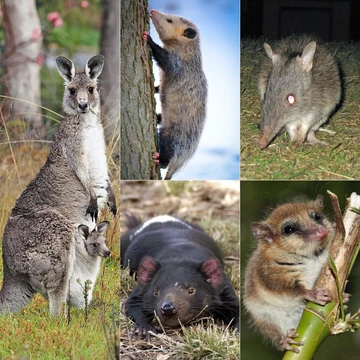
Wallaroo
Moderately large macropods native to Australia and Papua New Guinea.
Wallaroo is a term for several macropod species that fall between kangaroos and wallabies in size, all native to Australia and Papua New Guinea. The name comes from the Dharug word *walaru*, with its spelling shaped by "kangaroo" and "wallaby."
Wallaroos are usually distinct species from kangaroos and wallabies, though the antilopine wallaroo is an exception: it is called an antilopine kangaroo when large, an antilopine wallaby when small, and an antilopine wallaroo at intermediate size.
Several species belong to the genus *Osphranter*. The common wallaroo (*Osphranter robustus*) is the best known, with four subspecies: the eastern wallaroo (*O. r. robustus*) and the euro (*O. r. erubescens*), both widespread, plus the Barrow Island wallaroo (*O. r. isabellinus*) and the Kimberley wallaroo (*O. r. woodwardi*), which have more limited ranges.
The black wallaroo (*O. bernardus*) lives in steep, rocky terrain in Arnhem Land. At about 60 to 70 cm long (excluding the tail), it is the smallest and most heavily built wallaroo. Males weigh 19 to 22 kg, females about 13 kg. It is little-known because it is wary and confined to a small, rugged area.
The antilopine wallaroo (*O. antilopinus*), also called the antilopine kangaroo or antilopine wallaby, inhabits grassy plains and woodlands. Unlike other wallaroos, which are solitary, it is gregarious.
- field
- Zoology
- native_to
- Australia and Papua New Guinea
- known_for
- Intermediate size between kangaroos and wallabies
- genus
- Osphranter
Lore & Background
The common wallaroo, also known as the wallaroo, is the best-known species within the genus *Osphranter*, which contains several moderately large macropods native to Australia and Papua New Guinea. These animals are intermediate in size between kangaroos and wallabies, a distinction that is typically clear-cut, though the antilopine wallaroo is an exception: it is called an antilopine kangaroo when large, an antilopine wallaby when small, and an antilopine wallaroo when of intermediate size. The common wallaroo has four subspecies: the eastern wallaroo and the euro, both widespread, plus the Barrow Island wallaroo and the Kimberley wallaroo, which have more restricted ranges. The black wallaroo is the smallest and most heavily built of the group, measuring about 60 to 70 cm in length excluding the tail. Males weigh 19 to 22 kg, while females are lighter at roughly 13 kg. This species occupies steep, rocky ground in Arnhem Land and is very wary, found only in a small area of remote, rugged country, making it little-known. In contrast, the antilopine wallaroo inhabits grassy plains and woodlands and is gregarious, unlike other wallaroos which are solitary. The name "wallaroo" comes from the Dharug language, with its spelling influenced by the words "kangaroo" and "wallaby."
Reader's Guide
Wallaroos occupy a distinct ecological niche as macropods of intermediate size, bridging the gap between kangaroos and wallabies. Their classification highlights the complexity of macropod taxonomy, particularly with the antilopine wallaroo, whose common name varies by size. The common wallaroo, with its multiple subspecies, demonstrates adaptation across diverse Australian environments, from the widespread eastern wallaroo and euro to the restricted Barrow Island and Kimberley forms. The black wallaroo, confined to Arnhem Land, represents a little-known but distinct species, while the antilopine wallaroo's gregarious behavior contrasts with the solitary nature of other wallaroos. Understanding wallaroos contributes to knowledge of marsupial diversity and the evolutionary relationships within the genus Osphranter.
Did You Know?
- The word 'wallaroo' is from the Dharug 'walaru', influenced by 'kangaroo' and 'wallaby'.
- The antilopine wallaroo is also called antilopine kangaroo or antilopine wallaby depending on size.
- The black wallaroo is the smallest wallaroo, at 60 to 70 cm in length excluding tail.
- The common wallaroo has four subspecies, including the euro and the Barrow Island wallaroo.
Frequently Asked Questions
What is a wallaroo?
A wallaroo is a moderately large macropod native to Australia and Papua New Guinea. It sits in the middle of the macropod family in terms of body size, between a kangaroo and a wallaby.
How does a wallaroo compare in size to kangaroos and wallabies?
Wallaroos are intermediate — noticeably larger than wallabies but smaller than kangaroos. They are classified under the genus Osphranter.
Where do wallaroos live in the wild?
These macropods are native to Australia and Papua New Guinea, where they favor rocky outcrops and arid terrain.
What is the scientific genus for wallaroos?
Wallaroos belong to the genus Osphranter, placing them within the macropod family alongside kangaroos and wallabies.
Where does the word 'wallaroo' come from?
The name traces back to the Dharug word 'walaru.' English spelling was later shaped by the similar-sounding words 'kangaroo' and 'wallaby.'
More in Marsupials 1-24
Spotted an error? Know more?
This is a living reference — every entry is fact-audited, and reader corrections feed straight into our audit queue. Suggest an edit · See this site's audit record