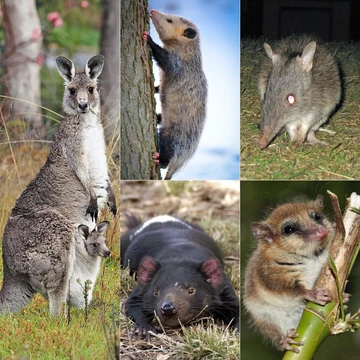
Honey possum
Tiny marsupial pollinator endemic to southwest Australia.

The honey possum, also called the noolbenger (Tarsipes rostratus), is a very small marsupial that belongs to its own family, Tarsipedidae, which has only one living genus. Its scientific name means "tarsier-foot," a reference to the foot shape noted by early describers. This animal is found only in southwest Australia, where it feeds on nectar and pollen from many different flowering plants, making it a key pollinator for species like Banksia attenuata, Banksia coccinea, and Adenanthos cuneatus.
Common names for this creature have included honey phalanger, long-snouted phalanger, tait, and brown barred mouse. In 1922, the term "honey mouse" was recorded as common around King George Sound. A study of Noongar words found three names in use: ngoolboongoor, djebin, and dat, with ngoolboongoor being the source of the name noolbenger.
The first scientific description was published on March 3, 1842, by Paul Gervais and Jules Verreaux, based on a specimen Verreaux collected. A second species, Tarsipes spenserae, was described five days later by John Edward Gray, who thought his specimen was different. Gray named it after his wife, Eliza Lucy Spencer. This second name was later considered a synonym, though some authors used it for a time. The honey possum’s closest relative was once thought to be Dromiciops gliroides, a small South American marsupial, but that idea is no longer accepted. Its ecological niche likely became available about forty million years ago, when its food plants diversified.
The honey possum is small, somewhat like a vole in appearance. Its underside is cream, blending to rufous on the flanks, while the back is a mix of brown and grey. It is easily recognized by its very long snout and three brown stripes running from head to rump: a dark central stripe between the ears, flanked by two paler ones. The tail is 70 to 100 mm long, longer than the head and body combined (65 to 85 mm), and is prehensile for climbing. Males weigh 7 to 11 grams, females 8 to 16 grams—about half the weight of a mouse. Its teeth are fewer and smaller than typical for marsupials, with molars reduced to tiny cones; the dental formula totals no more than 22 teeth. The long snout and specialized jaws are adapted for eating pollen and nectar. The tongue is extensible and tipped with brush-like papillae, and the lower incisors and palate work together to comb and gather food. The honey possum has trichromat vision, like some other marsupials and primates, which helps it spot bright yellow flowers such as those of Banksia attenuata. Its typical lifespan is one to two years.
Though restricted to southwest Western Australia, the honey possum is locally common and not considered threatened as long as its heath, shrubland, and woodland habitats remain intact and diverse. Museum records show it is more common in areas with high Proteaceae diversity, such as Banksia woodlands where flowers bloom year-round. It is mainly nocturnal but may feed during cool daylight hours. By day, it sleeps in whatever shelter is handy: a rock crevice, tree hollow, or abandoned bird nest.
- scientific_name
- Tarsipes rostratus
- weight_range
- 5 to 10 g (0.18 to 0.35 oz)
- body_length
- 65 to 85 mm (2.6 to 3.3 in)
- tail_length
- 70 to 100 mm (2.8 to 3.9 in)
- lifespan
- one to two years
- diet
- nectar and pollen
- distribution
- southwest Australia
Lore & Background
The honey possum is a diminutive marsupial, resembling a vole in size and shape, with a body and head length of 65 to 85 mm and a longer, prehensile tail of 70 to 100 mm. Its weight ranges from 5 to 10 g, with males typically weighing 7 to 11 g and females 8 to 16 g—roughly half that of a mouse. The pelage is cream below, merging to rufous at the flanks, while the upperparts are a mix of brown and grey hairs. It is readily distinguished by an exceptionally long muzzle and three brown stripes running from head to rump: a dark central stripe between the ears and two paler adjacent stripes. The dental formula is reduced to a maximum of 22 teeth, with molars diminished to tiny cones, reflecting its specialized diet. The tongue is extensible and tipped with brush-like papillae; the lower incisors are keel-like, and the palate has a fine combing surface, together replacing the function of typical teeth. The species has trichromat vision, similar to primates and some other marsupials, adapted for detecting bright yellow inflorescences like those of *Banksia attenuata*. Endemic to southwest Australia, it is locally common in heath, shrubland, and woodland, particularly in regions with high Proteaceae diversity where flowers bloom year-round. Its typical lifespan is one to two years.
Reader's Guide
The honey possum is a keystone species in the ecology of the coastal sands of Southwest Australia, particularly in kwongan plant communities. It feeds on nectar and pollen from diverse flowering plants, primarily genera of Proteaceae, Myrtaceae, and Epacridaceae. Its feeding activity involves visiting many individual plants, and its head often carries a small pollen load that can be conveyed more effectively than birds. The species Banksia attenuata appears to be obliged to this animal as a pollination vector, and both species have evolved mutualistic interactions. A nine-gram individual requires about 7 ml of nectar and 1 g of pollen daily. The honey possum is mainly nocturnal, but may feed during daylight in cooler weather. It can enter torpor when exposed to cooler temperatures or lack of food. Although restricted to a fairly small range, it is locally common and not threatened as long as its habitat remains intact. Its sister taxon was thought to be Dromiciops gliroides, a South American marsupial, but this is no longer believed to be true.
Did You Know?
- The honey possum is the only entirely nectarivorous mammal that is not a bat.
- Its tongue is extensible and covered in brush-like papillae for gathering pollen and nectar.
- It has trichromat vision, similar to some other marsupials and primates, unlike most mammals.
- Males can move up to 0.5 km in a night and use areas averaging 0.8 hectares.
Taxonomic Placement & Classification
The honey possum, scientifically designated Tarsipes rostratus, occupies a distinctive position within the mammalian tree of life. It belongs to the family Tarsipedidae, a small family represented by this single genus and species, and falls within the superfamily Petauroidea alongside gliders, ring-tailed possums, and feathertail gliders. At the suborder level, it is grouped under Phalangeriformes, a diverse assemblage of roughly seventy species of small to medium-sized marsupials found across Australia, New Guinea, and Sulawesi. However, this suborder has been identified as paraphyletic with respect to Macropodiformes, meaning that if Phalangeriformes is treated as a natural group, the kangaroo and wallaby lineage would actually nest within it. The honey possum sits within the broader order Diprotodontia, which encompasses about two-thirds of all Australian marsupials and is divided into three suborders: Vombatiformes, Phalangeriformes, and Macropodiformes. This taxonomic complexity underscores that the honey possum's evolutionary story is intertwined with some of Australia's most iconic marsupial lineages.
Dietary Specialization: The Nectar-Feeding Niche
Within the broad dietary spectrum of Phalangeriformes, the honey possum stands out as one of the most ecologically specialized feeders. While its relatives range from generalist herbivores and omnivores like the common brushtail possum, to specialist browsers of eucalyptus foliage such as the greater glider, and to insectivores like the mountain pygmy possum, the honey possum has committed itself to a nectar-feeding lifestyle. This makes it a remarkable outlier among the roughly seventy species in its suborder. The group as a whole is characterized by quadrupedal locomotion and long tails, yet their feeding strategies vary enormously. The honey possum's reliance on nectar places it in a narrow ecological niche, one that likely demands specific floral resources and seasonal availability. This specialization contrasts sharply with the dietary flexibility seen in other phalangeriformes, some of which have even adapted to urban environments by exploiting a wide variety of food sources. The nectar-feeding strategy of Tarsipes rostratus represents a unique evolutionary trajectory within a group otherwise defined by broad dietary generalism.
Body Plan, Locomotion & Habitat
As a member of Phalangeriformes, the honey possum shares a fundamental body architecture with its suborder-mates: it is a quadrupedal marsupial equipped with a long tail. This tail, combined with four-limbed locomotion, forms the structural basis for the group's characteristic movement through three-dimensional environments. Phalangeriformes species are typically nocturnal, meaning the honey possum's active period falls within the dark hours, and they are at least partially arboreal, indicating a strong association with trees and vegetation. The group predominantly inhabits vegetated habitats, providing the structural complexity these animals need for foraging and shelter. Size within Phalangeriformes spans an extraordinary range: from the Tasmanian pygmy possum, the smallest diprotodont marsupial at just 70 millimeters in head-body length and 10 grams in weight, up to the bear cuscus species that can exceed seven kilograms. The honey possum, as a small to medium-sized member of this group, occupies the lower end of this spectrum. Several phalangeriformes have demonstrated remarkable adaptability, adjusting well to urban settings, though the honey possum's specialized nectar diet may limit its capacity for such flexibility.
Naming, Misconceptions & Evolutionary Kinship
The common name "possum" applied to the honey possum and its Australasian relatives carries a fascinating etymological baggage. The term derives from the creatures' resemblance to the opossums of the Americas, whose own name traces back to the Powhatan word "aposoum," meaning "white animal," ultimately from the Proto-Algonquian root *wa·p-aʔɬemwa, meaning "white dog." This naming convention, based purely on superficial visual similarity, is deeply misleading from an evolutionary standpoint. While opossums are indeed marsupials, Australasian possums are far more closely related to other Australasian marsupials such as kangaroos, wallabies, and the musky rat-kangaroo. The honey possum's true evolutionary kin are found within the order Diprotodontia, a group that accounts for approximately two-thirds of all Australian marsupial species. This means the honey possum shares a deeper common ancestor with the kangaroo than it does with the North American opossum that inspired its common name. The alternative name "noolbenger," also applied to Tarsipes rostratus, sidesteps this taxonomic confusion entirely and may better reflect the animal's true identity.
Frequently Asked Questions
What is the honey possum?
The honey possum (Tarsipes rostratus) is a very small marsupial found only in the southwest corner of Australia. It belongs to its own little family, Tarsipedidae, making it a one-of-a-kind lineage in the marsupial world.
What makes the honey possum unique among mammals?
It holds the distinction of being the only non-bat mammal that feeds exclusively on nectar. No other member of the marsupial group has evolved to rely solely on flower nectar and pollen for survival.
How big is a honey possum?
Adults weigh just 5 to 10 grams and measure roughly 65 to 85 millimeters from nose to tail base, with a tail adding another 70 to 100 millimeters. In practical terms, it's about the size of a large hazelnut.
Where can you find honey possums in the wild?
They are endemic to the southwestern region of Australia, meaning you won't encounter them anywhere else on Earth. Their range is tied to the native vegetation of that particular corner of the continent.
Why does the honey possum matter ecologically?
It serves as a critical pollinator for several native plant species, including Banksia attenuata, Banksia coccinea, and Adenanthos cuneatus. Without its visits to these flowers, reproduction in those plants would be significantly reduced.
More in Marsupials 1-24
Spotted an error? Know more?
This is a living reference — every entry is fact-audited, and reader corrections feed straight into our audit queue. Suggest an edit · See this site's audit record