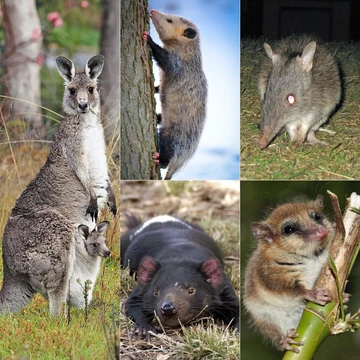
Tasmanian devil
Carnivorous marsupial, now confined to Tasmania, endangered by facial tumour disease.

The Tasmanian devil, known scientifically as *Sarcophilus harrisii* and in palawa kani as purinina, is a meat-eating marsupial from the family Dasyuridae. Its appearance is stocky and muscular, with black fur, a strong smell, a famously loud screech, a sharp sense of smell, and a reputation for being fierce while eating. Thanks to its oversized head and neck, it can deliver one of the most powerful bites for its body size among any living land predator.
Once found across mainland Australia, the species died out there roughly 3,500 years ago and now lives only on the island of Tasmania. About the size of a small dog, it became the largest carnivorous marsupial alive after the thylacine went extinct in 1936. It is related to quolls and more distantly to the thylacine. Devils hunt for prey and also eat carrion.
Though they usually live alone, devils sometimes gather in one spot to eat and leave droppings together. Unlike most other dasyurids, they can regulate their body temperature well and stay active in the middle of the day without overheating. Despite looking round and heavy, they can move surprisingly fast and keep going for a long time, and they are able to climb trees and swim across rivers.
Devils do not mate for life. Males fight each other for females and guard their partners to stop them from mating with others. During the breeding season, a female can ovulate three times in three weeks, and 80% of two-year-old females are found to be pregnant during that annual period. Over her lifetime, a female typically has four breeding seasons. After a three-week gestation, she gives birth to 20 to 30 live young. At birth, the babies are pink, hairless, with barely formed facial features, and weigh about 0.20 grams. Since the mother’s pouch has only four nipples, competition is intense, and few newborns survive. The young grow quickly and are pushed out of the pouch after roughly 100 days, at which point they weigh around 200 grams. They become independent after about nine months.
In 1941, devils received official protection. Starting in the late 1990s, a disease called devil facial tumour disease (DFTD) has caused a severe drop in their numbers and now threatens the species with extinction; in 2008, they were declared endangered. Since 2013, Tasmanian devils have again been sent to zoos around the world as part of the Australian government’s Save the Tasmanian Devil Program. The animal is an iconic symbol of Tasmania, appearing in the logos of many organisations, groups, and products linked to the state. It is considered a major draw for tourists to Tasmania and gained worldwide fame through the Looney Tunes character of the same name.
**Taxonomy**
Naturalist George Harris wrote the first published description of the Tasmanian devil in 1807, thinking it was a type of opossum. He named it *Didelphis ursina* because of its bearlike features, such as its round ear, and had earlier presented the topic at the Zoological Society of London. However, that name had already been given to the common wombat (later reclassified as *Vombatus ursinus*) by George Shaw in 1800, so it was unavailable. In 1838, Richard Owen named a specimen *Dasyurus laniarius*, but by 1877 he had moved it to the genus *Sarcophilus*. The modern Tasmanian devil was named *Sarcophilus harrisii* (“Harris’s flesh-lover”) by French naturalist Pierre Boitard in 1841.
A later revision in 1987 tried to change the species name to *Sarcophilus laniarius* based on a few mainland fossil records, but the broader taxonomic community did not accept this. The name *S. harrisii* remains in use, while *S. laniarius* is now considered a fossil species. Early explorers of Tasmania gave the devil the vernacular name “Beelzebub’s pup,” after a religious figure who is a prince of hell and an assistant of Satan; they first encountered the animal by hearing its far-carrying calls at night. Other 19th-century names included *Sarcophilus satanicus* (“Satanic flesh-lover”) and *Diabolus ursinus* (“bear devil”), all stemming from early misunderstandings that the species was irredeemably vicious. The Tasmanian devil belongs to the family Dasyuridae, and the genus *Sarcophilus* contains two other species known only from Pleistocene fossils: *S. laniarius* and *S. moomaensis*. Phylogenetic analysis shows its closest living relatives are quolls.
According to Pemberton, the devil’s possible ancestors may have needed to climb trees to find food, which led to a larger body size and the hopping gait seen in many marsupials; he speculated these adaptations might explain the modern devil’s unusual walk. The specific lineage of the Tasmanian devil is thought to have emerged during the Miocene, with molecular evidence suggesting a split from the ancestors of quolls between 10 and 15 million years ago. This was a time of severe climate change in Australia, shifting from warm and moist to an arid, dry ice age that caused mass extinctions. As most prey animals died from the cold, only a few carnivores survived, including the ancestors of the quoll and thylacine. It is believed the devil lineage may have arisen then to fill a niche as a scavenger, cleaning up carrion left by the thylacine, which ate selectively. The extinct *Glaucodon ballaratensis* from the Pliocene has been called an intermediate species between the quoll and devil. Fossil deposits in limestone caves at Naracoorte, South Australia, dating to the Miocene include specimens of *S. laniarius* that were about 15% larger and 50% heavier than modern devils. Older specimens, thought to be 50,000 to 70,000 years old, have been found in Darling Downs in Queensland and in Western Australia. It remains unclear whether the modern devil evolved from *S. laniarius* or if the two coexisted; Richard Owen argued for the latter in the 19th century.
- scientific_name
- Sarcophilus harrisii
- family
- Dasyuridae
- native_range
- Tasmania (formerly mainland Australia)
- gestation
- Three weeks
- average_lifespan_breeding_seasons
- Four
Lore & Background
The Tasmanian devil is a carnivorous marsupial roughly the size of a small dog, making it the largest carnivorous marsupial alive today following the extinction of the thylacine. Its appearance is stocky and muscular, with black fur, a large head, and a thick neck that enables it to generate one of the strongest bites per unit body mass of any living predatory land mammal. The animal is also known for its pungent odour, extremely loud screech, and keen sense of smell. Despite its rotund build, it is surprisingly fast and enduring, capable of climbing trees and swimming across rivers. It is active during the middle of the day without overheating, unlike most other dasyurids. Historically present across mainland Australia, the devil became extinct there around 3,500 years ago and is now confined solely to the island of Tasmania. It hunts prey and scavenges on carrion, and though usually solitary, individuals sometimes eat and defecate together at communal sites. The species is related to quolls and distantly related to the thylacine. Its defining characteristics include its ferocity when feeding, its effective thermoregulation, and its non-monogamous mating system, where males fight for females and guard partners to prevent infidelity. Females can ovulate multiple times during the mating season, and most two-year-old females become pregnant annually.
Reader's Guide
The Tasmanian devil is an iconic symbol of Tasmania, used in logos of many organisations, groups, and products associated with the state. It is seen as an important attractor of tourists to Tasmania and has come to worldwide attention through the Looney Tunes character of the same name. The devil's genome was sequenced in 2010 by the Wellcome Trust Sanger Institute. Devils have a low genetic diversity compared to other Australian marsupials and placental carnivores, consistent with a founder effect. Outbreaks of DFTD cause an increase in inbreeding. A sub-population of devils in the north-west of the state is genetically distinct from other devils, but there is some exchange between the two groups.
Did You Know?
- Females give birth to 20 to 30 live young after three weeks' gestation, but only four nipples exist in the pouch, so few newborns survive.
- The devil's genome was sequenced in 2010 by the Wellcome Trust Sanger Institute.
Frequently Asked Questions
What is a Tasmanian devil?
The Tasmanian devil (Sarcophilus harrisii) is a stocky, black-furred carnivorous marsupial in the Dasyuridae family, roughly the size of a small dog. It is instantly recognisable by its powerful jaws, pungent smell, and extremely loud screeching calls when feeding.
How does a Tasmanian devil reproduce?
Gestation is remarkably brief, lasting only about three weeks before the tiny, underdeveloped young are born. The newborns then crawl into the mother's pouch to continue growing, following the classic marsupial life cycle.
More in Marsupials 1-24
Spotted an error? Know more?
This is a living reference — every entry is fact-audited, and reader corrections feed straight into our audit queue. Suggest an edit · See this site's audit record