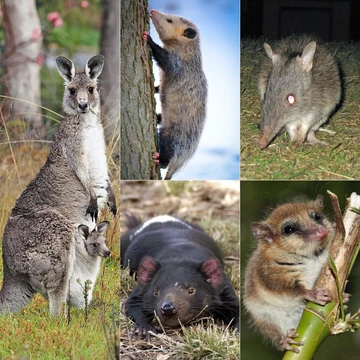
Dunnart
Narrow-footed marsupials of Australia and New Guinea.

Dunnarts are narrow-footed marsupials of the genus *Sminthopsis*, roughly the size of a European mouse. The common name derives from the Noongar word *donat*. These small, largely insectivorous animals are found exclusively in Australia and New Guinea. The genus name *Sminthopsis* was established by Oldfield Thomas in 1887, who noted that the earlier name *Podabrus* was already in use for a genus of beetles. The type species for the genus is *Phascogale crassicaudata*, described by John Gould in 1844, which is now known as the fat-tailed dunnart. There are 19 recognized species within the genus, organized into several species groups based on characteristics such as tail shape and geographic distribution. These groups include the *S. crassicaudata* group (containing the fat-tailed dunnart), the *S. macroura* group (which includes the Kakadu, Carpentarian, Julia Creek, stripe-faced, and red-cheeked dunnarts), the *S. granulipes* group (white-tailed dunnart), the *S. griseoventer* group (grey-bellied dunnart), the *S. murina* group (which includes the Kangaroo Island, chestnut, little long-tailed, sooty, Gilbert’s, white-footed, and slender-tailed dunnarts), and the *S. psammophila* group (hairy-footed, Ooldea, sandhill, and lesser hairy-footed dunnarts). Additionally, the American Society of Mammalogists recognizes three further species: Froggatt’s dunnart, Stalker’s dunnart, and the western red-cheeked dunnart. This same authority considers the grey-bellied dunnart a synonym of the sooty dunnart and has moved the long-tailed dunnart to the genus *Antechinomys*. A notable biological characteristic of the male dunnart is that its Y chromosome is the smallest known among all mammals.
- number_of_species
- 22 (as recognized by the American Society of Mammalogists)
Lore & Background
The dunnart, known in the Noongar language as *donat*, is a narrow-footed marsupial roughly the size of a European mouse. The genus name *Sminthopsis* was established in 1887 by Oldfield Thomas, who noted that the earlier name *Podabrus* was already in use for a genus of beetles. The type species for the genus is *Phascogale crassicaudata*, described by John Gould in 1844. Dunnarts are primarily insectivorous in their feeding habits. The genus contains 19 species found across Australia and New Guinea, with the American Society of Mammalogists recognizing an additional three species: Froggatt's dunnart, Stalker's dunnart, and the Western Red-cheeked dunnart. Among the species groups are the fat-tailed dunnart (*S. crassicaudata*) and the group containing the Kangaroo Island dunnart and the little long-tailed dunnart. A defining biological characteristic is that the Y chromosome of a male dunnart is the smallest known mammalian Y chromosome.
Reader's Guide
Dunnarts are significant as a diverse genus of small marsupials endemic to Australia and New Guinea. Their taxonomy has undergone revision, with the genus name Sminthopsis replacing the preoccupied Podabrus. The 19 recognized species, plus additional forms acknowledged by the American Society of Mammalogists, illustrate ongoing taxonomic debate. The fat-tailed dunnart (S. crassicaudata) serves as the type species, originally described as Phascogale crassicaudata. The group's ecological role as insectivores contributes to their importance in their habitats. The extreme reduction of the male Y chromosome in dunnarts is of particular interest to geneticists studying mammalian sex chromosome evolution. The species groups—such as the S. macroura group (including the Kakadu and Julia Creek dunnarts) and the S. psammophila group (including the sandhill dunnart)—reflect morphological and geographic variation. The American Society of Mammalogists' alternative classification, which synonymizes S. griseoventer with S. fuliginosa and reassigns S. longicaudata, highlights the fluid nature of marsupial systematics. Overall, dunnarts represent a model for understanding marsupial diversity, adaptation, and chromosomal biology.
Did You Know?
- A male dunnart's Y chromosome is the smallest known mammalian Y chromosome.
- The American Society of Mammalogists recognizes 22 species of dunnarts, including S. griseoventer as a valid species and S. longicaudata within the genus Sminthopsis.
Origins and the Story Behind the Name
The common name "dunnart" traces back to the Noongar word "donat," a reminder that these small marsupials have long been woven into the cultural landscape of Australia's south-west. The scientific genus, however, carries a more tangled history. This species, the fat-tailed dunnart, has served as the reference point against which all other members of the genus are compared. The naming saga illustrates how taxonomy is rarely a single, clean act but rather a layered process of correction, reassignment, and negotiation unfolding over decades of observation and debate.
A Rich Tapestry of Species
All nineteen recognized species of Sminthopsis are confined to two landmasses: mainland Australia and New Guinea. They are organized into six species groups, each clustering closely related forms. The crassicaudata group contains the fat-tailed dunnart, while the macroura group gathers the Kakadu, Carpentarian, Julia Creek, stripe-faced, and red-cheeked dunnarts. The granulipes and griseoventer groups each represent a single species, whereas the murina group is the largest, housing seven species including the Kangaroo Island, chestnut, sooty, Gilbert's, white-footed, slender-tailed, and little long-tailed dunnarts. The psammophila group rounds out the set with four members. Taxonomic consensus is not universal, though: the American Society of Mammalogists recognizes three additional species—Froggatt's, Stalker's, and the Western Red-cheeked dunnart—while simultaneously treating S. griseoventer as a synonym of S. fuliginosa and transferring S. longicaudata to the separate genus Antechinomys. These disagreements underscore that the boundaries of the dunnart radiation remain an active area of discussion.
Small Stature, Specialized Niche
Despite their modest size—roughly that of a European mouse—dunnarts occupy a distinct ecological niche as narrow-footed marsupials. Their slender build and compact body plan suit a life spent foraging among leaf litter, low vegetation, and rocky outcrops across their Australian and New Guinean range. Dietarily, they are largely insectivorous, relying on the small invertebrates that populate the ground layers of their habitats. This feeding strategy, combined with their diminutive stature, places them in a different ecological role from larger marsupial predators, even though they share the broader marsupial body plan with their bigger relatives. The narrow-footed morphology is a defining physical trait that sets them apart visually and functionally from other small mammals of similar size. As members of the genus Sminthopsis, they represent a compact but diverse radiation of insect-eating marsupials that have diversified across the varied landscapes of the Australasian region.
A Genetic Curiosity
Among the many remarkable features of the dunnart, one stands out with particular force in the world of genetics: the male of this genus carries the smallest known Y chromosome of any mammal. This finding is significant because the Y chromosome, which determines maleness in most mammals, is typically a relatively substantial genetic structure. In the dunnart, however, it has been reduced to an extraordinarily compact form, making it a subject of intense interest for evolutionary biologists and geneticists studying chromosome evolution. The fact that such a tiny Y chromosome still functions to establish male sex in these animals raises questions about how genetic information is compressed and maintained under selective pressure. For a marsupial no larger than a mouse, the dunnart thus punches well above its weight in the realm of genomic research, offering a natural laboratory for understanding the limits of chromosome reduction across mammalian lineages.
Frequently Asked Questions
What is a dunnart?
A dunnart is a small, narrow-footed marsupial belonging to the genus Sminthopsis. They are roughly the size of a European mouse and are native to Australia and New Guinea.
How many dunnart species are recognized?
The American Society of Mammalogists currently recognizes 22 species within the genus Sminthopsis.
What do dunnarts eat?
Dunnarts are largely insectivorous, relying mainly on insects and other small invertebrates for their diet.
Where can you find dunnarts in the wild?
They are distributed across Australia and New Guinea, occupying a variety of habitats in those regions.
More in Marsupials 1-24
Spotted an error? Know more?
This is a living reference — every entry is fact-audited, and reader corrections feed straight into our audit queue. Suggest an edit · See this site's audit record