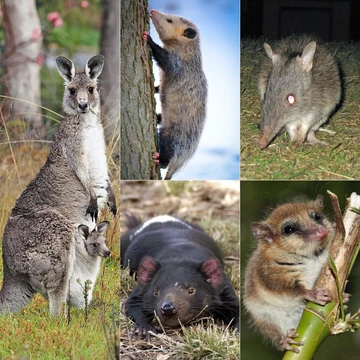
Vombatiformes
Suborder of marsupials including koalas, wombats, and extinct giants.

The Vombatiformes are one of the three suborders that make up the marsupial order Diprotodontia. This group encompasses nine known families, of which only two remain extant: the Phascolarctidae, represented today solely by the koala, and the Vombatidae, which includes three living species of wombat. The remaining seven families are entirely extinct, representing a vast and diverse evolutionary history. Among these lost lineages is the family Diprotodontidae, which contained the largest marsupials ever to have lived, including the rhinoceros-sized *Diprotodon*. Another extinct family, the Thylacoleonidae, is known as the "marsupial lions," while the Palorchestidae are referred to as "marsupial tapirs." The classification of the suborder is further divided into two infraorders: Phascolarctomorphia, which houses the koala family Phascolarctidae along with several extinct genera such as *Koobor*, *Litokoala*, and *Nimiokoala*; and Vombatomorphia, which contains the wombat family Vombatidae and its extinct relatives. Within Vombatomorphia, the superfamily Vombatoidea includes the living wombats of the genera *Lasiorhinus* and *Vombatus*, as well as extinct genera like *Phascolonus* and *Warendja*. The superfamily Diprotodontoidea encompasses the family Diprotodontidae, with genera such as *Diprotodon* and *Zygomaturus*, and the family Palorchestidae. Additional extinct families within the suborder include the Ilariidae, Wynyardiidae, Maradidae, and Mukupirnidae, each contributing to the rich fossil record of this marsupial group.
- suborder
- Vombatiformes
- order
- Diprotodontia
- extant_families
- 2 (Phascolarctidae, Vombatidae)
- extinct_families
- 7
- largest_member
- Diprotodon (rhinoceros-sized)
- notable_extinct_groups
- Thylacoleonidae (marsupial lions), Palorchestidae (marsupial tapirs)
Lore & Background
The Vombatiformes suborder includes a wide range of marsupials, though only two families remain today: Phascolarctidae, which contains the koala, and Vombatidae, which comprises three living species of wombats. The extinct members of this group were remarkably diverse. The family Diprotodontidae included the largest marsupials ever known, such as *Diprotodon*, which reached the size of a modern rhinoceros. Another extinct family, Thylacoleonidae, is commonly called the "marsupial lions," while the Palorchestidae are known as "marsupial tapirs." The suborder is divided into two infraorders: Phascolarctomorphia, which includes koalas and their extinct relatives like *Koobor* and *Litokoala*, and Vombatomorphia, which contains wombats and their extinct kin. Within Vombatomorphia, the superfamily Vombatoidea includes the living wombat genera *Lasiorhinus* and *Vombatus*, alongside several extinct genera such as *Phascolonus* and *Warendja*. The superfamily Diprotodontoidea includes the family Diprotodontidae and its subfamily Zygomaturinae, which contains genera like *Zygomaturus* and *Hulitherium*. Other extinct families within Vombatiformes include Ilariidae, Wynyardiidae, Maradidae, and Mukupirnidae. In total, seven of the nine known families in this suborder are extinct, leaving only the koala and wombat lineages as survivors.
Reader's Guide
The Vombatiformes suborder is significant for illustrating the evolutionary diversity of Australian marsupials. While only koalas and wombats survive today, the extinct families demonstrate a wide range of body sizes and ecological roles, from the massive herbivorous Diprotodon to the carnivorous marsupial lions. The classification within Vombatiformes includes infraorders Phascolarctomorphia (koalas and their extinct relatives) and Vombatomorphia (wombats and related extinct forms), as well as superfamilies such as Vombatoidea and Diprotodontoidea. The fossil record of this suborder helps paleontologists understand marsupial evolution and extinction patterns in Australia. The legacy of Vombatiformes is preserved in the living koala and wombat species, which are iconic representatives of Australia's unique fauna.
Did You Know?
- Seven of the nine known families within Vombatiformes are extinct.
- The extinct family Diprotodontidae includes the largest marsupials ever, such as the rhinoceros-sized Diprotodon.
- Thylacoleonidae are known as 'marsupial lions' and Palorchestidae as 'marsupial tapirs.'
- Only two families survive: Phascolarctidae (koalas) and Vombatidae (wombats).
Frequently Asked Questions
Who is Vombatiformes?
Vombatiformes is a suborder nested inside the marsupial order Diprotodontia, uniting the koala, the three living wombat species, and seven families that have since vanished. It is one of the three major suborders recognized within Diprotodontia.
What are Vombatiformes's powers or role?
This suborder is famous for producing the most extreme body sizes ever seen in marsupials, from rhinoceros-scale herbivores to the apex-predator Thylacoleonidae. It also includes the Palorchestidae, often called the 'marsupial tapirs,' showing just how varied its members were.
How does Vombatiformes's story end?
Seven of the nine families that once made up the suborder have gone completely extinct, leaving only Phascolarctidae (the koala) and Vombatidae (the wombat) as living representatives. The rest, including the giants and the marsupial lions, survive solely as fossils.
Why is Vombatiformes important?
It holds the record for the largest marsupials ever to live and displays a remarkable spread of ecological niches, from small tree-dwelling koalas to massive ground herbivores and top predators. Its heavy extinction history also makes it a central case study in how Australia's marsupial fauna shifted over millions of years.
What is Vombatiformes's biggest member?
That title goes to Diprotodon, a member of the now-extinct Diprotodontidae family that grew to roughly the size of a rhinoceros. It remains the largest known marsupial in the entire fossil record.
More in Marsupials 1-24
Spotted an error? Know more?
This is a living reference — every entry is fact-audited, and reader corrections feed straight into our audit queue. Suggest an edit · See this site's audit record