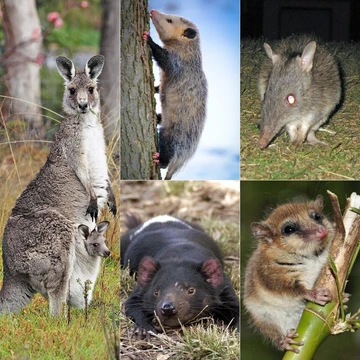
Koala
Last updated
The koala is a robust arboreal marsupial with a large head, vestigial tail, and a body length of 60 to 85 cm.[1] Its scientific name is Phascolarctos cinereus, and it is classified in the family Phascolarctidae within the order Diprotodontia.[2] The word "koala" comes from the Dharug word gula, and the species is also known as the native bear or koala bear.[3][4]
Scientific classification
- KingdomAnimalia
- PhylumChordata
- InfraclassMarsupialia
- OrderDiprotodontia
- FamilyPhascolarctidae
- GenusPhascolarctos
- SpeciesPhascolarctos cinereus
Named by (Goldfuss, 1817)
Sources: Wikipedia taxobox: Koala (CC BY-SA 4.0)
Conservation status
Vulnerable (VU)
- LC
- NT
- VU▲ this species
- EN
- CR
- EW
- EX
Source: IUCN Red List assessment · GBIF copy of the Red List category
How big is it?
Largest length in the source, 0.85 m, next to a 1.8 m person.
Diagram: drawn by Codexery, schematic shapes to scale (not a likeness). Length: Wikipedia: Koala
Where the koala has been recorded
Each dot is a place where the species has been observed and reported (451,504 records, half-degree grid) — not a modelled range. 90 inland records left out (institution coordinates).
Map: drawn by Codexery. Data: GBIF occurrence search (records CC0 / CC BY) · Natural Earth basemap (public domain)
Biology and range
Koalas are herbivorous and strongly prefer around 30 species of Eucalyptus, though they also eat leaves from genera such as Acacia and Melaleuca.[5] They sleep about 20 hours a day due to their low-energy diet, and are predominantly active at night.[6] The koala's pelage is denser on the back, with colour varying from light grey to chocolate brown, and the belly fur is whitish.[7] Relative to a typical diprotodont, the koala's brain is about 60% smaller, with an average weight of only 19.2 g.[8]
Social behaviours among koalas occupy only about 15 minutes each day, as they are asocial animals.[9] A female koala gives birth to a single joey, or occasionally twins, after a gestation period of 33–35 days.[10] In the wild, koalas typically survive 13 to 18 years, though males often have shorter lifespans due to riskier behaviors.[11]
What the specialist sources record
The Species Profiles account notes that the koala's Australian indigenous name is koobor, meaning "does not drink water".[12] Extreme wildfire kills or severely burns koalas by killing or scorching the tree canopy.[12] According to the Species Profiles, wasting disease from nitrogen deficiency can occur during prolonged drought when eucalyptus leaves contain less digestible nitrogen.[12] The Species Profiles account reports that male koalas generally have a larger home range than females.[12]
A 2013 news article by Davey reports that Australian scientists sequenced the koala genome, finding about 12,000 genes and progressing toward the complete set of 20,000 genes.[13] The Species Profiles account records that the newborn koala is approximately 19 mm long and 5.5 g in weight.[12]
References
- Wikipedia, "Koala" (CC BY-SA 4.0), which cites: Jackson, S., "Koala: Origins of an Icon", Allen & Unwin, 2010; Nowak, R., "Walker's Marsupials of the World", Johns Hopkins University Press, 2005, p. 135–36; Nowak, R., "Walker's Marsupials of the World", Johns Hopkins University Press, 2005, p. 135–36; Jackson, S., "Australian Mammals: Biology and Captive Management", CSIRO Publishing, 2003, p. 147–51; "The Koala: Natural History, Conservation and Management", New South Wales University Press, 1999 (original not read by us) en.wikipedia.org
- GBIF Backbone Taxonomy and occurrence index, Phascolarctos cinereus (taxon key 2440012). CC BY 4.0 (backbone); counts are facts. gbif.org
- Wikipedia, "Koala" (CC BY-SA 4.0), which cites: Dixon, "Australian Aboriginal Words in English: Their Origin and Meaning", Oxford University Press, 2006, p. 65; "Koala", Species Profiles, 30 June 2022 (we also read that source) en.wikipedia.org
- Wikipedia, "Koala" (CC BY-SA 4.0), which cites: Edward E. Morris, "Dictionary of Australian Words (orig) Austral English", 1898; Leitner, "Aboriginal words and concepts in Australian English", World Englishes, 1998, p. 153–69; Leitner, "Aboriginal words and concepts in Australian English", World Englishes, 1998, p. 153–69 (original not read by us) en.wikipedia.org
- Wikipedia, "Koala" (CC BY-SA 4.0), which cites: Jackson, S., "Koala: Origins of an Icon", Allen & Unwin, 2010; Martin, R., "Encyclopedia of Mammals", Oxford University Press, 2001, p. 852–854; Tyndale-Biscoe, H., "Life of Marsupials", CSIRO Publishing, 2005; Osawa, R., "Dietary preferences of Koalas, Phascolarctos cinereus (Marsupiala: Phascolarctidae) for Eucalyptus spp. with a specific reference to their simple sugar contents", Australian Mammalogy, 1993, p. 85–88 (original not read by us) en.wikipedia.org
- Wikipedia, "Koala" (CC BY-SA 4.0), which cites: Jackson, S., "Koala: Origins of an Icon", Allen & Unwin, 2010; "Anatomy and development of the koala, Phascolarctos cinereus: An evolutionary perspective on the superfamily Vombatoidea", Anatomy and Embryology, 2001, p. 211–223 (original not read by us) en.wikipedia.org
- Wikipedia, "Koala" (CC BY-SA 4.0), which cites: Jackson, S., "Australian Mammals: Biology and Captive Management", CSIRO Publishing, 2003, p. 147–51; Jackson, S., "Koala: Origins of an Icon", Allen & Unwin, 2010; Nowak, R., "Walker's Marsupials of the World", Johns Hopkins University Press, 2005, p. 135–36; "Metabolism and heat balance in an arboreal marsupial, the koala (Phascolarctos cinereus)", Journal of Comparative Physiology B, 1979, p. 293–301 (original not read by us) en.wikipedia.org
- Wikipedia, "Koala" (CC BY-SA 4.0), which cites: Jackson, S., "Koala: Origins of an Icon", Allen & Unwin, 2010; "Encephalization of the Koala, Phascolarctos cinereus", Australian Mammalogy, 1998, p. 315–320; "The Koala: Natural History, Conservation and Management", New South Wales University Press, 1999; Jackson, S., "Koala: Origins of an Icon", Allen & Unwin, 2010 (original not read by us) en.wikipedia.org
- Wikipedia, "Koala" (CC BY-SA 4.0), which cites: Jackson, S., "Koala: Origins of an Icon", Allen & Unwin, 2010 (original not read by us) en.wikipedia.org
- Wikipedia, "Koala" (CC BY-SA 4.0), which cites: Johnston, "Semen-induced luteal phase and identification of a LH surge in the koala (Phascolarctos cinereus)", Reproduction, 1 November 2004, p. 629–634; "Gestational length in the koala, Phascolarctos cinereus", Animal Reproduction Science, 2002, p. 261–66 (original not read by us) en.wikipedia.org
- Wikipedia, "Koala" (CC BY-SA 4.0), which cites: "The Koala: Natural History, Conservation and Management", New South Wales University Press, 1999; "The Koala: Natural History, Conservation and Management", New South Wales University Press, 1999 (original not read by us) en.wikipedia.org
- "Koala", Species Profiles, 30 June 2022. wildlife.org.au
- Davey, M., "Australians crack the code of koala's genetic blueprint", The Age, 10 April 2013. theage.com.au
Each numbered sentence above was checked against the source it cites before publication. Sentences citing Wikipedia adapt text from the English Wikipedia article Koala (contributors), used under CC BY-SA 4.0; this entry is available under the same licence. Other sources were used for facts only.
More in Marsupials
Test yourself
Three questions drawn from this entry’s sources. Pick an answer to check it.
Answers checked against the source article
Sources
Compiled from Wikipedia and the sources listed below. Text from Wikipedia is available under CC BY-SA 4.0; this entry is adapted from it.
- Wikipedia: Koala (CC BY-SA 4.0).
- Conservation status: IUCN Red List assessment.
- Occurrence records: GBIF (CC0 / CC BY). Basemap: Natural Earth (public domain).
- Word definitions: the Codexery glossary, each quoted from its Wikipedia article.
Spotted an error? Know more?
Reader corrections go straight into our review queue. Suggest an edit · How this site is sourced